starter

Top 5 for starters

I wrote a post a while back about my philosophy on starters, so thought I’d supplement it with a post about great websites for no-fuss five-minute activities. Most of the starters on these sites require very little or no preparation, so can be used off the cuff. So, in no particular order, here are my top sites for starters:

Transum (Starter of the Day)

I know that Transum’s probably one of the oldest sites out there – in fact, I remember one of my teachers using it when I was at school, as it had just come out then! However, it’s often easy to forget about or overlook things that have been around for ages. Using the randomly generated starter as intended can be a little unpredictable, as some are just too easy or difficult, and some are designed to work best if pupils can access computers. Instead, I tend to use the Topics page to search for activities related to that lesson’s work.

That said, it’s worth looking at the random starter every so often – I discovered the Ice Cream Combinations activity this way, which developed into a whole lesson about listing combinations with Year 8 a couple of years ago. There’s also a load of other useful stuff on there, which is also easy to overlook, but I’m saving those features for a later post.

Flash Maths

I blogged about Flash Maths earlier this year; this site has a growing collection of short activities suitable for display on interactive whiteboards, with pupils working on mini-whiteboards or in exercise books. Check the previous post for a bit more detail, or just go and have a look round the site itself.

Form Time Ideas

Ignore the slightly misleading title – while all of the resources on here are indeed fantastic for use in form time, the numeracy stuff on Form Time Ideas is also highly applicable as a great lesson starter for Year 10s and 11s to keep reminding them of the basics in the run-up to GCSEs.

There’s plenty of coverage of basic algebra, percentages (including change), fractions, ratio and negative numbers, with an option to print a blank template for pupils to work on. We’re using this with Year 11 during form time next year, but I may also incorporate it into standard maths lessons in the run-up to exams.

Teachit Maths

Teachit Maths is a great general resource site – as it’s all quality-checked and formatted nicely, most of the materials on the site can be used directly in the classroom with little preparation. However, I’ve just found their Starters and Plenaries section, which helpfully lists a load of their short activities by topic. 

Some are worksheet-based, but there are plenty that could be displayed straight away on an interactive board for pupils to attempt in books or on mini-whiteboards. I’ll be adding some of these great activities to my Resources section over the next few months!

Maths-Starters.co.uk

I’ve only recently discovered this site, but some of the content on there looks fantastic for time-saving starters. There are currently twelve Flash apps, with three more in development, and they focus on basic skills practice, such as Tables Torture, a simple multiplication grid generator, and Substitution Store, which generates algebraic substitution problems.

I particularly like the feature which allows you to enter your choice of numbers into the activity – so, for example, you could create a substitution activity using only negative numbers. The app also works out the answers for you, which is incredibly convenient!

Top 5 for starters Read More »
The new Sudoku

Another quick post today as I am/will be busy preparing for part two of the wedding celebrations and again am/will be nowhere near a computer (I’m still struggling with tenses – see yesterday’s post!).

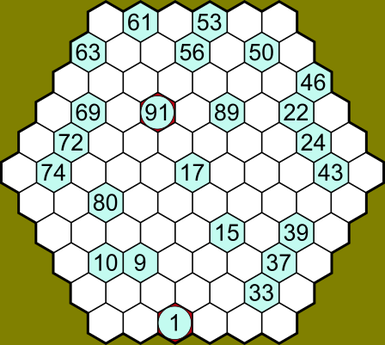
I’m aware that there have been a few “thoughts and musings” posts lately, rather than anything particularly useful, but I’m happy to say that Beehive Hidato transfers well to the classroom and makes for a nice five-minute puzzle.

The link takes  you to an article Alex Bellos wrote on the Guardian about a month ago. After reading that, I printed off the puzzles as a four-per-page worksheet and used as a time-filler towards the end of term. The pupils seemed to find it much more engaging than Sudoku, and I quite enjoy doing them myself!

You can get loads to solve online or print out at Hidato.com. Happy puzzling!

The new Sudoku Read More »

And your starter for ten…

Starters can be a contentious issue; the term “starter” is a hangover from the days of three-part lessons in bite-size chunks, which seem to have fallen from vogue now. However, they are still a key part of my teaching, and today’s SBPC looks at why.

In my mind, my lesson “starters” fall into three categories, and they’re not mutually exclusive. Sometimes it’s appropriate to have a couple of “starter” activities (I’m dropping the quote marks now because I’m irritating myself). I once had a lesson starter that went on for the entire lesson, as it became painfully apparent that the class had completely forgotten to solve simultaneous equations, so my quick prior knowledge check turned into an off-the-cuff revision session.

I remember one lesson observation when I was told off for getting pupils to spend five minutes working on problems similar to those they’d solved in the previous lesson. I was told that they weren’t making measurable progress during this five minutes. I was only a newbie at the time, so didn’t want to argue with my observer, so nodded along, decided that I’d make sure I didn’t do it in observed lessons in future, but carried on doing it as part of my standard teaching practice.

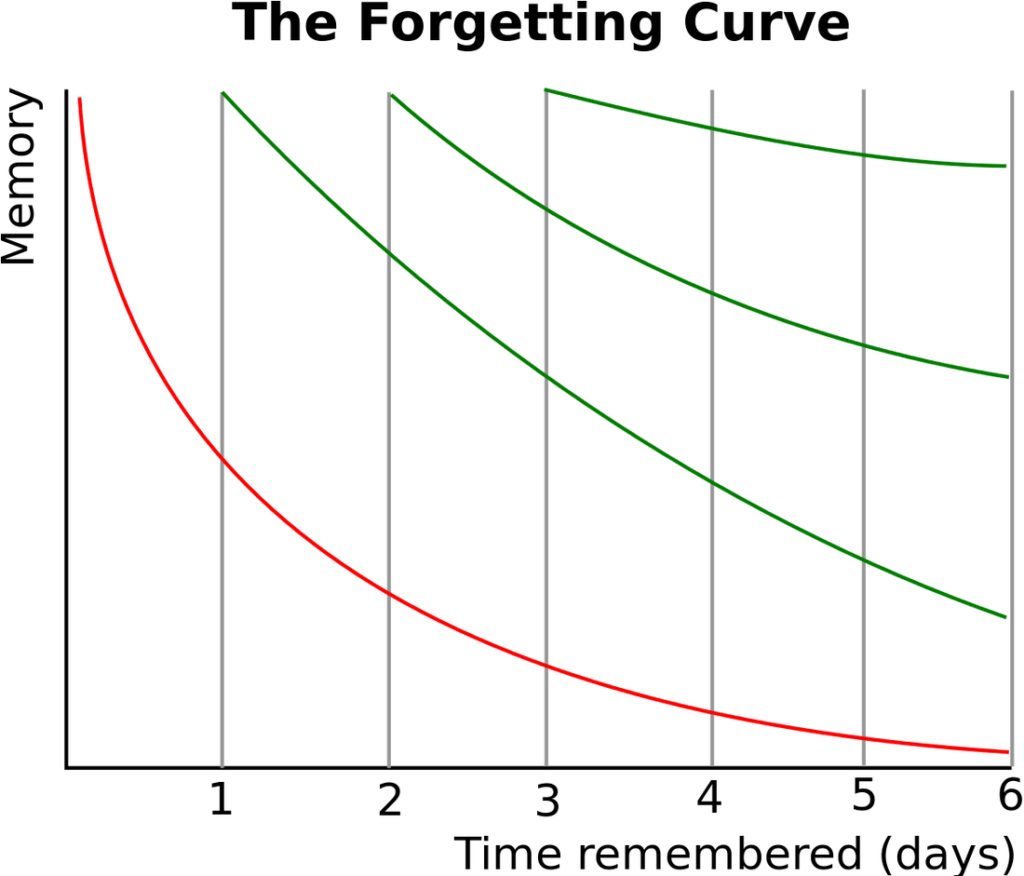
I still think that it’s really important to spend some time each lesson getting pupils to practise skills they’ve already learned. Read about the Ebbinghaus Forgetting Curve and this all starts to make sense (while you’re at it, read this post about blindly accepting research too – it’s good to know that Ebbinghaus is fine). 

Pupils often ask me why I’m “so good at maths”. My response is that I use it every day – there’s not something innate in me that makes me a mathematician. I tell them about how I had to re-learn my times tables when I started teaching – although I’d learned them before, I was very rusty and my recall wasn’t as snappy as I would have liked, due to over-reliance on a calculator at university.

Spaced repetition

If you’re lucky enough to teach a class on consecutive days, they’ve already dropped to under 40% recollection of the previous day’s work. If there’s a weekend in between your lessons, you’re down to around 30%, although the drop-off does decrease as the time period extends. It gives validity to “Miss, I’ve slept since then”, but continued spaced practice is part of beating this curve.

In my mind, there’s no better time to do this than at the start of a lesson. While you’re sorting out who’s forgotten their book and who’s rocking up late, the rest of them can do something meaningful with their time, both in terms of overall progress (which can’t be measured meaningfully over five minutes) and in preparation for the learning they’re about to do, which is almost definitely going to link to what they did last lesson.

Whetting the appetite

Sometimes it’s appropriate to pick a short activity that leads into the learning for the lesson. This could combine with the spaced repetition activity, but might need to be something different. It might explain why the learning for that lesson is particularly relevant to real-life (avoiding pseudo-contexts, of course), or generate a discussion to lead into the main chunk of teaching.

Here are a few examples:

  • Starting off a lesson on square numbers by getting pupils to build squares out of linking cubes – this is then a springboard for discussion about why they are called square numbers and links to area;
  • Asking the class to think of or bring in examples of percentages in real-life, making the relevance of the topic you’re about to teach clear in their minds.
  • Showing a picture for discussion and asking them to identify any maths they can see in it, making sure the topic you’ll be doing is prominently featured – this helps to build links to other strands of mathematics.

A segue into the non-curricular

These are my favourite type of starter. They often get featured on particular dates, such as getting the pupils to sum the numbers from 1 to 100 on Gauss’s birthday, but occasionally I throw things in to keep everyone focused on the point we bother learning maths in the first place – not just to get a grade C (5?) but because it’s such an historically rich, fascinating subject. Let’s face it, the curriculum can end up pretty dry at times, and sometimes a nice puzzle or problem that’s never going to crop up on the syllabus but is interesting and challenging to do keeps me and the pupils awake and enthused.

Unfortunately, I’m really bad at not letting this type of “starter” take over my entire lesson. I once ended up teaching Year 7 about radians instead of doing whatever we were supposed to be doing on Pi Day, due to a great discussion we were having about the number of degrees in a circle, and I gave up trying to fit Fermat’s Last Theorem into a starter and just planned a whole lesson around it instead. But never mind, there’s always the next lesson!

And your starter for ten… Read More »

Flash Maths

Just a quick post to say I’ve just found an excellent site for quick starters and practice – Flash Maths is chock full of Flash applications for generating questions on loads of different topics. A five-minute poke-around unearthed these little gems:

Equation Roulette: Generates linear equations up to old NC level 7. The buttons at the top can be used to select a level of difficulty, or the spinner can be used to generate a random problem. I can see lots of scope for using this as a quick revision tool.

Substitution Grids: Another great quick activity, this time for algebraic substitution. I particularly like the ability to change the difficulty of the problems, by including negatives, decimals and making the algebraic expressions easier. I frequently make algebraic substitution grid puzzles similar to this as quick starters, but I’m really looking forward to trying this interactive timesaver.

Dice Target
Countdown-type activity for practising addition and probability. I can see some lovely discussions about strategies developed by students coming out of this.

Flash Maths Read More »