Zoombini Maths – Sorting using Carroll diagrams in the Stone Cold Caves
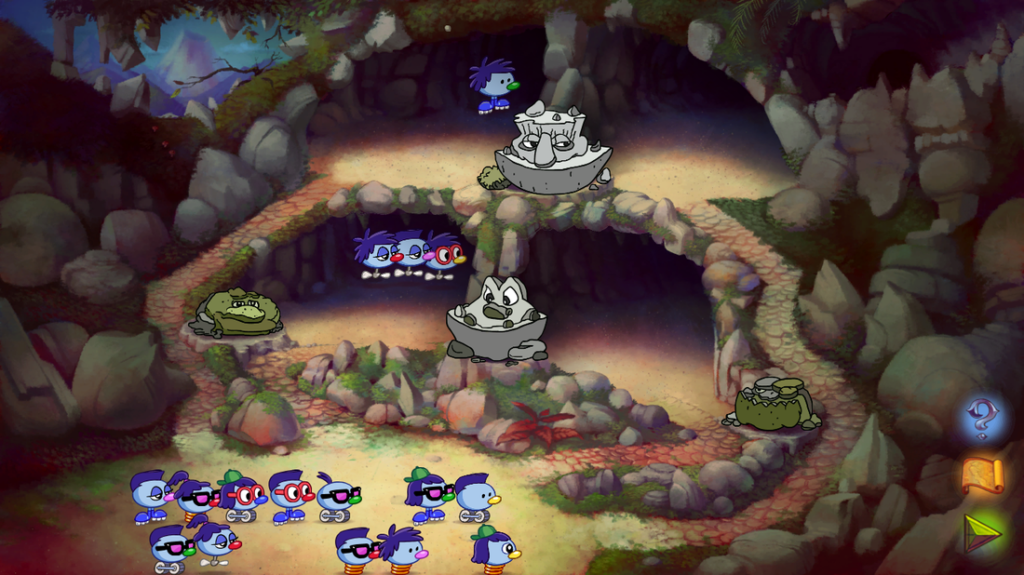
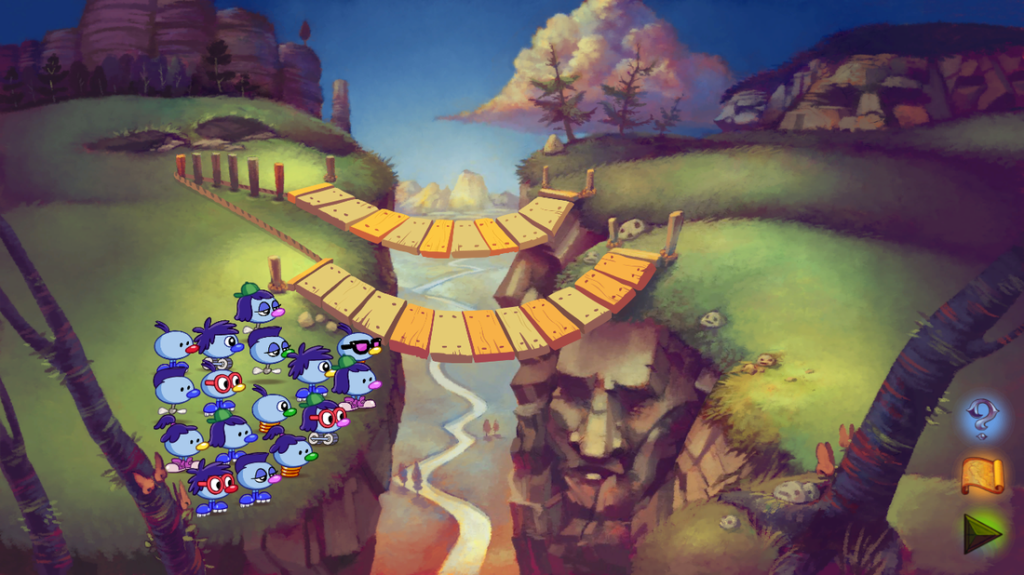
The second puzzle on the Zoombinis’ journey is the Stone Cold Caves, and another based mostly on sorting and sets. There are four caves, guarded by two pairs of rock trolls. The two smaller trolls on the furthest left and right determine whether a particular Zoombini can travel up that path, while the two larger central trolls determine whether a Zoombini can enter their two caves. These entry requirements are based on the characteristics of the Zoombinis, in a similar way to the Allergic Cliffs.
The Mathematical Learning notes that accompany the game list identical skills to the Allergic Cliffs:
- observation
- forming and testing theories
- forming sets
- using evidence
- logical reasoning
As with the Cliffs, I tried to spot the strategies I was using to solve each difficulty level. One strategy that was quite efficient was choosing Zoombinis that looked fairly similar to follow each other – this allowed me to work out which characteristics were important in each attempt at the puzzle.
Not So Easy
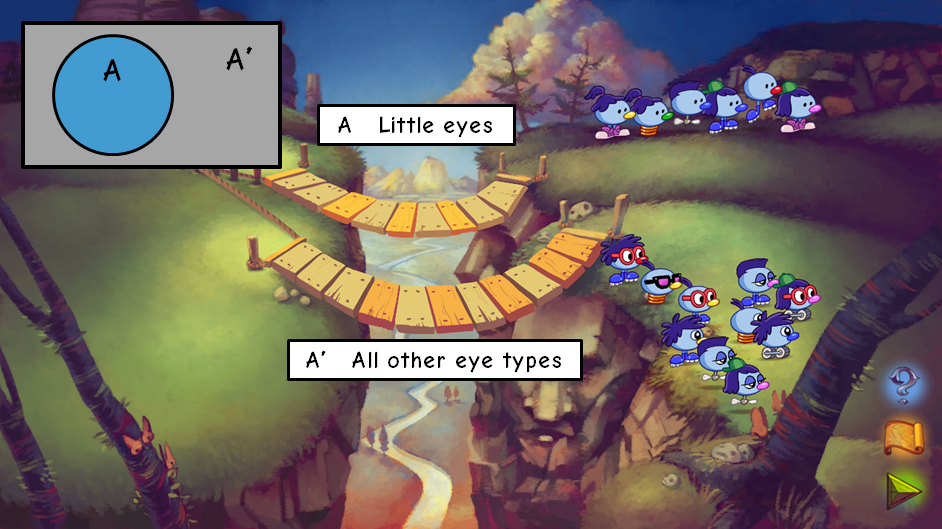
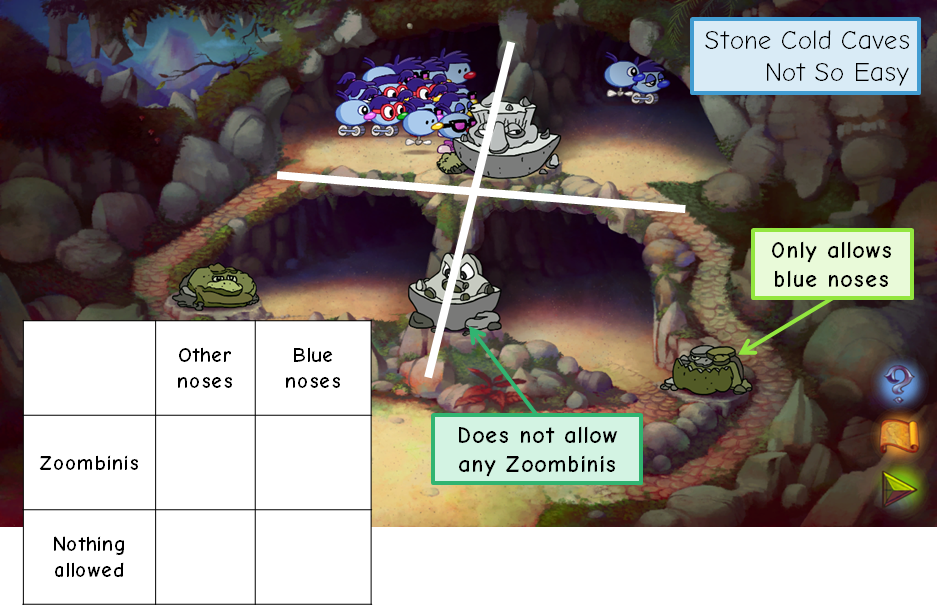
Initially, the puzzle is quite straightforward to solve; one of the vertical trolls will not allow any Zoombinis in at all, while one of the side trolls only allows Zoombinis with a particular characteristic – in the example below, the bottom troll won’t let anyone in, and the right-hand troll will only admit Zoombinis with blue noses. This ends up being mathematically identical to the Allergic Cliffs on Not So Easy mode, albeit with another two redundant options.
After annotating the white lines over the puzzle, I realised that it had started to look suspiciously like a Carroll diagram, a two-way table used for grouping objects which have or do not have a particular attribute or set of attributes. Here, we have “blue noses” and “not blue noses” as our vertical characteristics and “Zoombinis” and “not-Zoombinis” (or in other words, nothing) as our horizontal characteristics. This similarity to Carroll diagrams becomes much more explicit on the next two difficulty levels, but falls apart slightly for Very Very Hard.
Oh So Hard
The next difficulty level unlocks all four caves, although it doesn’t necessarily follow that each cave will have Zoombinis in each time – this depends on the party make-up. This time, one of both the horizontal and vertical pair of trolls will only allow Zoombinis with a particular characteristic, while the Zoombinis without this characteristic get sent up the other path.
When all four caves are used, it’s easier to see the similarities with a traditional 2×2 Carroll diagram, in this case splitting into smooth/not smooth hair down the columns and propeller/not propeller along the rows.
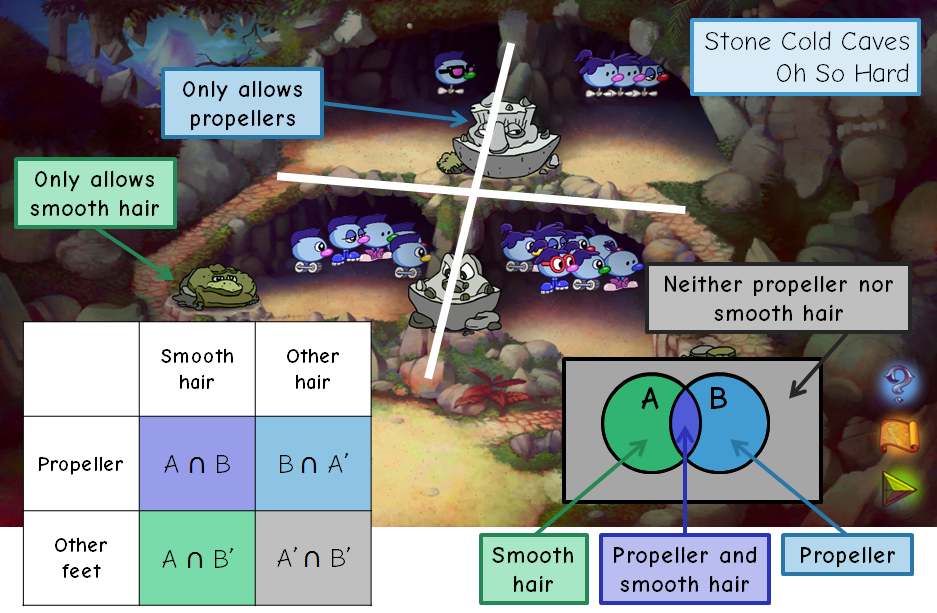
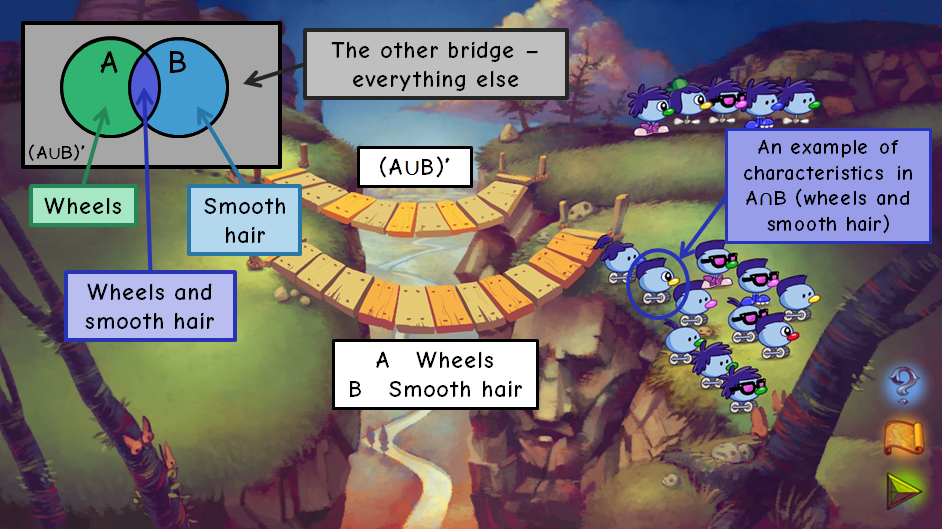
Although this puzzle sorts Zoombinis in a similar way to the Allergic Cliffs on Very Hard (namely by picking two characteristics from two types that are important), the layout of the puzzle as a grid of four means there is direct correlation with each section of the Venn diagram. The top left quadrant represents the intersection – those Zoombinis with smooth hair and propellers. Unlike the Allergic Cliffs, the sole Zoombini sitting in the intersection here is not mixed in with the other groups.
We can also distinctly see the sets of Zoombinis with only one of the key features – top right has propellers but not smooth hair, while bottom left has smooth hair but not propellers. Finally, the bottom right quadrant contains all the Zoombinis without either of the key features.
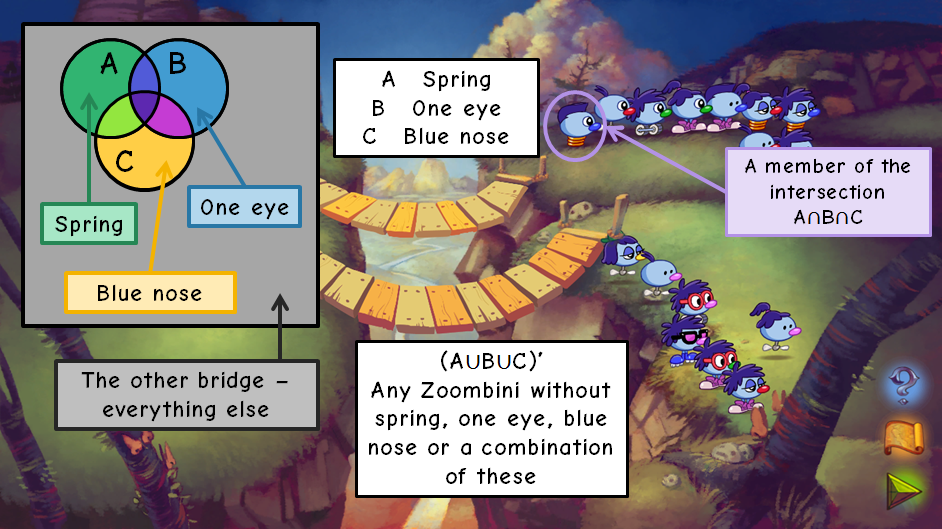
I think there’s definitely scope for using this puzzle along with the Allergic Cliffs to examine Venn diagrams in more detail, particularly as you can see the intersection and sets “A and not B” and “B and not A” so clearly.
Very Hard
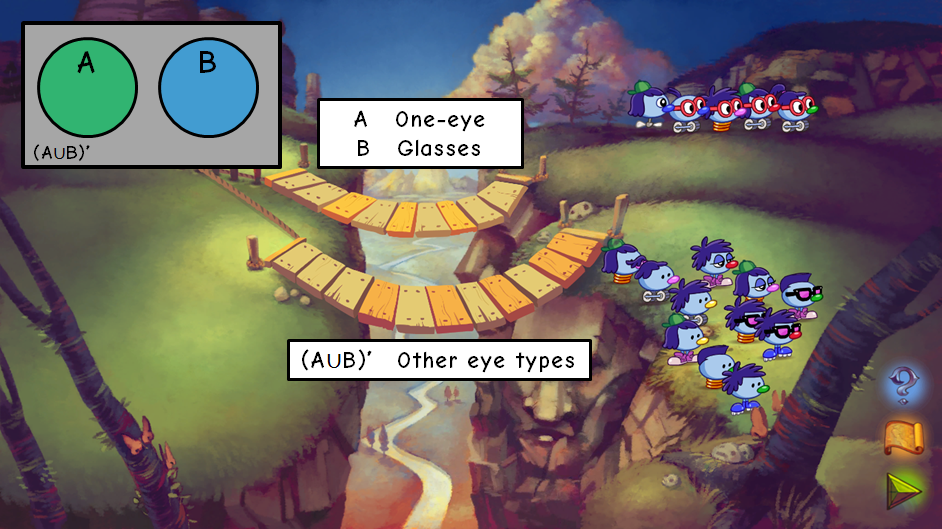
The only change when the difficulty level ramps up here is the number of features selected by each guard. As before, each pair of guards are concerned with a certain feature type (hair, eyes etc) – in the example below, the vertical pair choose hair and the horizontal pair choose eyes. However, rather than one guard selecting one characteristic from that type (i.e. only allowing glasses up the right-hand path), one guard selects two characteristics from that type, while Zoombinis with the remaining three characteristics go up the other path.
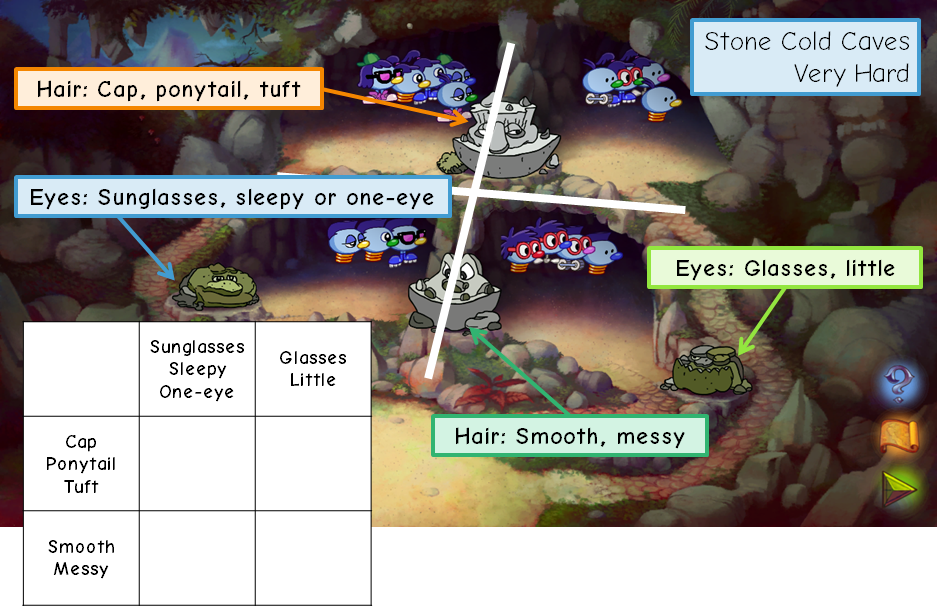
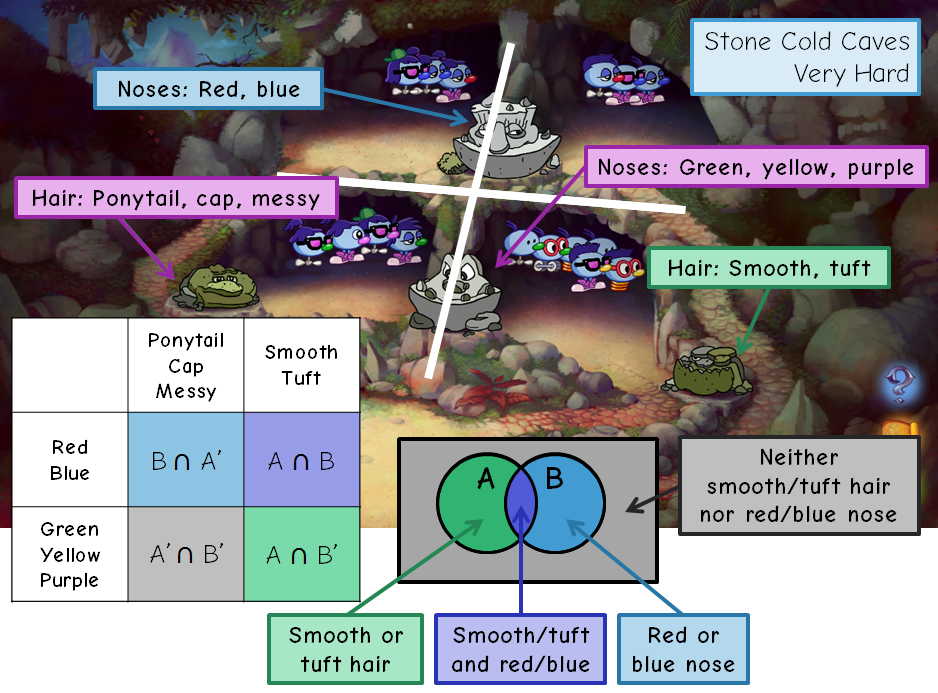
I did a couple of test runs on this one just to check, particularly after my experiences with Very Very Hard mode and trying to work out what on earth was going on there! It seems that Very Hard mode always has a strict 2/3 split of characteristics across each pair of trolls (as 1/4 is just back to the Oh So Hard puzzle). We can still consider a Venn diagram model for this puzzle – as you can see below, we still have four distinct regions on the Venn diagram represented by the four distinct caves. The only difference is that the sets A and B will now be things like “smooth or tuft hair” rather than simply “smooth hair” as they would have been on the previous difficulty level.
Very Very Hard
Initially, I couldn’t see the connection between Very Very Hard and the other three levels of difficulty. On the only available half-decent walkthrough, I found the following advice:
Very Very Hard: One of the large rocks will not accept roughly half the Zoombinis for varied reasons; one of the small rocks will not accept roughly half the Zoombinis for varied reasons. These reasons usually are: Having 1 of 2 features, having a combination of 2 features, or having 1 of 3 features.
This seemed to make some sense based on observations, but seemed to imply that the puzzle changed somewhat between Very Hard and Very Very Hard. Thinking a little more, and after several run-throughs, I’ve come to the following conclusions:
- One of the vertical and one of the horizontal guards have specific rules about which characteristics will be allowed, while the other guard in their pair allows the complement of that set – identical to the rule structure all the way through so far.
- The “rule picking” guards still pick two characteristics each, but there are two crucial differences between Very Hard and Very Vary Hard:
- Firstly, each guard picks two rules from different characteristic types – in the example below, the vertical guards care about hair and eyes, while the horizontal guards care about noses and feet.
- Secondly, each rule is now better worded as an undesirable characteristic – such as the left-hand guard refusing to admit springs or green noses in the example below. This leads to the player placing Zoombinis according to the features they don’t have, which is a subtly different kind of thinking.
- The four rules picked by the two guard pairs completely cover each set of characteristic types in each puzzle – one guard picks two from hair, eyes, nose and feet, leaving the other guard with the remaining two characteristic types.
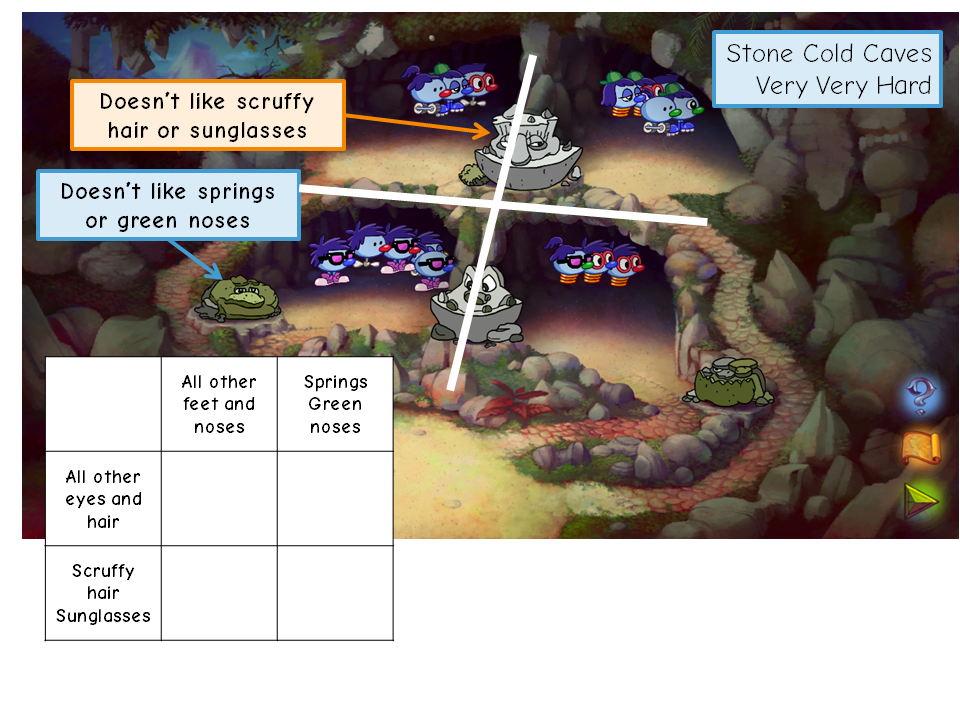
It’s interesting to note that the “not”-type wording of the rule makes it more difficult to positively state the nature of each set. Here’s another example on Very Very Hard. I’d initially decided that the bottom guard was also sorting on eyes here, as every Zoombini with one eye appears in the top two caves, agreeing with the walkthrough’s statement about “one of three features”.
However, when I started to put the labelling and diagrams together, I noticed the little chap I’ve highlighted in yellow – he doesn’t appear immediately problematic as he’s not actually “breaking” any of the rules. However, with the rule set as it is, there’s no explanation for why he’s not in the bottom-left cave rather than bottom-right.
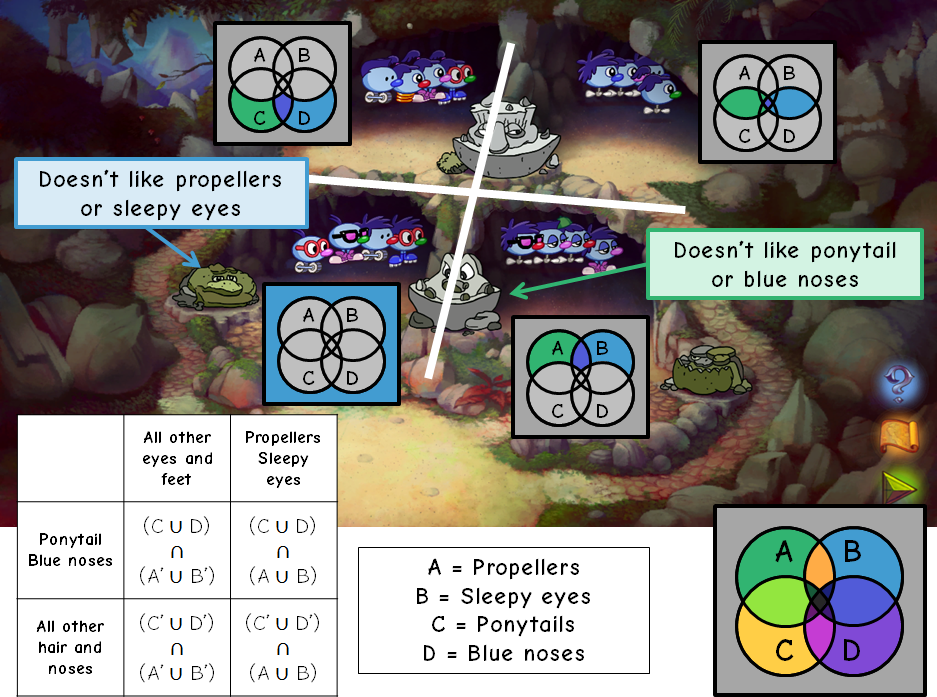
Looking again, I realised it was just chance that all the Zoombinis with one eye had ended up in the top two caves – they all had either a ponytail or a blue nose, and it was these two features that were getting a rejection from the bottom guard. I refined the ruling slightly and came up with this, which is consistent with my interpretation of the problem and also with earlier levels.
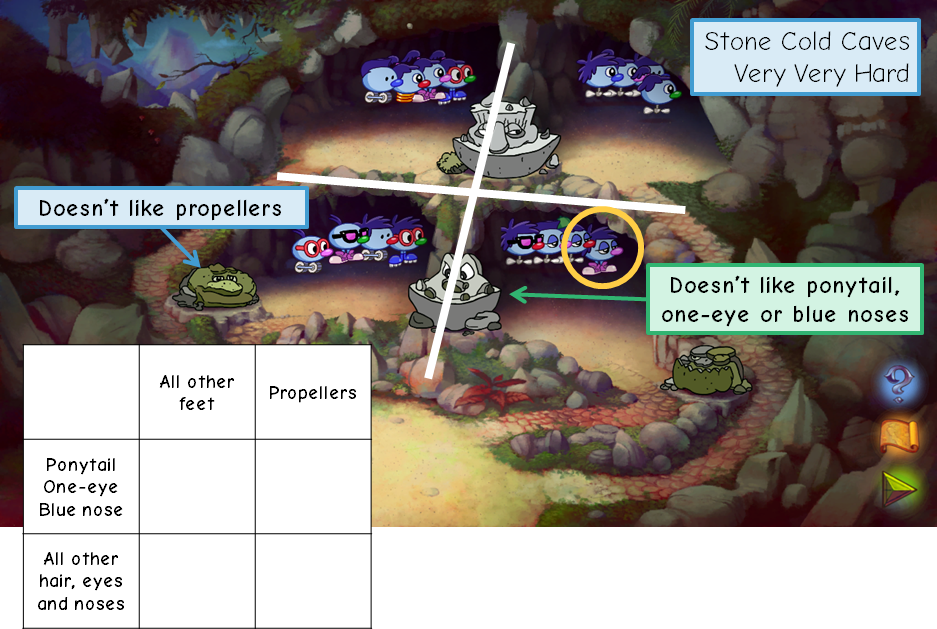
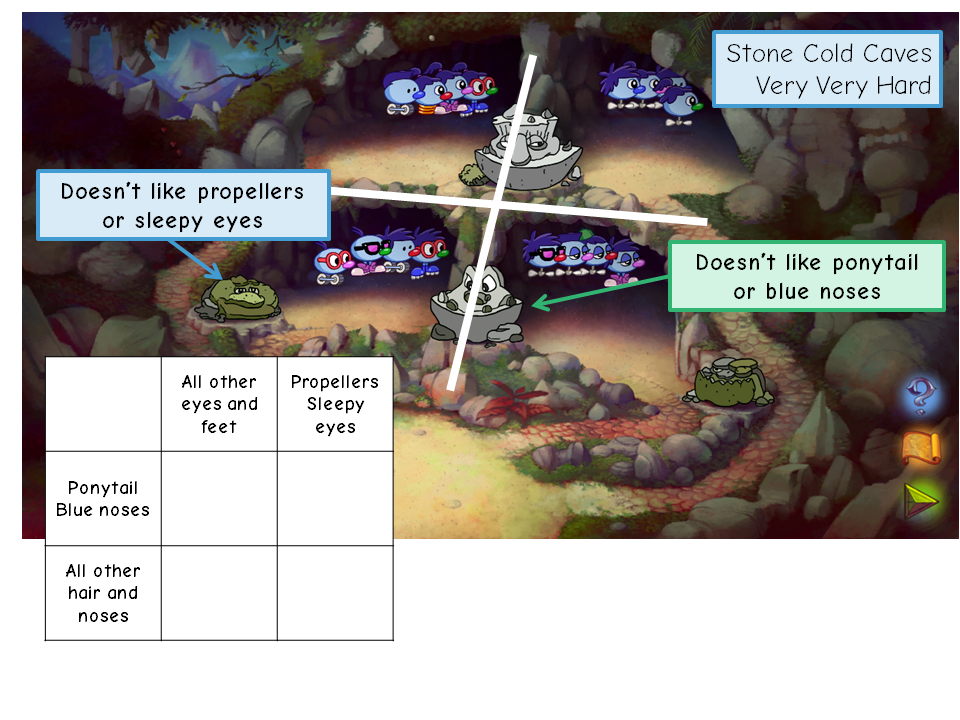
I’ve included Venn diagram representations of this problem for completion, but it all gets very complicated with four important characteristics. However, it is particularly nice to see pictorally how each cave contributes to the complete party of Zoombinis.
Zoombini Maths – Sorting using Carroll diagrams in the Stone Cold Caves Read More »