zoombini maths

Zoombini Maths – Have a pizza party!
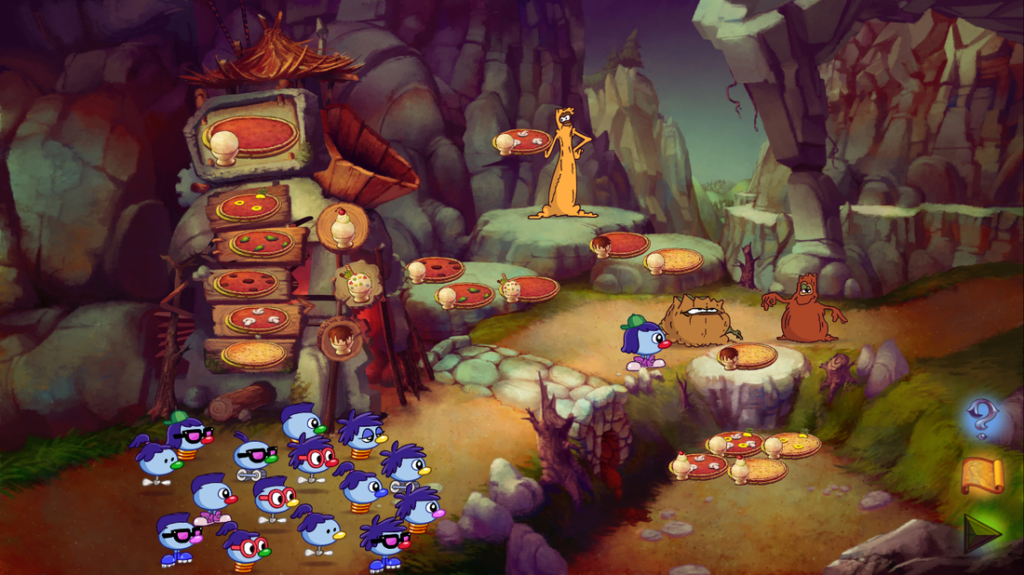
This level was undoubtedly one of my favourites when I played the game as a child, and is responsible for many pizza-related sayings in my house. Unlike the previous two levels, this one is not focused at all on Zoombini characteristics. Instead, the player is tasked with creating the perfect pizza for some very picky tree trolls. When each troll has had their pizza made, they move out of the Zoombinis’ way, allowing to group to continue.

Not So Easy

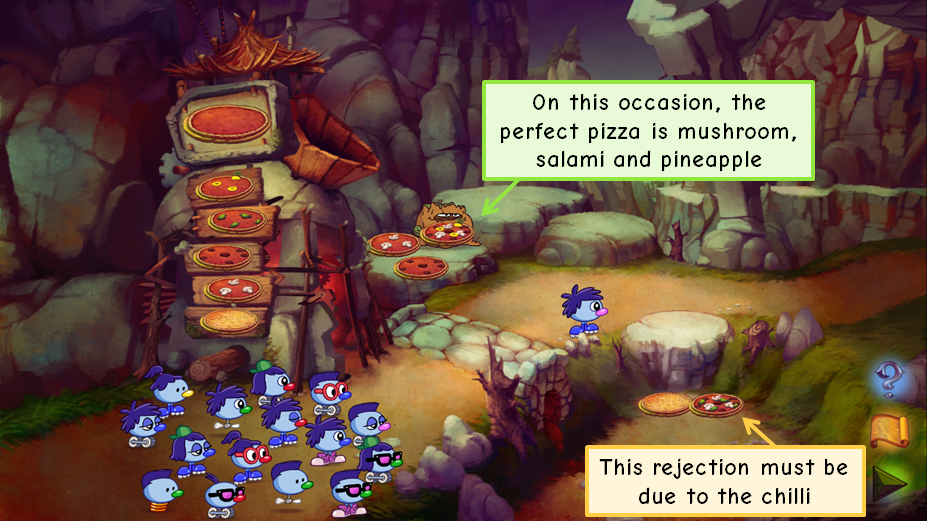
On the first level, players have to create a pizza for a single troll, Arno, from a choice of five different toppings. It’s a little unclear what some of the toppings are, so I’ve taken a best guess at names. To create a pizza, the player selects one or more desired toppings from the machine on the left, then presses the large pizza button at the top. The pizza is transported over Arno, who either flings it on the rock behind him if the pizza is OK but missing something, or in the pit to the front if there’s something on it that he doesn’t approve of. On Not So Easy, the player gets six attempts before Arno starts hitting his pizza-delivery Zoombinis off the screen and back to Zoombini Isle in frustration.
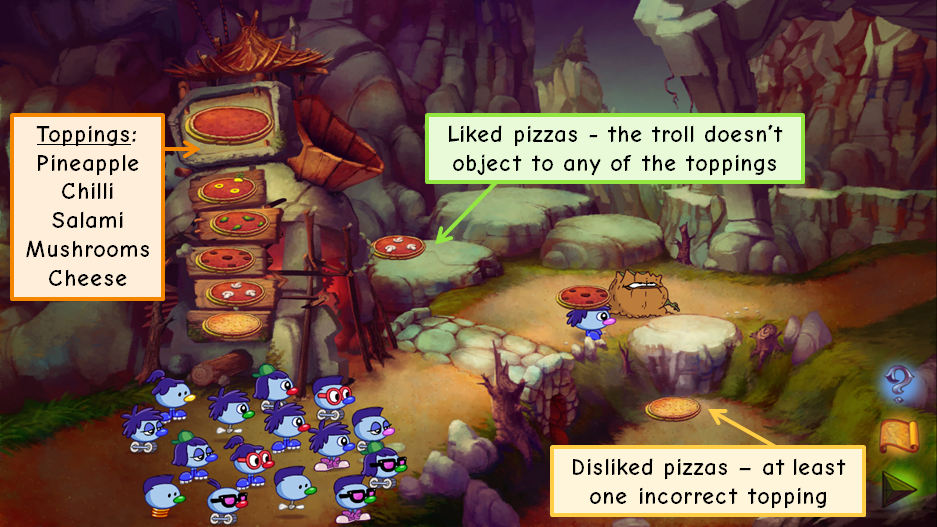
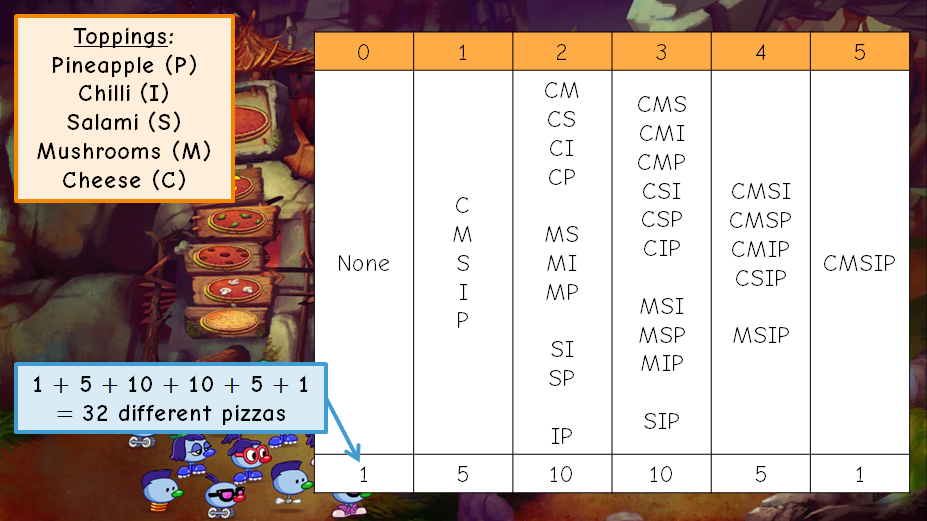
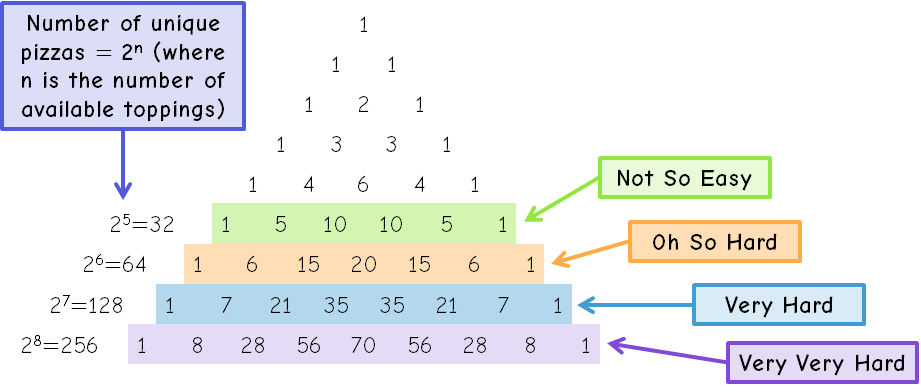
In total, there are 32 possible pizza combinations, which makes pure guesswork an inefficient strategy. However, with six chances before you start to lose Zoombinis, and only one troll to satisfy, it’s a perfectly acceptable approach to produce each of the five single-topping pizzas, judge his reaction to each, and then use your sixth attempt to create the correct combination from this. It’s worth noting that the completely blank pizza also counts as an option – if all five toppings are rejected, the sixth attempt can be used to present the blank pizza.

It’s also OK to introduce a new topping each time. In the example below, once I had figured out that Arno liked mushrooms and salami (but not cheese), I knew that these two ingredients would have to be on his perfect pizza anyway, so included them in my tests of chilli and pineapple.
It might be interesting in a classroom situation to get pupils to consider or even to work out all the possible pizza combinations. This could be done quite easily by listing as here, and could then lead to further discussion about combinations or patterns in Pascal’s Triangle.
Oh So Hard

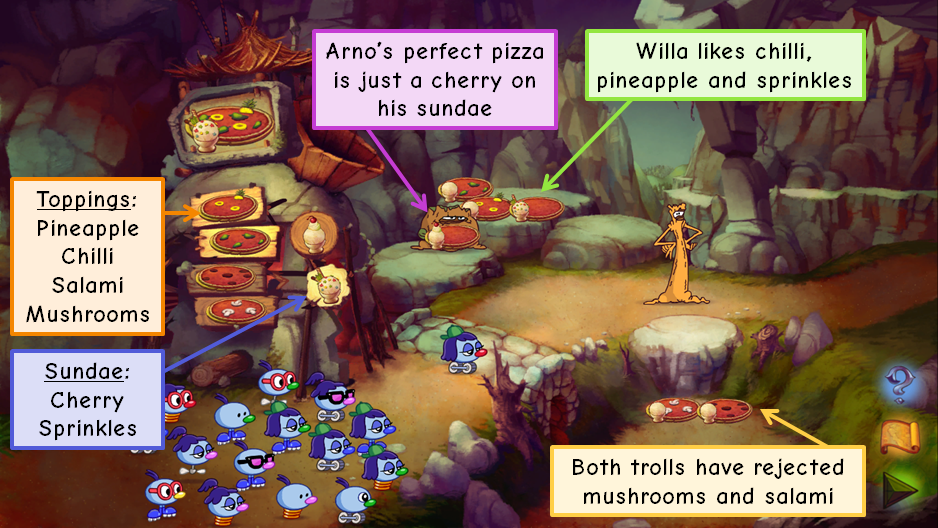
The next difficulty level introduces an extra troll, Willa, and some extra choices for the pizza machine. Cheese is removed, but is replaced with two ice-cream sundae options, namely sprinkles and a cherry. Essentially, both still function as “pizza toppings”, giving the player a choice of six toppings in total and doubling the number of possible unique pizzas to 64.

​As before, the player has sufficient attempts (seven on this difficulty setting) to try each topping on its own, then combine to create both trolls’ perfect pizzas. There is never any overlap between the two trolls – for example, they will never both like mushrooms. However, there is no guarantee that all of the toppings will be used, and the trolls frequently both reject one or two toppings.
Very Hard

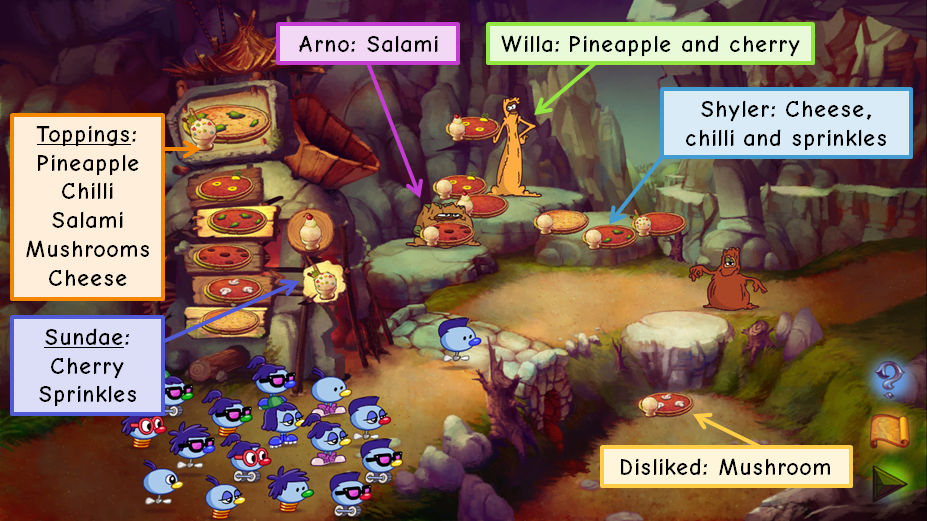
The third difficulty level introduces a third troll, Shyler, and cheese appears once again on the pizza machine. A choice of seven toppings now means that there are 128 possible unique pizzas, making guessing correctly nearly impossible. However, with eight pizza attempts before your Zoombinis end up getting smacked around, the tactic of producing single-topping pizzas still works every time.
Once the player has figured out the correct approach, the first three difficulty levels of the Pizza Pass become fairly trivial. The algorithm of “create one of each single topping, then combine” works sufficiently in every case. However, the quirkiness of the trolls and the excellent voice acting mean it doesn’t really get boring to replay. 

It’s at Very Very Hard that the puzzle changes subtly, so the algorithmic approach breaks down and alternative tactics are needed. Because of these greater complications, I’ve saved this for a separate post, as this one was getting too long!

Thoughts on Classroom / Educational Use

  • Get pupils to work out or list the total number of pizza combinations for each level of difficulty – a great opportunity for some systematic listing and pattern spotting.
  • Create Pascal’s Triangle from the pizza choices – explore the link between the number of available toppings and the number of unique pizza combinations.
  • Explore different strategies for solving each problem – as yet, I’ve not found a more efficient algorithm than the one described above – but there may be one!
Zoombini Maths – Have a pizza party! Read More »
Zoombini Maths – Sorting using Carroll diagrams in the Stone Cold Caves

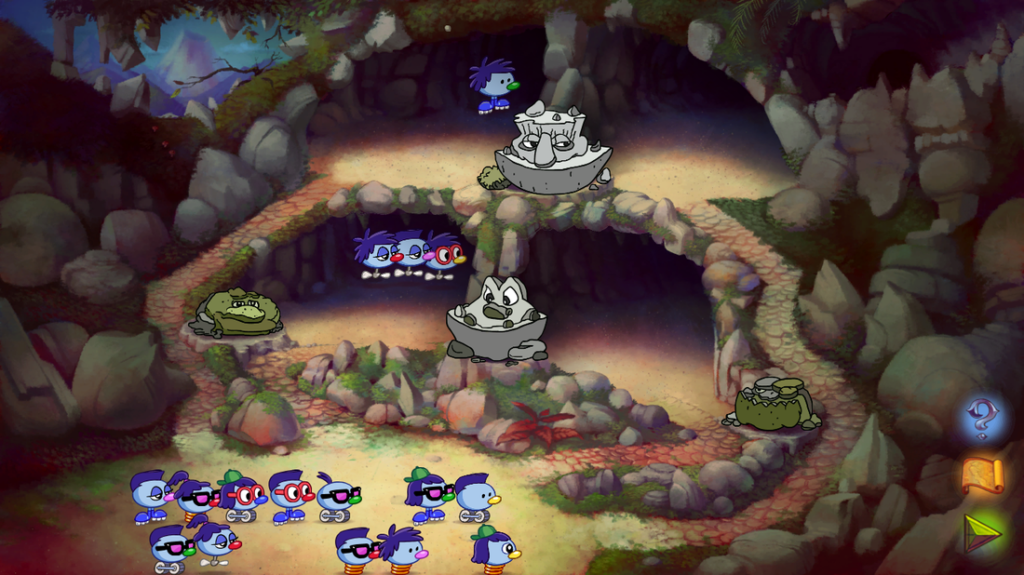
The second puzzle on the Zoombinis’ journey is the Stone Cold Caves, and another based mostly on sorting and sets. There are four caves, guarded by two pairs of rock trolls. The two smaller trolls on the furthest left and right determine whether a particular Zoombini can travel up that path, while the two larger central trolls determine whether a Zoombini can enter their two caves. These entry requirements are based on the characteristics of the Zoombinis, in a similar way to the Allergic Cliffs.

The Mathematical Learning notes that accompany the game list identical skills to the Allergic Cliffs:

  • observation
  • forming and testing theories
  • forming sets
  • using evidence
  • logical reasoning

As with the Cliffs, I tried to spot the strategies I was using to solve each difficulty level. One strategy that was quite efficient was choosing Zoombinis that looked fairly similar to follow each other – this allowed me to work out which characteristics were important in each attempt at the puzzle.

Not So Easy

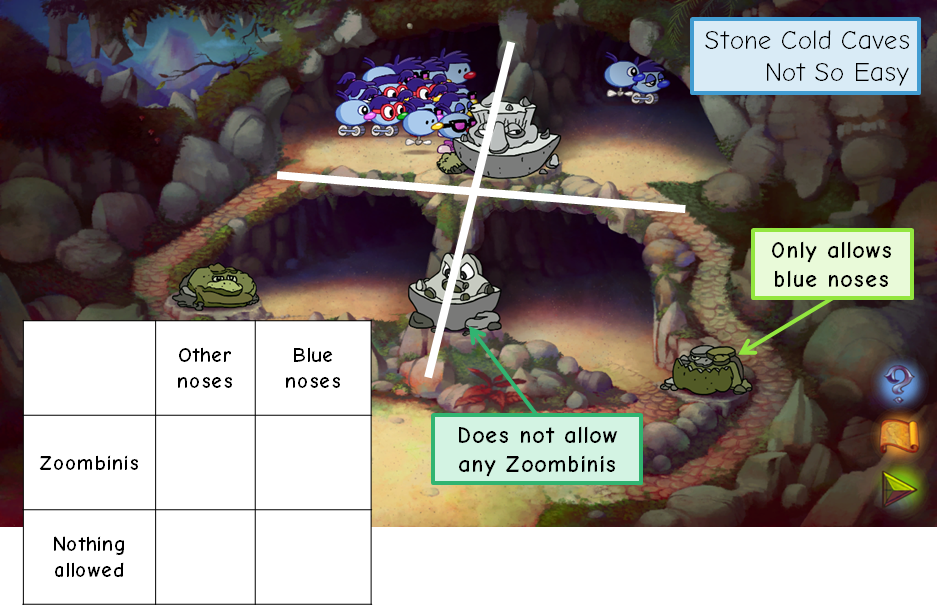
Initially, the puzzle is quite straightforward to solve; one of the vertical trolls will not allow any Zoombinis in at all, while one of the side trolls only allows Zoombinis with a particular characteristic – in the example below, the bottom troll won’t let anyone in, and the right-hand troll will only admit Zoombinis with blue noses. This ends up being mathematically identical to the Allergic Cliffs on Not So Easy mode, albeit with another two redundant options.

After annotating the white lines over the puzzle, I realised that it had started to look suspiciously like a Carroll diagram, a two-way table used for grouping objects which have or do not have a particular attribute or set of attributes. Here, we have “blue noses” and “not blue noses” as our vertical characteristics and “Zoombinis” and “not-Zoombinis” (or in other words, nothing) as our horizontal characteristics. This similarity to Carroll diagrams becomes much more explicit on the next two difficulty levels, but falls apart slightly for Very Very Hard.

Oh So Hard

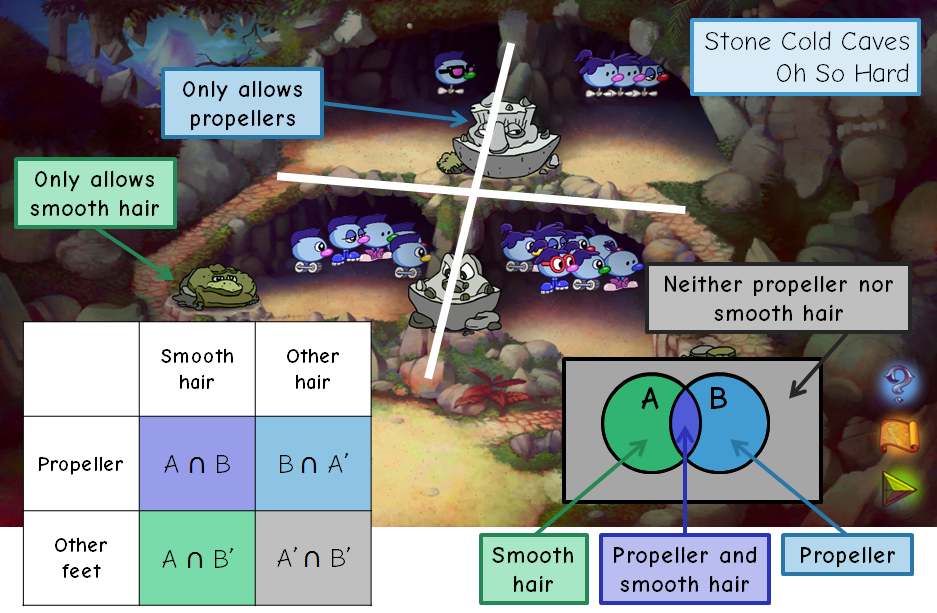
The next difficulty level unlocks all four caves, although it doesn’t necessarily follow that each cave will have Zoombinis in each time – this depends on the party make-up. This time, one of both the horizontal and vertical pair of trolls will only allow Zoombinis with a particular characteristic, while the Zoombinis without this characteristic get sent up the other path.

When all four caves are used, it’s easier to see the similarities with a traditional 2×2 Carroll diagram, in this case splitting into smooth/not smooth hair down the columns and propeller/not propeller along the rows.

Although this puzzle sorts Zoombinis in a similar way to the Allergic Cliffs on Very Hard (namely by picking two characteristics from two types that are important), the layout of the puzzle as a grid of four means there is direct correlation with each section of the Venn diagram. The top left quadrant represents the intersection – those Zoombinis with smooth hair and propellers. Unlike the Allergic Cliffs, the sole Zoombini sitting in the intersection here is not mixed in with the other groups. 

We can also distinctly see the sets of Zoombinis with only one of the key features – top right has propellers but not smooth hair, while bottom left has smooth hair but not propellers. Finally, the bottom right quadrant contains all the Zoombinis without either of the key features.

I think there’s definitely scope for using this puzzle along with the Allergic Cliffs to examine Venn diagrams in more detail, particularly as you can see the intersection and sets “A and not B” and “B and not A” so clearly.

Very Hard

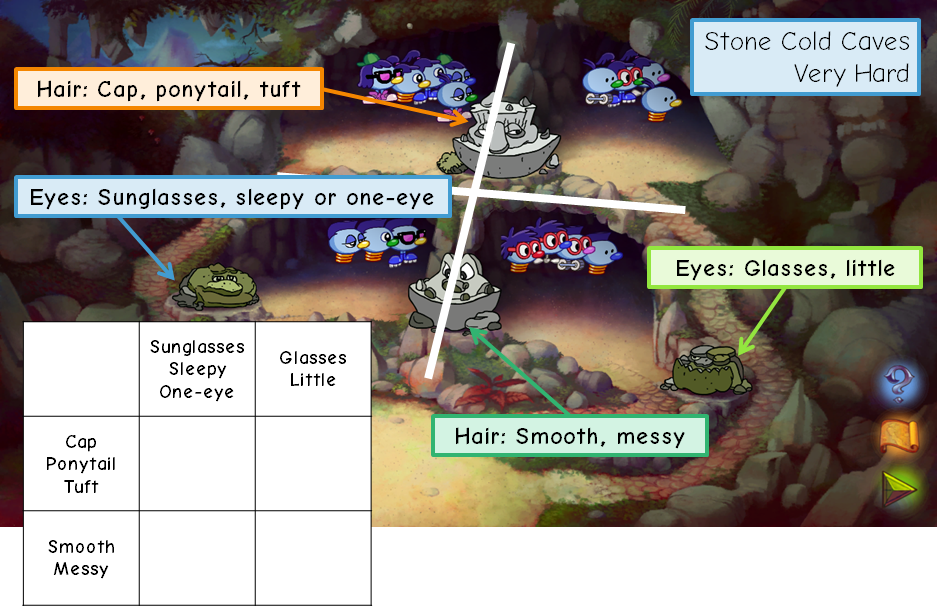
The only change when the difficulty level ramps up here is the number of features selected by each guard. As before, each pair of guards are concerned with a certain feature type (hair, eyes etc) – in the example below, the vertical pair choose hair and the horizontal pair choose eyes. However, rather than one guard selecting one characteristic from that type (i.e. only allowing glasses up the right-hand path), one guard selects two characteristics from that type, while Zoombinis with the remaining three characteristics go up the other path.

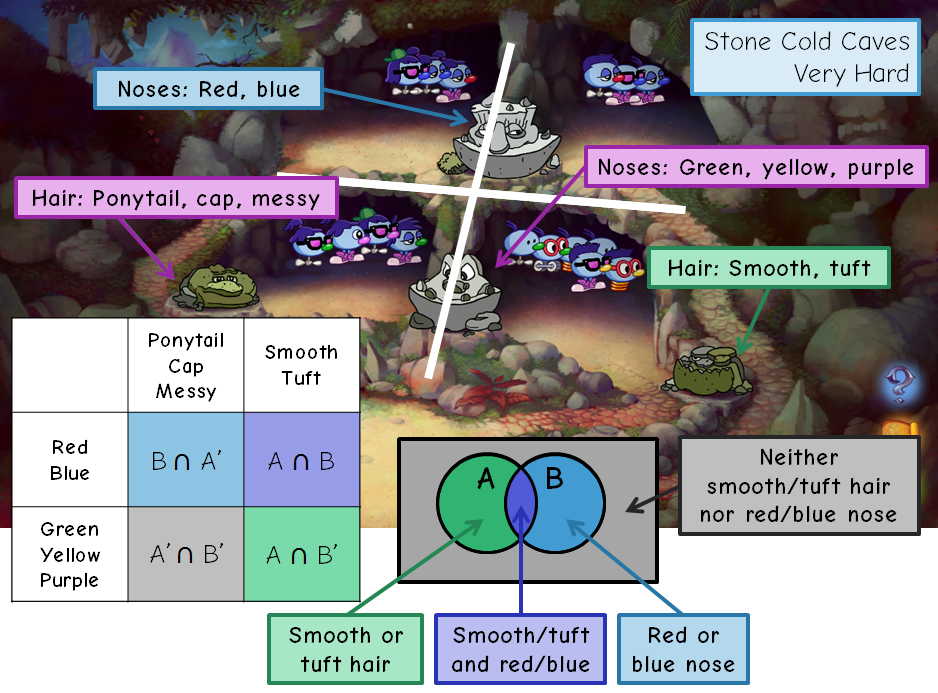
I did a couple of test runs on this one just to check, particularly after my experiences with Very Very Hard mode and trying to work out what on earth was going on there! It seems that Very Hard mode always has a strict 2/3 split of characteristics across each pair of trolls (as 1/4 is just back to the Oh So Hard puzzle). We can still consider a Venn diagram model for this puzzle – as you can see below, we still have four distinct regions on the Venn diagram represented by the four distinct caves. The only difference is that the sets A and B will now be things like “smooth or tuft hair” rather than simply “smooth hair” as they would have been on the previous difficulty level.

Very Very Hard

Initially, I couldn’t see the connection between Very Very Hard and the other three levels of difficulty. On the only available half-decent walkthrough, I found the following advice:

Very Very Hard: One of the large rocks will not accept roughly half the Zoombinis for varied reasons; one of the small rocks will not accept roughly half the Zoombinis for varied reasons. These reasons usually are: Having 1 of 2 features, having a combination of 2 features, or having 1 of 3 features.

This seemed to make some sense based on observations, but seemed to imply that the puzzle changed somewhat between Very Hard and Very Very Hard. Thinking a little more, and after several run-throughs, I’ve come to the following conclusions:

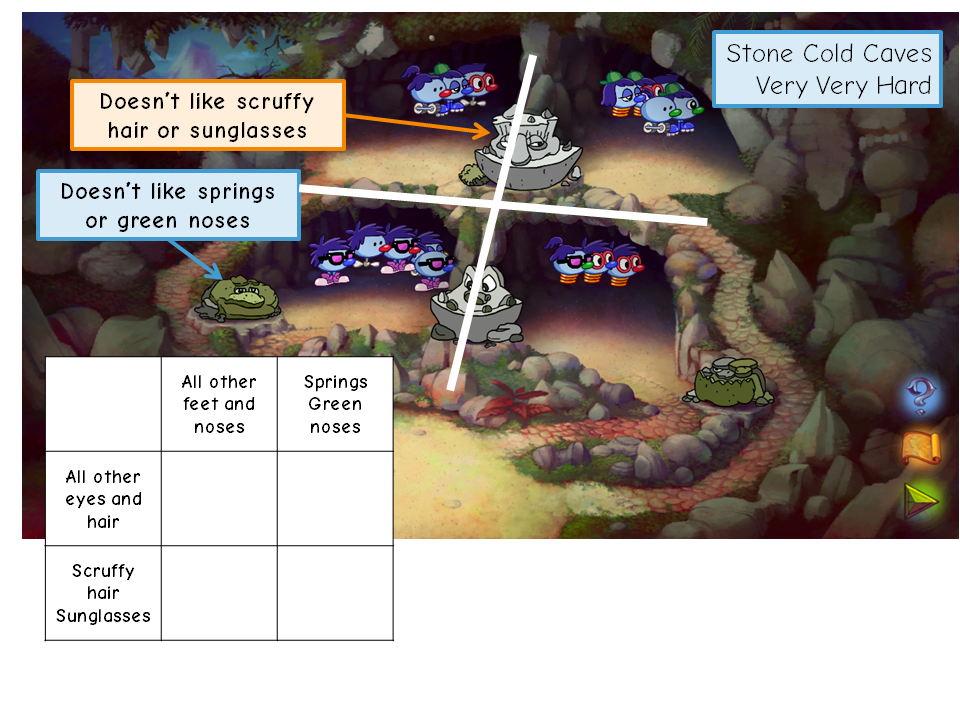
  • One of the vertical and one of the horizontal guards have specific rules about which characteristics will be allowed, while the other guard in their pair allows the complement of that set – identical to the rule structure all the way through so far.
  • The “rule picking” guards still pick two characteristics each, but there are two crucial differences between Very Hard and Very Vary Hard:
    • Firstly, each guard picks two rules from different characteristic types – in the example below, the vertical guards care about hair and eyes, while the horizontal guards care about noses and feet.
    • Secondly, each rule is now better worded as an undesirable characteristic – such as the left-hand guard refusing to admit springs or green noses in the example below. This leads to the player placing Zoombinis according to the features they don’t have, which is a subtly different kind of thinking.
  • The four rules picked by the two guard pairs completely cover each set of characteristic types in each puzzle – one guard picks two from hair, eyes, nose and feet, leaving the other guard with the remaining two characteristic types.

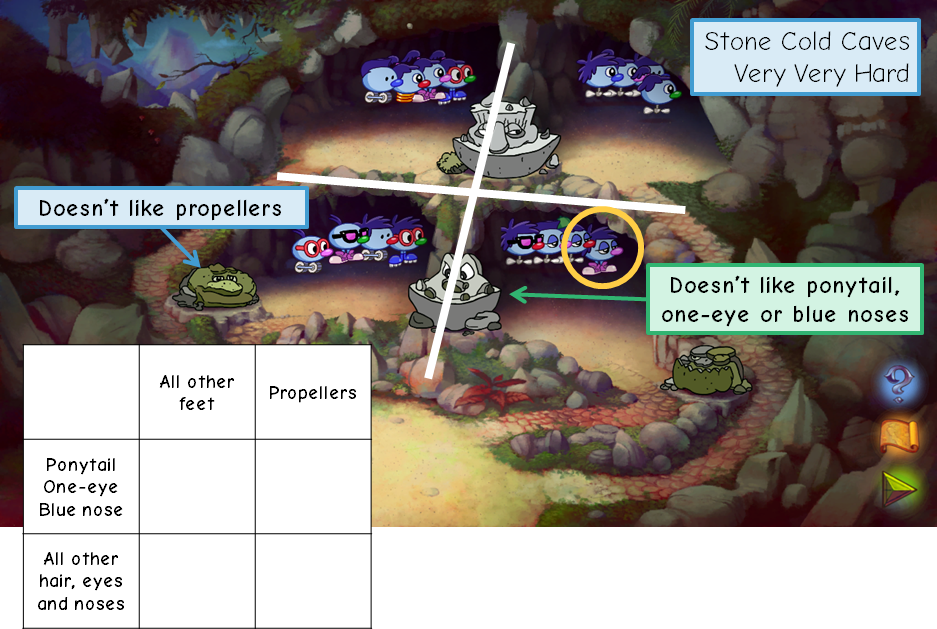
It’s interesting to note that the “not”-type wording of the rule makes it more difficult to positively state the nature of each set. Here’s another example on Very Very Hard. I’d initially decided that the bottom guard was also sorting on eyes here, as every Zoombini with one eye appears in the top two caves, agreeing with the walkthrough’s statement about “one of three features”.

However, when I started to put the labelling and diagrams together, I noticed the little chap I’ve highlighted in yellow – he doesn’t appear immediately problematic as he’s not actually “breaking” any of the rules. However, with the rule set as it is, there’s no explanation for why he’s not in the bottom-left cave rather than bottom-right.

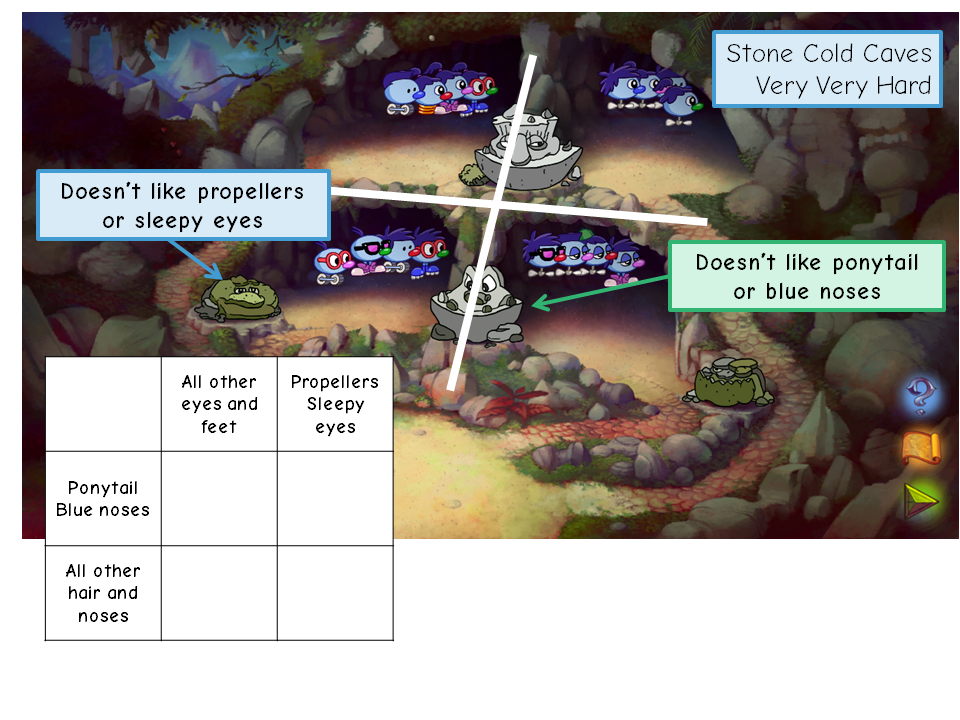
Looking again, I realised it was just chance that all the Zoombinis with one eye had ended up in the top two caves – they all had either a ponytail or a blue nose, and it was these two features that were getting a rejection from the bottom guard. I refined the ruling slightly and came up with this, which is consistent with my interpretation of the problem and also with earlier levels.

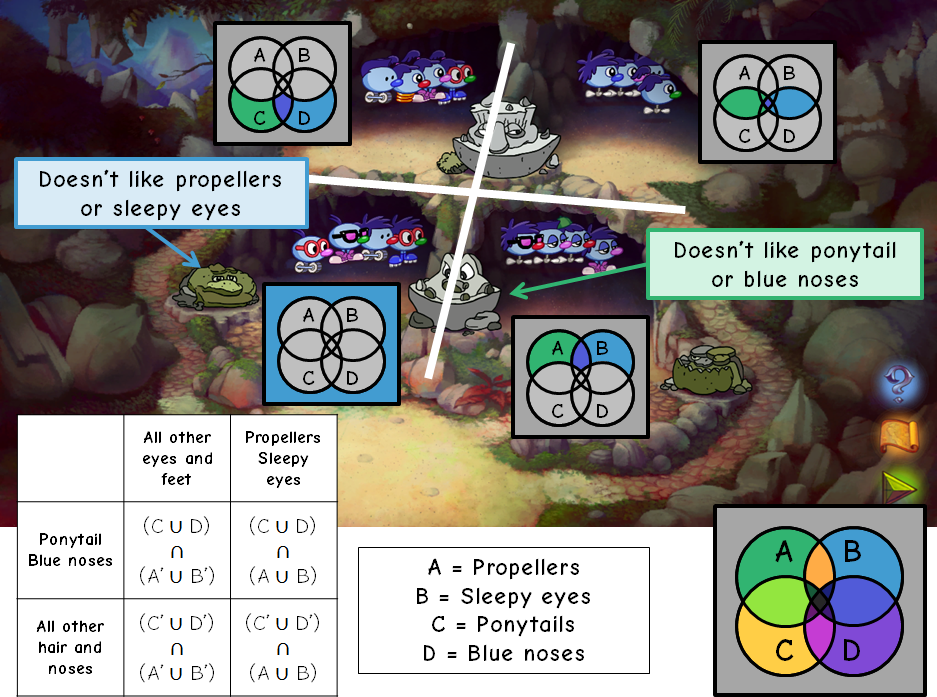
I’ve included Venn diagram representations of this problem for completion, but it all gets very complicated with four important characteristics. However, it is particularly nice to see pictorally how each cave contributes to the complete party of Zoombinis.

Zoombini Maths – Sorting using Carroll diagrams in the Stone Cold Caves Read More »

Zoombini Maths – Sneezing Cliffs and set theory

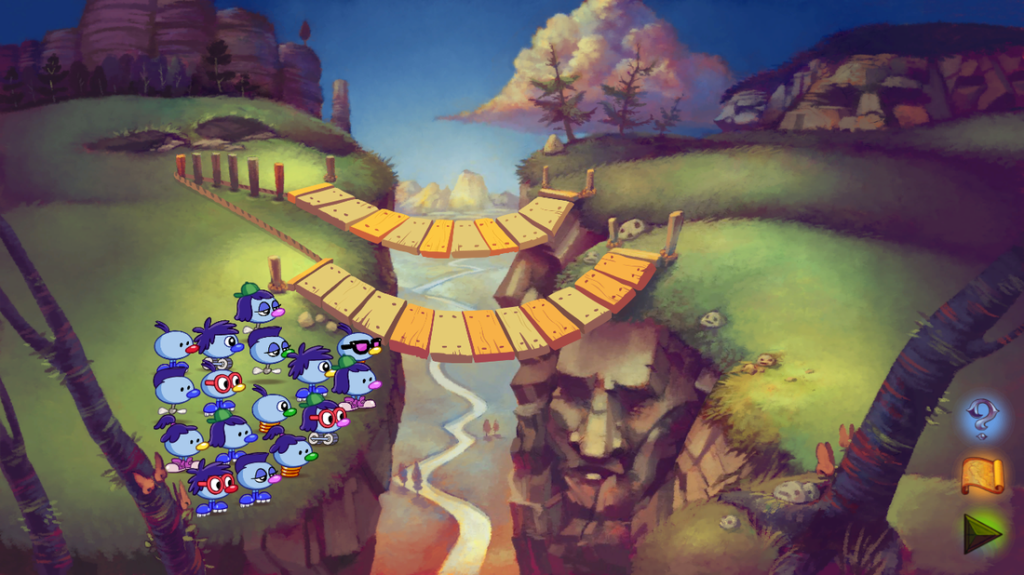
The very first impasse that the Zoombinis tackle is the Allergic Cliffs . Much like most puzzles in the game, the object is to get the Zoombinis across or through some physical feature in the landscape – in this case, a massive gulf between two cliffs, straddled by two rickety rope bridges. The “faces” on each cliff are “allergic” to specific features – such as sneezing when a Zoombini with rollerblades tries to pass over it.

The Mathematical Learning notes that accompany the game list these skills:

  • observation
  • forming and testing theories
  • forming sets
  • using evidence
  • logical reasoning

Important skills such as theory testing and logical reasoning are particularly difficult to teach or assess explicitly, but, whether due to increase in age or teaching experience since I last played this game, I found myself much more aware that I was creating and testing hypotheses almost subconsciously by seeking out Zoombinis with similar features to allow me to work out if it was red noses or rollerskates that was causing rejections.

Not So Easy

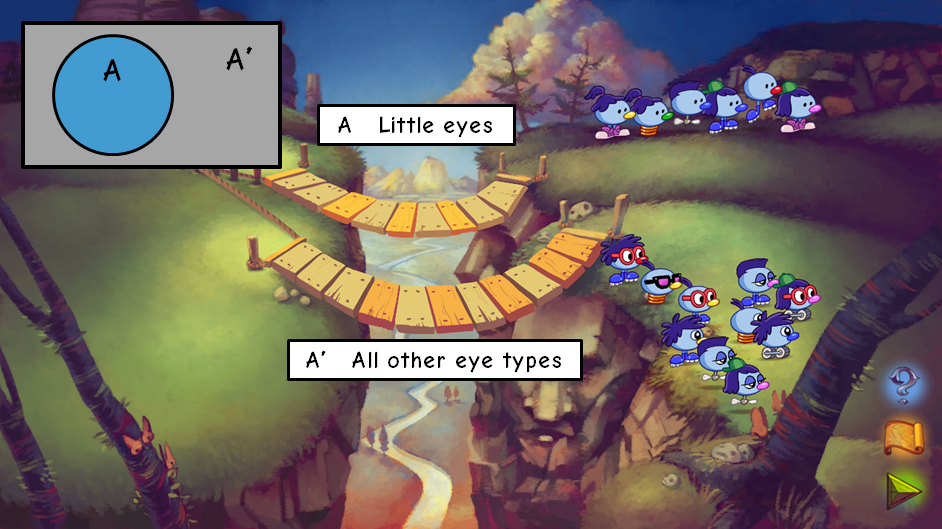
On the first level of difficulty, one cliff is allergic to one particular feature – in the example below, the bottom cliff is allergic to “little” eyes. If we consider the set A being ‘all Zoombinis with little eyes’, then the Zoombinis that pass over the top bridge are all members of that set, while the Zoombinis that pass over the bottom bridge are members of the set ‘not A’ – in other words, Zoombinis that don’t have little eyes. This nicely illustrates the concepts of a set, its absolute complement and the associated complement laws.

Oh So Hard

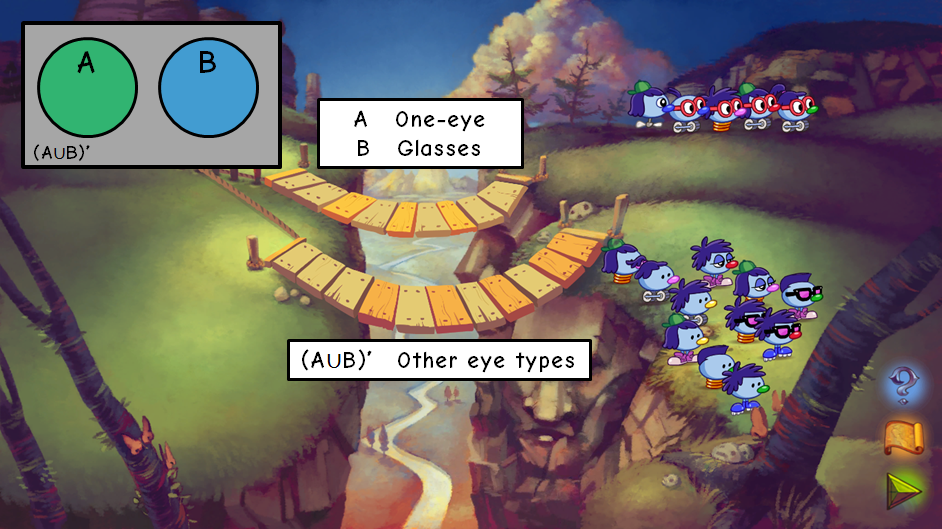
Kicking up the difficulty a notch, we then introduce another characteristic for set formation. Now, one cliff will accept Zoombinis with one of two characteristics from one type – in the example below, the top cliff only accepted Zoombinis with either one eye or glasses, while the other three eye types travelled across the bottom bridge.

We’ve now got two distinct sets, demonstrating the idea of mutual exclusivity; Zoombinis can have either one eye or glasses, and not both – hence there is no intersection in the Venn diagram.

Very Hard

The next difficulty level introduces set intersections, and immediately gets much more challenging – depending on the luck of your first few guesses, you can end up a few lives down before managing to form any workable theories.

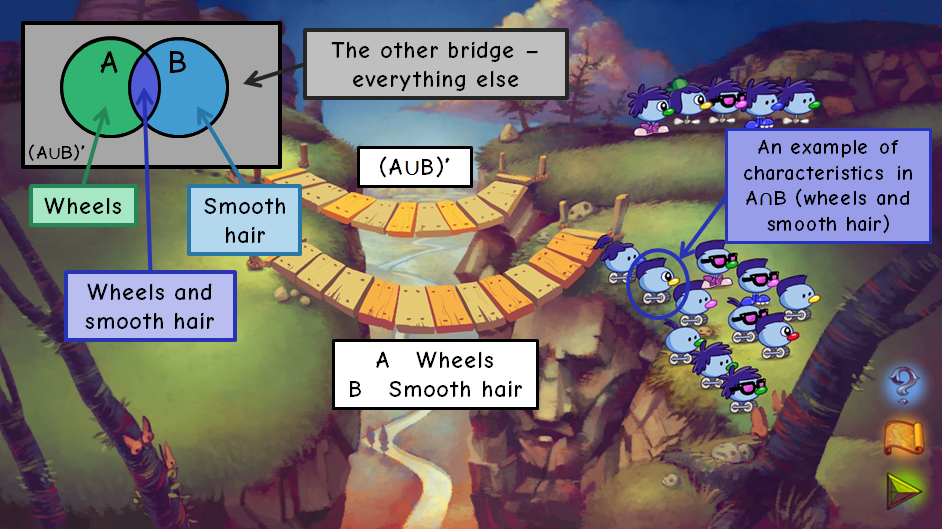
In a similar vein to Oh So Hard, one cliff still accepts Zoombinis with one of two characteristics, but now these characteristics are selected from different types – such as wheels and smooth hair in the example below. As far as I can tell, it’s always the case that the features are selected from two different types, otherwise we’d be back to the previous level of difficulty.

There’s a lot of interesting set-theoretic ideas here too – quite a few Zoombinis that passed over the bottom bridge had smooth hair and glasses, which places them in the dark blue intersection area on the Venn diagram. 

Very Very Hard

This took me forever to get my head around, and a bit of swift Googling indicates that, by the time you get on to Very Very Hard mode with a fairly varied group of Zoombinis, there’s no workable algorithmic approach to ensure success every time. 

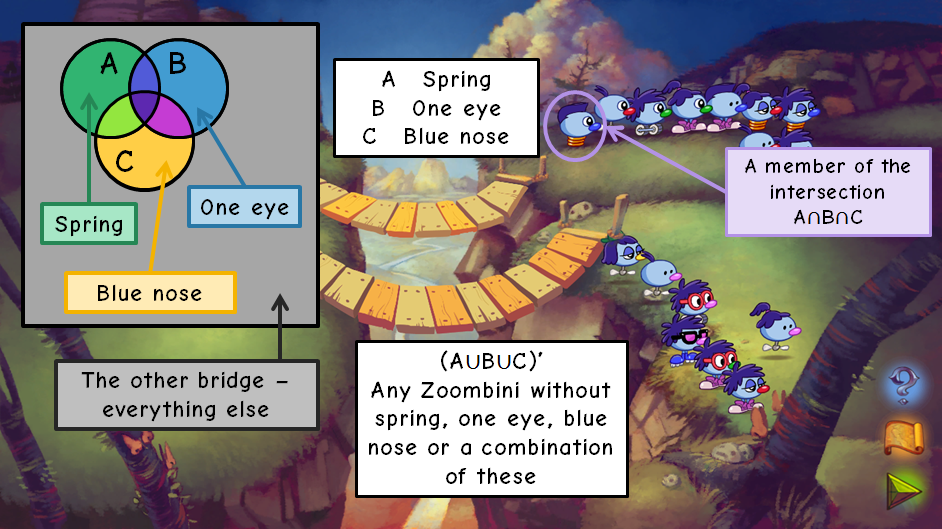
The tweak from Very Hard to Very Very Hard is conceptually simple – it’s just an additional characteristic added to the list of “acceptable” ones, and again, as far as I can tell, these characteristics will all be picked from different characteristic types. In my example, the top cliff was allergic to all Zoombinis except those with either a spring, one eye, a blue nose or any combination of these features.

In some cases, it’s not easy to spot the three sets even once the puzzle is complete. I had several run-throughs on practice mode, mostly because I spent the first ones losing spectacularly, but then because I was unable to categorically identify the three sets from the completed puzzle. I was pretty pleased with this final one, because not only are the sets pretty visible, but there’s also a little chap that lies in the intersection of all three sets, as he has a spring, one eye and a blue nose.

Thoughts on classroom/educational use

  • Complete the puzzle as a class on interactive board, getting pupils to make their reasoning and hypotheses explicit.
  • Screenshot completed puzzles and ask pupils to identify where particular Zoombinis would fit in each Venn diagram.
  • Screenshot completed puzzle and ask pupils to identify the sets or rules – this is incredibly challenging for a random group of Zoombinis on Very Very Hard mode.

Zoombini Maths – Sneezing Cliffs and set theory Read More »

Zoombini Maths and a new blog challenge

Half term’s been unusually busy for me – normally I earmark this week in October for catching up with school-work and sleep, but instead, my husband decided we needed a few days away. We popped off to Portugal from Saturday to Wednesday, giving me a complete break from my laptop, marking, Twitter and providing me with an excuse to lounge around, read, do puzzles and not feel guilty because I physically wasn’t able to do any work if I wanted.

Today, I’m off to Bath for a friend’s hen do. She’s also a teacher, hence the half-term date choice, but all this holidaying means I’ve had exactly one day to myself all holiday, which was mostly spent washing and tidying. I’d fully intended to use the seven hours I’ll be spending on a train in the next couple of days to get on top of some resources, but my husband left for work this morning with one of the most dangerous parting sentences imaginable: “You’ll never guess which one of your favourite games has just been released on Steam” (an online computer games portal, through which you can download pretty much anything available for PC).

So I went looking, and got quite excited when I found out that the game he was on about is The Logical Journey of the Zoombinis (now re-released as just “Zoombinis“), which was probably the most memorable computer game from my childhood. It was only about a fiver, so I bought it straight away and decided to have a little play through for the nostalgia factor. While the title includes the phrase “Logical Journey” and the original box had a lot of mathematical words I now recognise well, I don’t recall it as a “maths” computer game. So while the game was downloading, I decided to go and have a poke around on the Internet and see what people had to say about any actual maths content in this game.

The Internet seemed to fail me at this point. Maybe because this game was so big in my circle of friends at middle school – there was one computer with this loaded onto it, which we could play as a treat for finishing all our maths work – I just assumed that it was popular everywhere. There seems to be a small cult following on Reddit, but very little about the mathematics or otherwise behind each puzzle, so I decided that, seeing as I was obviously going to lose several hours to this game again over the next couple of weeks, I may as well try looking for some of the maths myself. Something I’m interested in exploring in a little more depth is whether or not this is something that might still work well in a classroom or online education today, particularly as the game is now available on tablets too, or if I’m just getting my perception of the educational usefulness of this game confused with my fond memories of playing it as a child.

There are likely to be a few blog posts over the next couple of weeks – I may attempt to do all the puzzles, or just pick my favourite ones. I’m halfway through one about the first puzzle, which relates nicely to set theory and Venn diagrams, but my train’s nearly arrived – so, for the time being, there are a few notes on each puzzle and the mathematical topics or processes explored in each available on Zoombinis for Educators

Just one little bugbear about the new version – one of the first things I spotted was the number of Zoombinis you can make in total has changed, dropping from 625 to 400. I distinctly remember working out quite early on when playing as a child that the original 625 would allow the player to make exactly one of each unique Zoombini, with no repeats, and ensuring that I did this in the game I completed. It’s worth pointing out that the game will allow you to create twin Zoombinis, but other multiples are not allowed.

I’m not sure why this change has been made for the re-release, but it means that a) I feel perfectly justified in dropping my urge to create unique Zoombinis and b) the game will take significantly less time to complete (if I decide to do so). I’m also pretty certain that this will make the game significantly more challenging than it was when I previously played it, as there are quite a few puzzles that rely on differences in the features of the Zoombinis.

Zoombini Maths and a new blog challenge Read More »