Putting the kettle on. Reading random education news articles, getting cross and closing them halfway through. Organising several appointments with estate agents, solicitors and dentists. Checking my emails. Ringing an old colleague for a chat. Actually doing some washing up even though we still have clean plates. Scrolling through the #mathschat hashtag on Twitter. Typing the first few words of a blog, then deleting them again. Investigating “interesting mathematical dates” – there’s nothing great this year, but I enjoyed 08/02/16. 04/04/16 is quite pleasant too. Napping – because I’m always tired at the moment. Annoyed that I can’t be bothered to make a new resource to blog about. Tea-drinking. Idling away the time by watching a couple of episodes of “The 100” – enjoying very much. Not doing anything even slightly meaningful with my evening! Glad that I’ve somehow managed to turn my brain mush into something resembling a blog post.
(Normal service resuming tomorrow) Image credit: By Alexandre Normand from San Francisco, United States – Procrastination (No Wall Uncovered VII), CC BY 2.0, commons.wikimedia.org/w/index….
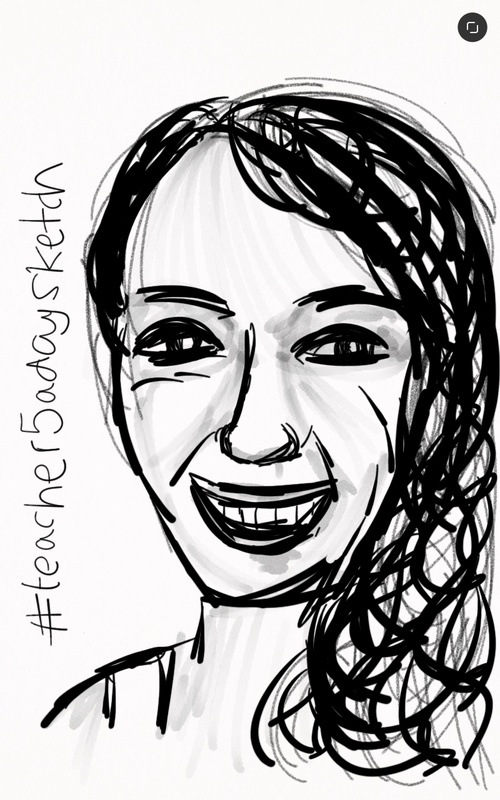
Today’s prompt got me thinking about use of technology and continuing advantages of pencil and paper methods, even with the leaps and bounds in computing. I like to think of myself as being fairly computer-literate, but I found the sketch today a real challenge – I did it on my tablet, using the Bamboo Paper app. It’s supposed to be a self-portrait from my Twitter picture, but I’ll hold my hands up now and say it’s really not the best thing I’ve ever done. I think my limited skills are somewhat better when drawing on actual paper than trying to do the same thing virtually.
Technology is great in the classroom – a few examples I can think of include my mini-webcam, which I use to photograph and display pupils’ work, my interactive whiteboard and the maths tools on Promethean Studio, which are great for demonstrating constructions, and the growth of excellent revision sites like Hegarty Maths and YouTube tutorials, which mean that pupils can access a teacher’s help outside of lessons. Then there’s the fact that I can communicate with and get teaching ideas from the community of maths teachers on Twitter, via Staffrm and the TES resources section – it’s much easier to share resources now that I imagine it was twenty years ago.
Despite all this, I still use the “normal” whiteboard in my classroom every day. I tend to create a PowerPoint/Flipchart for most lessons I teach, but these are very basic and used to scaffold the sequence of activities for the lesson. While there are some beautifully designed electronic resources out there, I steer away from anything that’s very step-by-step, because I feel like it interrupts the flow of the lesson – it becomes more about me delivering a lecture than responding to what pupils are saying or thinking. Most of the time, I pre-write any examples I’m going to use, so I can choose them carefully to sequence what I want pupils to discover, but I don’t pre-write solutions – that’s done by hand, either annotating on top of an electronic resource or on the standard whiteboard I have by my electronic version.
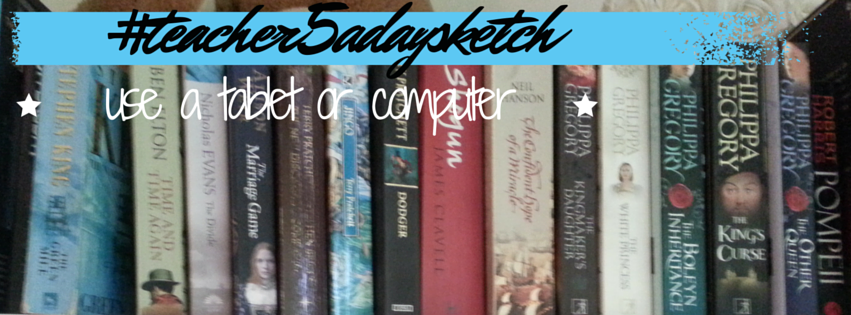
I’m the same with books – a couple of years ago, a friend gave me his old Kindle with over a hundred books already loaded on. I’ve picked it up once and really didn’t get on with it – I found the experience of not being able to turn the pages of the book really offputting. Since then, I must have bought and read another thirty-odd paper books, all of which require storage space (see small selection in header photo!). The advantages of electronic books are apparent, but I still can’t quite take that part of my life completely online either. It’ll be interesting to see how technology and education develop together in the future, but I’m still convinced that some learning has to stay rooted in a physical environment.
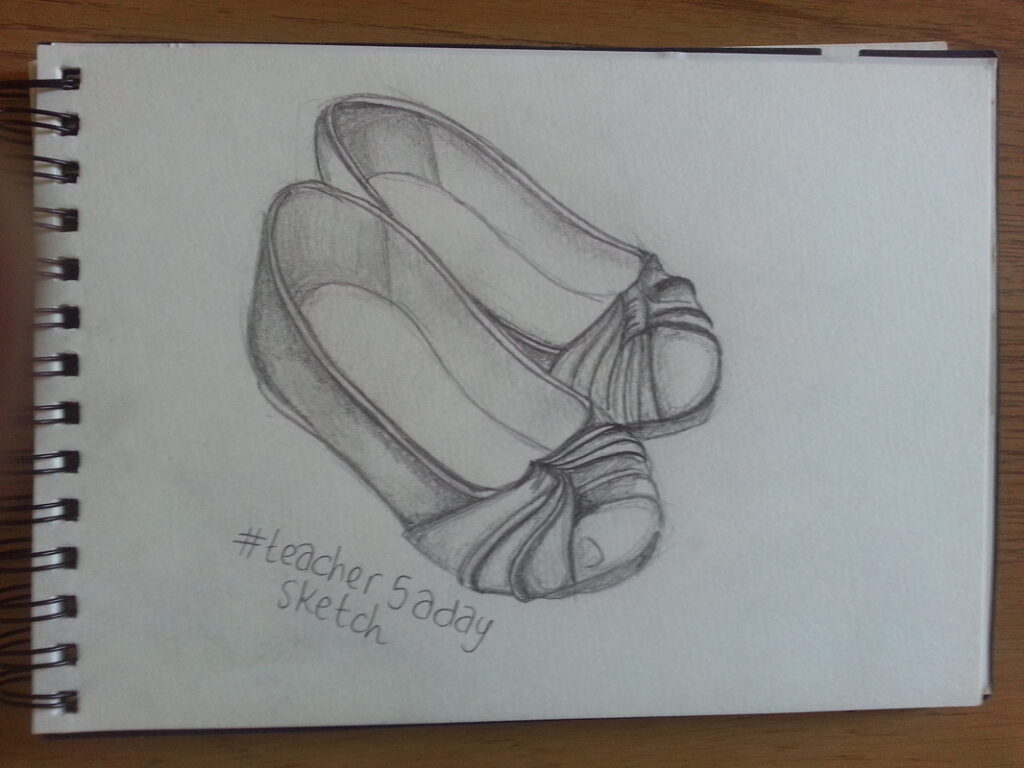
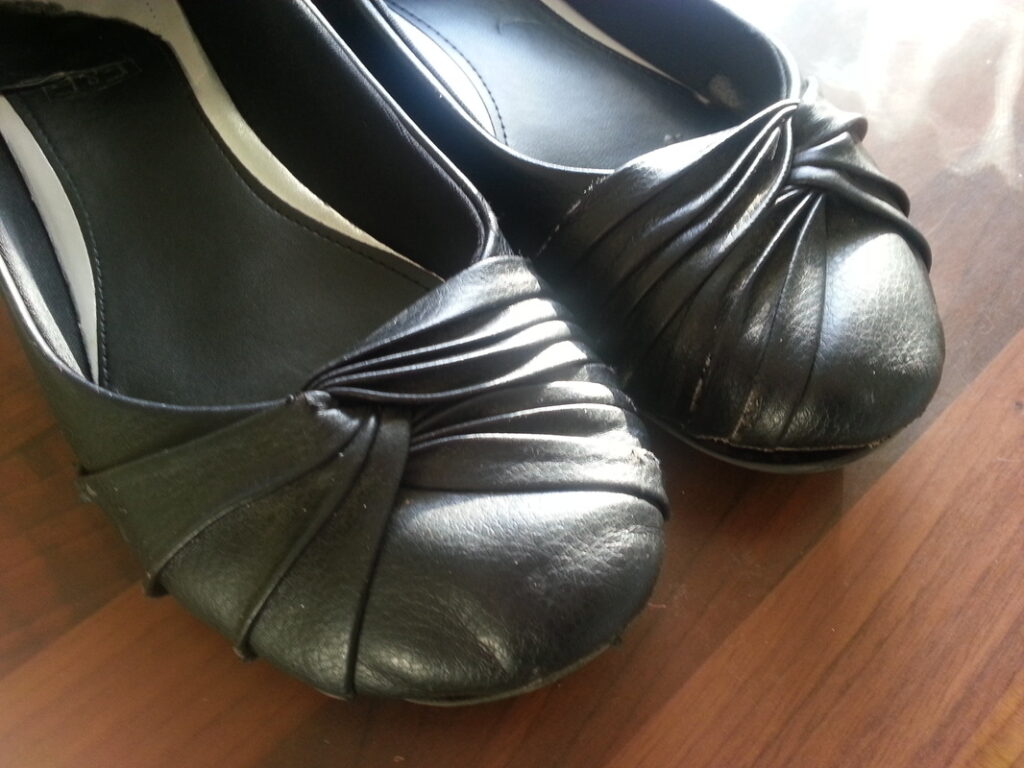
So today’s prompt is “sketch your favourite pair of school shoes”. This was pretty easy, as I only have one pair. I can’t stand wearing heels at school, so flats are my go-to. They are a little boring, but very comfortable – let’s save the giraffe-esque sandals for the weekend, eh?
Here’s a picture of the actual shoes. Pretty happy with my amazing skillz here!
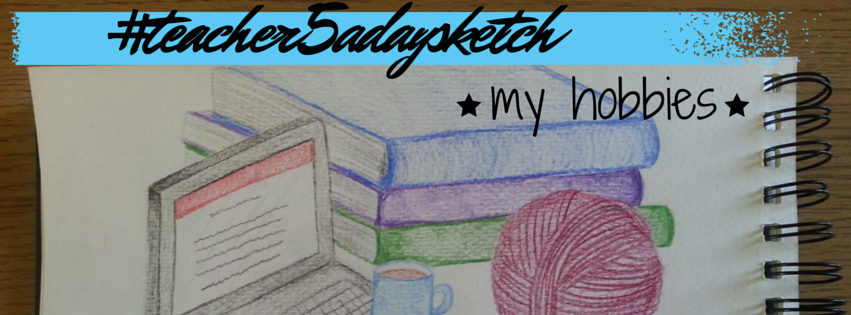
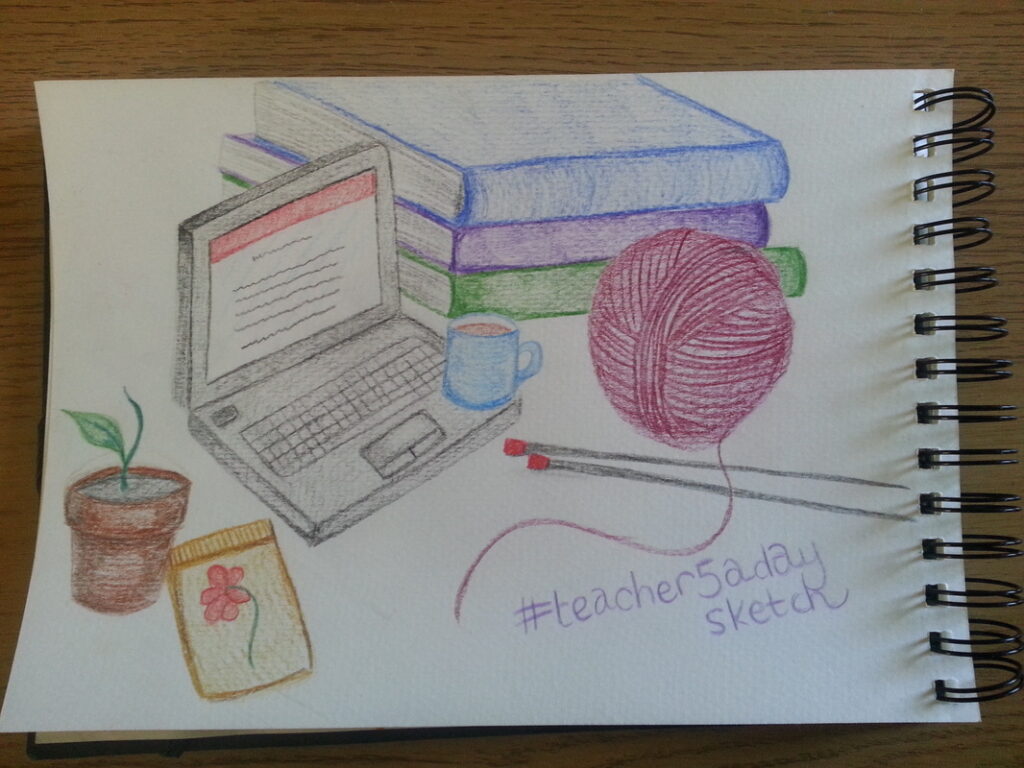
As half term is an opportunity to relax, I thought I’d do something different this week – having seen the #teacher5adaysketch challenge on Twitter, I cracked out my sketchbook and pencils to draw “my hobby”.First though, a few caveats:
I don’t have one hobby; I am very very bad at doing lots of different things for a bit, then putting them down and trying something else. There were lots of things I could have illustrated here, but I decided to go for the longest enduring ones.
I haven’t done much drawing since Art GCSE (although I do other crafty things), so you’re not going to get the Mona Lisa in any of these posts.
I cheated a little bit with this one and started it last night while watching the Baftas – but I did just finish it this morning, so it still counts!
I chose to draw:
My laptop, which represents both blogging and gaming. I’ve enjoyed computer games since I was really young – I grew up without a television, but I was the first person in my class to have a home PC, so as a family,we got our entertainment by playing games together. I have really fond memories of playing Myst and Riven over Christmas with my dad, and working together to figure out all the complicated puzzles. Blogging is fairly new to me – I set up my website in 2012, but only started blogging properly last year, and it’s both addictive and a fantastic form of reflection.
A ball of wool and knitting needles. My nan taught me to knit when I was about six or seven, and I’ve progressed from making scarves to (just about) being able to follow a pattern, and I can now knit without looking, which is fab when you’re trying to watch a movie at the same time.
A pile of books. The aforementioned lack of TV when I was a child meant that I got a lot of my stories from books instead. I absolutely love reading, and my book collection drives my husband mad – but I do re-read an awful lot of them, and the idea of taking any of my books to the charity shop really upsets me! I do read quite a bit of adult fiction, but my favourites are still things like the Harry Potter series (which I re-read at least once a year), Phillip Pullman’s His Dark Materials, The Hunger Games and (recently) the Divergent series. I also like reading maths books, because I’m a massive geek.
Gardening. If you’d told me five years ago that I’d actually enjoy weeding, mowing the lawn and growing things, I’d have thought you insane. However, it’s insidiously crept up on me, and this time of year I’m getting excited about starting off some new seedlings ready for planting out when the frost’s over (May perhaps?!).
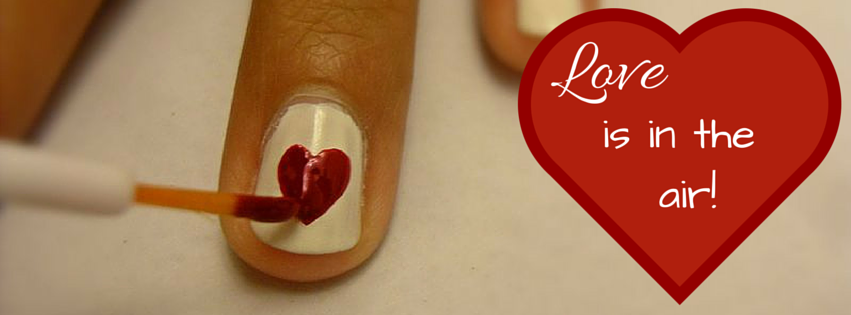
When I was younger, I was ridiculously cynical about Valentine’s Day – I’d wonder why people needed one special day to tell or show their significant other how much they love them, when surely that should be happening all the time. However, as I’m often working late into the evenings (I get in at 4pm but usually do 2-3 hours at home in the evening), sometimes I find my husband’s come in at 5 and I’ve not even acknowledged him, because I’m so engrossed in school-work. It’s very easy to neglect to remind the people who are important to you just how important they are – family and friends as well as significant others.So today’s post is just a quick reminder to myself that I need to get better at doing that, and remind myself that I’m not just a teacher.
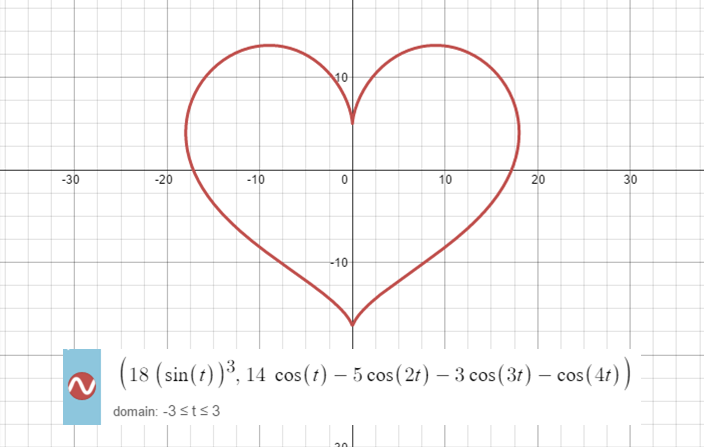
I’ve also discovered how to use Desmos to graph parametric equations, and produced this pretty heart graph:
It’s quite fun changing the coefficients to see how this affects the heart shape, with a nice link to transformations of graphs – I’ll have to remember this for my A Level group for next year.
Happy Valentine’s Day!
P.S. As it’s half term, I’m going to give #teacher5adaysketch a go – so next week’s blogs are mostly going to be my poor attempts at drawing! (Image credit: By Farrah Zakir – Own work, CC BY-SA 4.0, https://commons.wikimedia.org/w/index.php?curid=46011611)
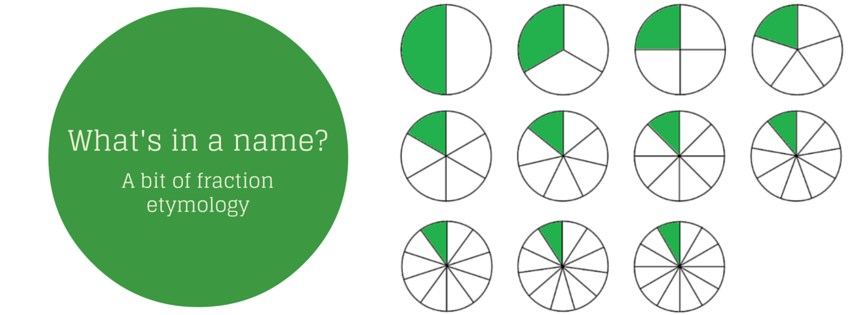
The etymology of mathematics absolutely fascinates me. The English language is remarkably irregular, but mathematical language is so close to the original Latin and Greek roots that it really can be broken down into constituent parts to derive meanings.
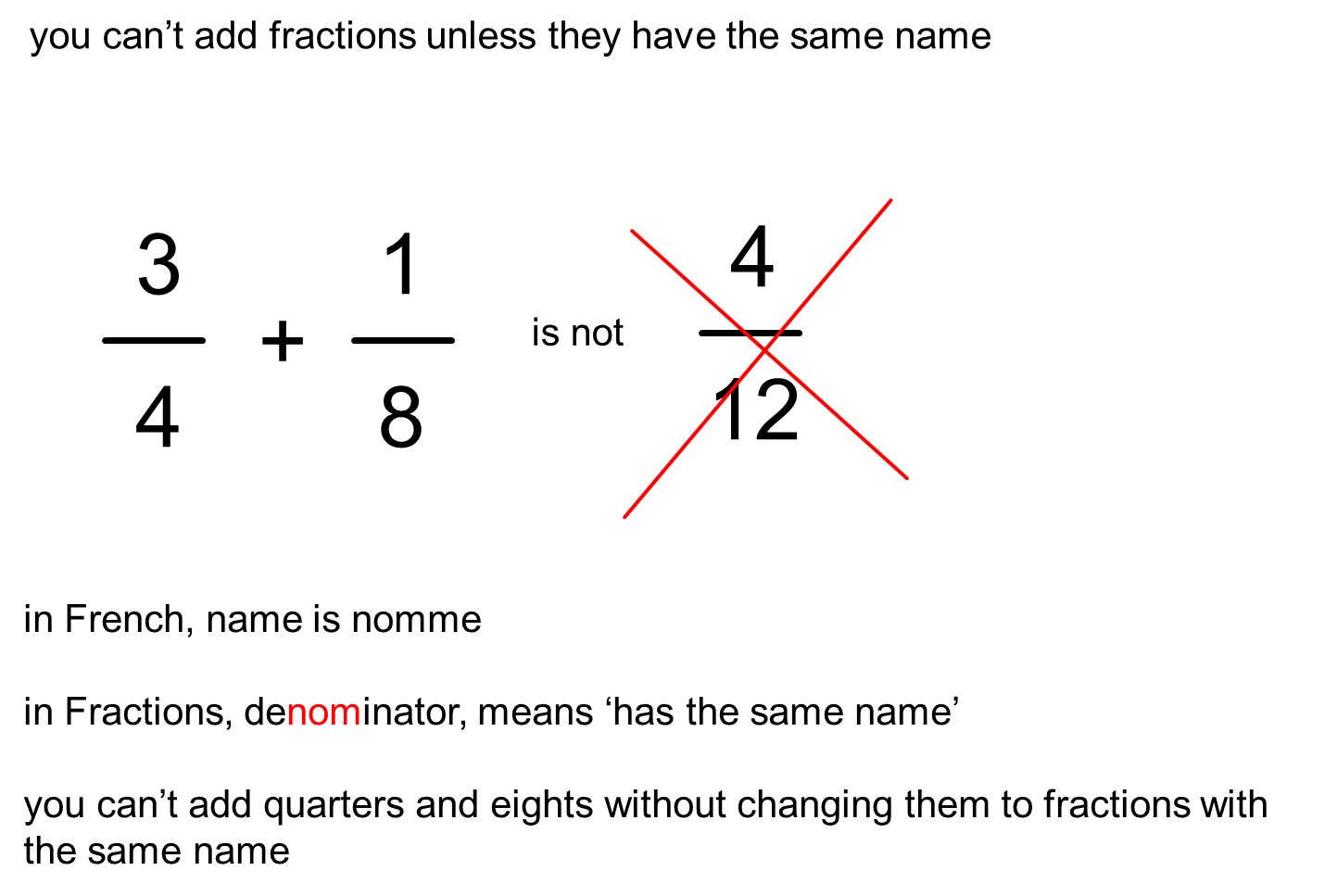
Therefore, I really enjoyed a post from Don Steward earlier this year, pointing out that the word “denominator” contains part of the French word “nomme”, meaning “name”. As even Year 7 are used to writing this on the front of their French exercise books, it served as a useful reminder of exactly what a denominator is – it’s the name or type of fraction. The 3 in 2/3 denotes that these fractions are called thirds, and we’re splitting into three bits.
It’s always surprised me just how resistant people are to writing division as a fraction. Historically, we’ve had fractions for much longer than our base 10 number system, and even the Egyptians (see Math Like an Egyptian), who used hieroglyphs rather than numbers, represented a fraction by writing the numerator (in their case, 1) above the denominator. This continued in Sanskrit practice during the first millenium AD, developing to fractions with denominators that weren’t 1, and dealing with mixed numbers – Sanskrit mathematicians would have written the fraction 4 1/2 as 4 1 2 in a vertical line.
Arabian mathematicians added the line in between the numerator and denominator (called a vinculum) a little later on, and this practice then spread to Medieval Europe along with the Arabian numeral system that we use today.
Conversely, the obelus (÷) – the division symbol that all primary pupils will be used to – didn’t appear until a book written in 1659 by a German mathematician called Johann Rahn, which was subsequently translated into English by John Pell. Up until that point, mathematicians were using a variety of symbols to represent division, including an open bracket or a colon (now used exclusively for ratio notation). The obelus was, confusingly, also being used to represent subtraction in some parts of Northern Europe.
Although there’s an argument that the two representations have their places in mathematics (perhaps 1 divided by 3 as 1 over 3 implies that you want the exact answer of one third, whereas writing 1 ÷ 3 expects the recurring decimal answer 0.333…), I’d wonder if the increasingly frequent use of computers will render both forms of notation redundant, and whether, in a few years’ time, if we’ll all be writing 1/3 instead… You might also want to check out this post from Matthew Compher, which looks at misconceptions that can arise from over-reliance on the obelus.
I had no idea what to blog about today. I spent all morning cleaning out my garage, just sat down to start writing and was clean out of inspiration. Therefore, I thought I’d plump for one of my go-to activities when there’s five minutes to kill at the end of the lesson.
I do this with a pack of number cards, marked from 1 to 34 (enough for my largest classes that way). Give each pupil a card, give them a minute and they have to tell you something interesting about that number. I let them decide what’s interesting – it can be that it’s someone’s birthdate or the number of pets they have, or it can be a mathematical fact.
So here’s seven interesting facts about the number seven:
1. It’s the lowest natural (counting) number that can’t be written as the sum of three square numbers. If you want to write 7 as a sum of squares, you have to use four: 1² + 1² + 1² + 2². Incidentally, Lagrange’s Four Square Theorem is a great way to practice square calculations without doing reams of textbook questions.
2. It’s a lucky prime, which, as far as I can fathom, is a completely useless but quite interesting property.
3. There are seven heavenly virtues and seven deadly sins. The deadly sins give us Se7en, horrible to type but the title of an excellent film starring Brad Pitt and one of my all-time faves, Kevin Spacey – watch it, it’s good.
4. The number seven is considered mystical or magical, and is religiously and culturally significant. In Christianity, the world was made in seven days. There were seven wonders of the Ancient World, historically it was believed there were only seven seas, and there are seven continents that make up the world. The Pythagoreans loved the number 7 because it combined the numbers 3 and 4, which, in representing the triangle and square, were hugely significant to their ideas about numerology.
5. The number seven is also considered lucky – it’s the jackpot on most slot machines. It’s theorised that this is to do with both its links to the mystical, and also because seven is the most likely number to be rolled on a pair of six-sided dice (there’s 6/36 = 1/6 chance).
6. There’s quite an interesting theory that short term and working memory can successfully hold and work with around seven items at the same time – see Miller’s Law and this article from Psychology Today.
7. When people are asked to think of a single digit, the most frequently picked is 7. According to Alex Bellos (Alex Through the Looking Glass), this is because all the other numbers (evens, multiples of 3, 0, 1 and 5) all feel rather unspontaneous. (Image credit: Botanischer Volkspark Blankenfelde-Pankow by Sebastian Wallroth – Own work, CC BY 3.0, commons.wikimedia.org/w/index….)
Tonight’s #mathschat is about New (School) Year’s Resolutions. I wrote a post back at the start of my summer blog challenge (I’ve just checked – it was in fact post number 1!) in which I wrote some targets for the new school year. Put the two together and I thought it would be time for a short, self-congratulatory blog to say WELL DONE ME for not mucking up yet.
I really need to keep my classroom tidy. I’ve drawn a wandering minstrel straw this year and am spending a bit of time in other people’s classrooms while I’m kicked out of mine. All my equipment is therefore in a big plastic box with a lid, and I count it in and out. I still have all the pens, rulers and pencils I started the year with! I’m also using folders to store paper resources which hang out on my desk – I’m thinking of getting a box or something for them. I haven’t lost anything yet, which is a drastic improvement on last year.
I need to get better at staying on top of my marking. RAG123 has turned me into a marking machine. With the exception of my top set 10s, who fill about eight pages a lesson, I’m RAG123ing each book after every single lesson, and it’s streamlining my planning massively. There is a blog coming, but I just tried to take photos of books and the light is awful, so that will have to be done at a non-dark sort of time, possibly tomorrow.
I need to think carefully about the balance between curriculum delivery and enrichment. A move to some mixed ability this year has meant that differentiation has been essential to make lessons run smoothly. I needed plenty of stuff to stretch the top ends of my groups, so I’ve been plundering Median for little problems and activities which I’m printing four-to-a-page and dishing out like sweets to those hungry for a challenge (it’s most of them!). I taught exponentials in context this week, and did simultaneous equations using French wine last week.
I need to reteach myself Further Maths over the summer. Yeah, I didn’t actually do this, but I’m being really good and doing all the exercises a few days before I teach each topic. We started with complex numbers so I remembered most of that. I even have a folder and plastic wallets!
1, 2 and 3 are all going to get more blog space later this year; I’ve had such a calm and organised start to this year, it’s almost feeling spooky, and I think that these three factors are having a major influence. But yeah… I need to get on with 4 for tomorrow now…
I was intending not to blog tonight, and was in the process of shutting down my laptop when I found the offending article via Twitter. Unfortunately I got so incensed by it that I had to forgo sleep to rant.
If you read my blog a lot, you’ll know I don’t do a lot of ranting and politics – I think the Internet can be a dangerous place to start an argument. This isn’t a personal attack against the journalist who wrote the article, but I think putting stuff like this in newspapers is really really damaging for both child and adult numeracy.
So…
If you are baffled by algebra and perplexed by long division, chances are you SUCK at maths.
Well that’s got me from the start – I managed to get a bachelor’s degree without doing any long division – I’ll freely admit to not understanding how it worked until I had to teach it, and even now I avoid it like the plague. Oops, I SUCK, please don’t tell my students.
On a serious note, if you’re going to ramp up the maths anxiety at the start of an article, why not pick the two things that people generally don’t get in school maths (and arguably aren’t particularly relevant to adult life or functional numeracy anyway).
1. You can only do your times tables if you say them out loud.
Me again. However, given that children learn their times tables in Japan in exactly this way (here’s a link to information about rhyming Kuku that primary children use, but it’s also mentioned in Alex Bellos and a variety of other sources) and Japanese children score pretty highly in global maths rankings, maybe they’re on to something. Presumably there’s a reason we’ve got kids to chant their tables since the dawn of time…
2. Recipes are so confusing. So how many ounces in a pound or what is 2/3 of a table spoon?! Let’s just get a take away.
If you’re getting put off by estimating 2/3 of a tablespoon (the handle?), working out the takeaway bill might prove tricky. And let’s not forget that nearly every recipe (unless you’re looking in your Grandma’s Mrs Beeton book) is written in grams, we have electronic weighing scales and we now work on the metric system.
4. If you can’t add it up on your fingers you have to use a calculator.
One professional mathematician (who I can’t source now, but will do when it’s not really late at night) freely admitted to being bad at adding up numbers.
7. You don’t know whether 23.9% APR interest on your credit card is good or bad.
Tip for life – credit cards usually don’t give stuff away for a steal.
8. Filling out tax forms gives you a panic attack.
Universally applicable to anyone who isn’t an accountant.
10. You got ten minutes into A Beautiful Mind before switching off because…numbers.
And you missed watching Paul Bettany being generally amazing for most of the movie and this (mathematically not wholly accurate but still) great scene about how economics is like dating. Oh, and the soundtrack. And it’s not even about maths, it’s about mental illness. But never mind.
11. When people talk maths they may as well be talking in an alien language.
Not an everyday occurrence, even in my social circles. Life isn’t the Big Bang Theory.
13. For all you know you are paying way too much for your electricity because you have no idea what all the numbers on your bill mean.
Ooops, me again! Of course, we’re assuming that the amount the electricity company is charging is linked in any way to your usage rather than an estimated reading you get a refund for in a few months…
16. You will never get a mortgage because it is all too confusing.
Yes. Yes it is. That’s why mortgage advisors exist. See also comment about tax.
18. You have no idea what a logarithm is. But you can spell it. Because while numbers are your enemy, words are your friends.
I understand that this is a cutesy, clickbaiting list a la Buzzfeed; I know it’s tongue-in-cheek and not meant to be taken seriously. This this THIS is what made me so cross. Putting the words “numbers are your enemy” in a pretty large national newspaper should really not be OK! Let’s not forget that adult numeracy in the UK has actually got worse, lots of people, both children and adults, really dislike or are actually scared of maths. As a teacher, it’s my job to try and work against that, to try and show people that maths actually isn’t the horrible monster under the bed that some people assume it is, and it is so difficult when you’re battling against a tide of anti-maths phrases and sentiment all the time.
We’ve discussed use of the phrase “I’m bad at maths” or “I could never do maths” at school – if pupils hear it coming from adults, that somehow makes it more acceptable. When I meet people for the first time and have the usual life/job chat, some people fall over themselves to tell me how much they hated maths, or were bad at it, or only got a grade D, as if I’m going to say “oh well done you!”. This cultural norm of it being “cool” to be bad at maths or to say that you hate maths probably has something to do with the falling numeracy levels, the fact that very few pupils take maths post-GCSE and also the association that “only geeks enjoy maths”.
Maths is everywhere – it forms the building blocks of our universe, world, home and electronic devices. Rather than sticking our heads in the sand and saying we don’t like it or SUCK at it, why don’t we start doing something about it?
Last year, I solemnly vowed that I wasn’t going to use textbooks in my maths lessons. I started the year with a variety of card sorts and problem-solving activities. I even arranged my tables in groups rather than rows from the word go to encourage collaboration. The first few weeks went well, but by half term I was exhausted and the novelty of Tarsia puzzles and Standards matching cards was wearing off for the pupils.
I spent the second half-term really unwell – I ruptured my eardrum and went deaf for a week and a half, then spent three weeks with the most painful sinuses I’ve ever experienced. I dragged myself to the Christmas holidays in a very sorry state. I don’t think this was anything to do with the brave new classroom I was foolishly attempting to create, but I realised that if I wanted to remain functional enough to be in school, I’d have to be a little “easier” on myself in terms of lesson planning.
I really felt a little guilty getting the textbooks back out of the cupboard in November, because I feel like “textbook” is a dirty word in mathematics teaching for some people. There’s an implicit idea that a teacher who uses a textbook is somehow lazier or less pedagogically secure than a teacher who doesn’t, and I guess this is why I went off half-cocked on my “textbook ban”.
Over the last twelve months, though, something has shifted in my mind with regards to my teaching practice. Maybe it’s ever-increasing experience, or maybe it’s because I’ve played around with so many different ideas and pedagogical theories, but I’m now much more comfortable in doing what I know works for me and the pupils in front of me. I quickly realised that my idea of working purely with physical resources and no textbooks wasn’t something that I thought was a good idea, it was what I thought I should be doing – I’m not sure where I got this notion from, as we don’t have any kind of policy in our school about the use or otherwise of textbooks.
The school I worked at in my NQT year didn’t have class sets of textbooks; this was both freeing and really, really scary, as I spent a lot of time sourcing resources from elsewhere. While I felt like it challenged me to look for other options than a textbook (I discovered a dusty set of cuisenaire rods in the storeroom and had a lot of fun with them), our photocopying budget was astronomical. As a department, we spent a lot of time doing the old-fashioned cut-and-stick to splice together worksheets from a variety of old books and sources** – this had the advantage of creating a worksheet that did exactly what we wanted for that lesson, but meant that each lesson took an extra 15 minutes to resource.
At one point in the year, someone suggested getting round this problem by printing booklets of 10 Ticks worksheets by level and hard-binding them…
Even in the “textbook ban” lessons last year, pupils still worked on problems in their books. I’d get them to record their working and answers for the Tarsia puzzles we were doing, and I’d still put problems or questions on the board for them to do. After I ditched the stupid idea that every lesson could be a card sort, I went back to carefully selected worksheets and (as the year went on) picked problems out of the textbook.
I suppose that’s the real problem with textbooks – they never do exactly what you want them to. We may as well bin the “teaching” and “examples” steps in them – I’m yet to see a decent UK GCSE textbook that pupils could actually use to teach themselves maths with any depth of understanding. In fact, if we ripped all those bits out, it would make the flipping things much easier to carry around and give out!
What I really want out of a textbook (and I haven’t found it yet) is a set of practice exercises that are chosen and written really really super-carefully. Some textbooks are completely illogical, with thirty easy problems, then a few “hard” ones at the end, which have usually been made more difficult by putting negatives or fractions in, rather than by actually increasing the difficulty or level of thought into the topic actually being learned.
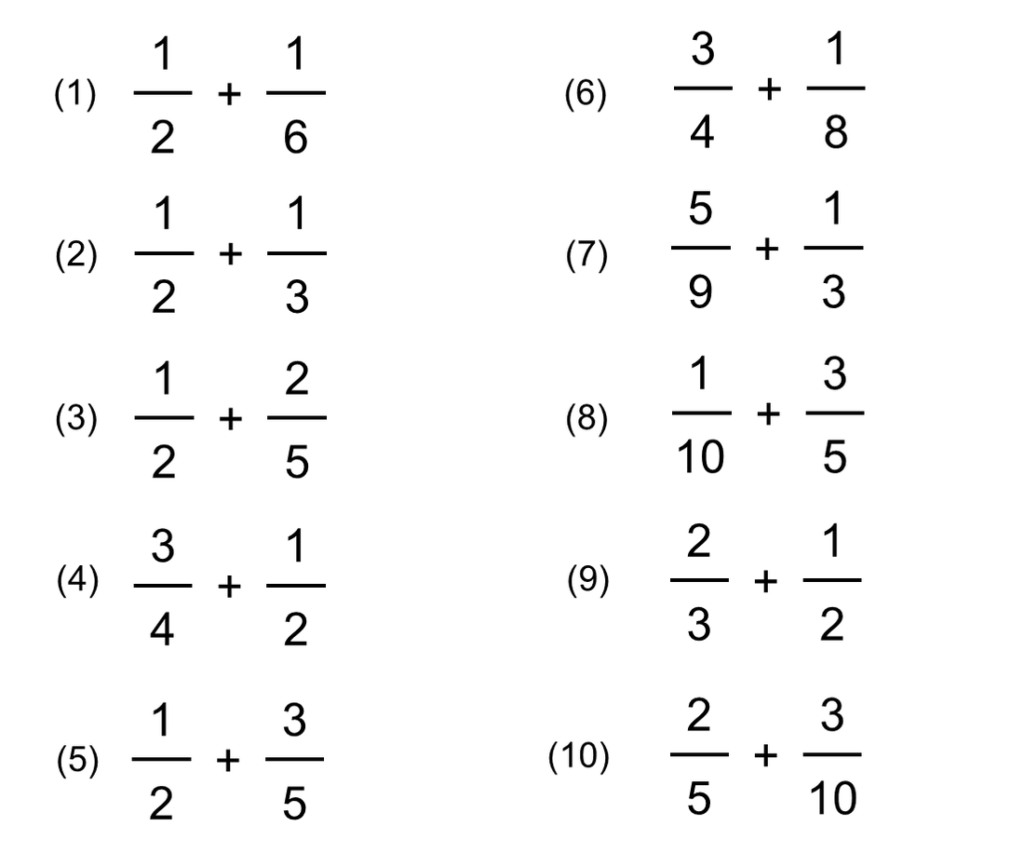
The reason all this waffle happened today is because I had a major faff trying to source some suitable adding fractions questions for my Year 9s. We’ve been working with bar modelling, and spent nearly a week playing with Which is bigger, so I wanted ones with sensible denominators. I also wanted to avoid them using “THE METHOD” to get a common denominator, namely multiplying the two denominators given, and actually engage their brains to think if there was a smaller common denominator first. Both sets of GCSE textbooks, even the Foundation book, gave two worked examples using the cross-multiply method, then within two questions pupils were expected to work with a common denominator of 24, which is all well and good for those who can work with equivalent fractions, but awful for the ones who can only do it using a bar at the moment.
See, now this is what I’m talking about! Sensible denominators, with most one as a simple multiple of the other – encouraging pupils to pick a sensible LCD rather than cross-multiplying (those who didn’t had a lot of cancelling down to do).
I really like how improper fractions crop up as early as question 4 – they shouldn’t be treated as somehow “more difficult” just because the fraction happens to have a total over one whole.
I guess if there’s any conclusion to this piece of brain dumping, it’s that UK textbooks need to be better. We replaced ours a few years ago, and I wasn’t hugely impressed with what was out there – it always feels like selecting an “it’ll do” rather than “oh wow this will really improve my classroom practice”.
The second part of the conclusion is that, even in their not-perfect form, there’s still room for a textbook in the maths classroom. Some exercises are great. Some are passable if you carefully select questions. Sometimes you need to remember that book A is brilliant for topic B, but you may as well ignore it for topic C.
This year’s policy is a healthy mix – we’ve done problems together, worked examples, worksheets, problem-solving, different approaches, modelling and yes, I even got the textbooks out for one lesson last week. It would be really nice to have the perfect book; unfortunately, as that doesn’t exist, I’ll make do and mend…
** EDIT: I feel I need to add a clarification here following a comment on Twitter about copyright theft – the books were used as sources of information and (in some cases) syllabus guides when they were up to date. Questions came from licensed material and sites such as the TES or worksheet generator websites.
We use cookies to optimize our website and our service.
Functional
Always active
The technical storage or access is strictly necessary for the legitimate purpose of enabling the use of a specific service explicitly requested by the subscriber or user, or for the sole purpose of carrying out the transmission of a communication over an electronic communications network.
Preferences
The technical storage or access is necessary for the legitimate purpose of storing preferences that are not requested by the subscriber or user.
Statistics
The technical storage or access that is used exclusively for statistical purposes.The technical storage or access that is used exclusively for anonymous statistical purposes. Without a subpoena, voluntary compliance on the part of your Internet Service Provider, or additional records from a third party, information stored or retrieved for this purpose alone cannot usually be used to identify you.
Marketing
The technical storage or access is required to create user profiles to send advertising, or to track the user on a website or across several websites for similar marketing purposes.