#teacher5adaysketch – Use a tablet or computer
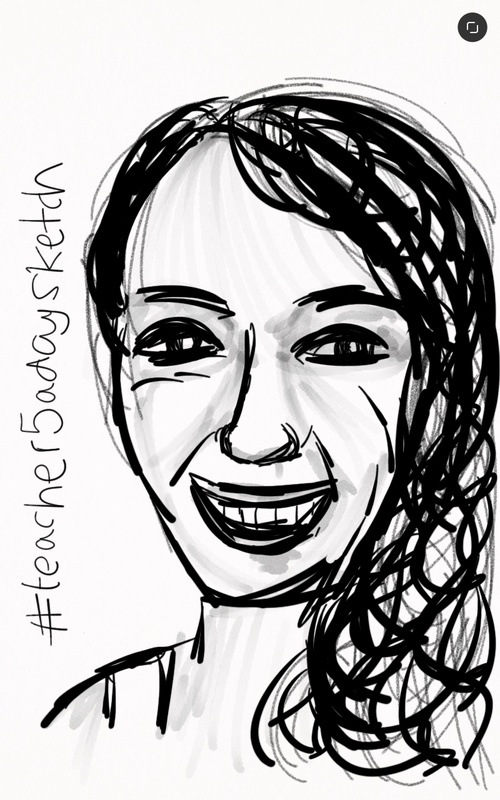
Today’s prompt got me thinking about use of technology and continuing advantages of pencil and paper methods, even with the leaps and bounds in computing. I like to think of myself as being fairly computer-literate, but I found the sketch today a real challenge – I did it on my tablet, using the Bamboo Paper app. It’s supposed to be a self-portrait from my Twitter picture, but I’ll hold my hands up now and say it’s really not the best thing I’ve ever done. I think my limited skills are somewhat better when drawing on actual paper than trying to do the same thing virtually.
Technology is great in the classroom – a few examples I can think of include my mini-webcam, which I use to photograph and display pupils’ work, my interactive whiteboard and the maths tools on Promethean Studio, which are great for demonstrating constructions, and the growth of excellent revision sites like Hegarty Maths and YouTube tutorials, which mean that pupils can access a teacher’s help outside of lessons. Then there’s the fact that I can communicate with and get teaching ideas from the community of maths teachers on Twitter, via Staffrm and the TES resources section – it’s much easier to share resources now that I imagine it was twenty years ago.
Despite all this, I still use the “normal” whiteboard in my classroom every day. I tend to create a PowerPoint/Flipchart for most lessons I teach, but these are very basic and used to scaffold the sequence of activities for the lesson. While there are some beautifully designed electronic resources out there, I steer away from anything that’s very step-by-step, because I feel like it interrupts the flow of the lesson – it becomes more about me delivering a lecture than responding to what pupils are saying or thinking. Most of the time, I pre-write any examples I’m going to use, so I can choose them carefully to sequence what I want pupils to discover, but I don’t pre-write solutions – that’s done by hand, either annotating on top of an electronic resource or on the standard whiteboard I have by my electronic version.
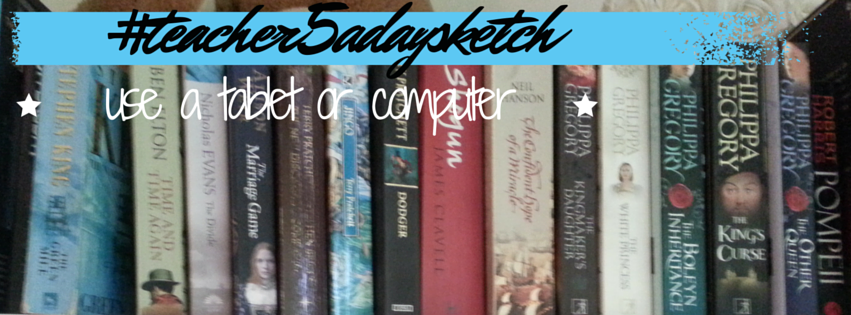
I’m the same with books – a couple of years ago, a friend gave me his old Kindle with over a hundred books already loaded on. I’ve picked it up once and really didn’t get on with it – I found the experience of not being able to turn the pages of the book really offputting. Since then, I must have bought and read another thirty-odd paper books, all of which require storage space (see small selection in header photo!). The advantages of electronic books are apparent, but I still can’t quite take that part of my life completely online either.
It’ll be interesting to see how technology and education develop together in the future, but I’m still convinced that some learning has to stay rooted in a physical environment.
#teacher5adaysketch – Use a tablet or computer Read More »