mastery

Lessons learned – writing a scheme of work
I’ve spent a large chunk of my time over the last 18 months writing a scheme of work for Key Stage 3. I wrote a blog in June about our experiences of a year of mastery teaching and it’s a theme I’ll come back to in later posts over the summer, as the endless (M)astery debate is getting a lot of air time at the moment. As a side note, it’s worth reading Charlie Stripp’s blog posts and Andrew Blair’s responses for views from both sides of the table.

I decided that today’s post for the SBPC (Summer Blog Post Challenge – read here) should be about that journey, and the pitfalls I’ve met along the way. For a much more in-depth chronicle of writing a scheme, I suggest checking out Craig Barton’s 19 part series – it takes a while to read, but has some great tips and ideas if you’re in the same position I was a few months ago.


Step 1 – Assess starting point

This was really easy for me – our starting point was nearly nothing. For a bit of context, the department had been using the New Maths Frameworking books for quite a while, and the scheme was pretty much “follow the textbooks”, with a bit of supplementary NRich material thrown in. The assessments weren’t really working for the pupils, and many of them felt that we were moving on far too quickly and nothing was sticking – evidenced by the fact that pupils were sometimes scoring 3 or 4 out of 50 on the half-termly tests, despite having superficially “got it” after one lesson.

However, even when starting a scheme from scratch, I was wary of throwing out the baby with the bathwater. We already had a good deal of stuff that worked, and I wanted to keep that in our new scheme.


Step 2A – Plan an approach

One of the fundamental things to change in our new scheme was the amount of time spent on topics. I started to think about the way I teach GCSE, which is to pick up a strand and follow that – for example, I usually teach linear sequences, followed by graphs, then into solving equations, which helps pupils to build the links between topics.

I started writing a thematic curriculum along these lines, with the idea that each year group would follow a certain “theme” each turn. So, for example, the Year 7 themes were:

  • Looking for patterns – Sequences, basic algebra, graphs, substitution
  • Planning a Christmas party – Written and mental calculations, ratio, rounding, measurements
  • The power of 10 – Place value, metric and imperial (because they were still in the curriculum then), multiplying and dividing by powers of 10.
  • The farmer’s field – Perimeter and area of squares, rectangles and composite shapes, mental calculation methods, unit conversion.
  • The average Year 7 – Basic data handling cycle.
  • Maths and Art – Shape and angle properties, transformations, 2D and 3D shapes.

I then broke it down further into single objectives for that unit – so the first unit in Year 7 consisted of:

Skills

  • Generate sequences from term-to-term or nth term rule.
  • Find nth term of a sequence.
  • Recognise arithmetic/geometric sequences.
  • Conventional notation for priority of operations, including brackets and powers.
  • (Informally) Use integer powers and associated real roots.
  • Use algebraic notation; understand that algebraic notation follows same convention (order of operations).
  • Understand concept of expressions, equations, terms.
  • Substitute into algebraic formulae.
  •  Work with coordinates.
  • Graphs of linear functions.
  • Interpret relationships algebraically and graphically.
  • Calculate gradients and y-intercepts graphically.
  • Link in ratio notation and discussion of proportion.
  • Direct proportion and linear relationships.

Exploration

  • Mobile phone tariffs.
  • Speed, distance, time relationships.
  • Important sequences e.g. square numbers, cube numbers, Fibonacci.
  • Fermat’s Last Theorem.
  • Happy Numbers.

I’ll add now that this isn’t what we ended up doing, for reasons detailed below. With a year of mastery teaching behind me, I’m now looking back and wondering if even that list of things is a little ambitious for some Year 7s to achieve in a half term, particularly those who can’t accurately multiply and divide. 

I’d still like to make a thematic curriculum work, as I think it would be quite enjoyable to teach. Unfortunately, I just don’t have the time to reinvestigate at the moment, particularly with all the changes we’re adapting to across the board.


Step 2B – Throw it all out and start again

Writing a thematic scheme for five year groups over the summer last year may well have killed me. Fortunately, before I’d gone too far down that route, my HoD came back from a meeting with the bare bones of Trinity’s Mastery Pathway. At this stage in its development, there was little more than a rough outline of objectives and a baseline assessment, so it would still take a lot of work. You can read about the basic ideas behind it here.

We decided to take this on for three reasons:

  1. It agreed with a lot of our aims about teaching less content more slowly – this is what mastery is in my head, and this was a few months before it became the contentious buzzword it is now.
  2. It sorted out our issues with assessing without levels.
  3. The chunking of topics was similar to the thematic bits that I’d written, but the order was more sensible – for example, starting off with basic number skills if pupils haven’t already mastered those. It’s difficult to teach algebraic fluency if numerical fluency isn’t already there.

Step 3 – Resourcing the scheme

Because (at that stage) we had very little to go on, and schemes of work were being written over the course of the year, I decided that I’d need to do a lot of work on the bare bones to turn it into something that the department could use.  

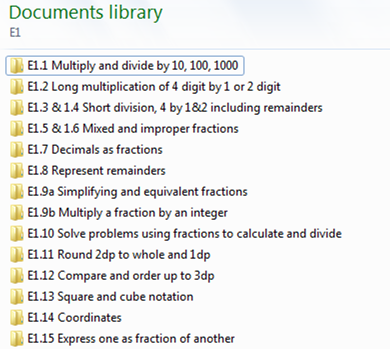
The first thing I did was collate all of the existing resources and categorise them by study step. Both the resources on our school system and my resources were in an absolute mess, with things randomly saved everywhere. Although this was probably the most time-consuming part of the project, it’s saved me countless hours over the course of this year, because I can just click on the step I’m currently teaching and find all the resources I’ve got saved.

I’m hoping to get a similar system up and running properly on my site this year to make it easier to share resources with other schools working on the Mastery Pathway.

Step 4 – Writing the flippin’ stuff

Once I’d got all the resources in place, I started trying to put together a working document to serve as our scheme. I was unsure how to make this work – I started with a document with several columns for each objective and began hyperlinking resources. This quickly got very unwieldy, as I wanted to include a description of each resource as I put it in.

I then decided to move away from having one document to writing a scheme, then objective plans. I’ll talk more about why this hasn’t worked in the next bit…The issue of time planning was further complicated by the fact that we have many split classes in Key Stage 3, so I had to try and split topics between teachers – so for example, one teacher would deliver the number content for that step, while the other delivered the algebra or shape. This didn’t work either…

I’ll add that doing both of these things took absolutely forever, and I really don’t recommend it.

It’s not all doom and gloom – the stuff I wrote has been used this year, and we’ve found it useful to be able to navigate quickly to appropriate resources.


Step 5 – Adopt, Adapt and Improve

Over the course of this academic year, I started properly developing the “Resources” section of my site, and found that I was duplicating an awful lot of my efforts. When I found new resources to add, I either wasn’t at school (so unable to access the objective plans easily), or didn’t have the time to muck around hyperlinking and adding a description. It was much easier to just plonk resources in the appropriate step folder, both for myself and for colleagues.

The scheme we have is now working well, but the management and improvement of it is not. It’s too much of a time-sink to keep on top of managing (by a rough count) approximately 200 separate documents and maintaining all the links, particularly when I’m doing a lot of that on my site already!

I’m currently playing around with ideas for how I’ll do this, and try to balance sharing my stuff with everyone, while also keeping our department’s work a priority. There’s another site section in development for all of this, and I’ve already reworked four step plans. There will be lots more blogging along these lines in my blog-post-a-day summer challenge!

Lessons learned – writing a scheme of work Read More »
A year of Mastery

Reflections on a year of teaching the Mastery pathway (mastery mathematics) at Key Stage 3.

Inspired by this evening’s #mathschat “How do you develop mastery from Year 7? What’s first for a new cohort”, and feeling slightly restricted by the 140 character limit in a tweet, I thought I’d take some time to write a post about my department’s journey this year using a mastery curriculum model.

1. A bit of history

We previously used a traditional “spiral” curriculum, based on the Collins Frameworking Books. I’ll make no secret that I really loathe them – I appreciate how difficult it is to write a good textbook for Key Stage 3, and I think they were one of the best out there, but I felt that my first couple of years of teaching were very bitty. The rough scheme was three chapters per half term, then a test. Most pupils scored fairly low on these, and we moved on without any time to really address what had gone wrong, other than a lesson of “going over the test”. 

In June/July last year, I started writing a new scheme of work for Key Stage 3 to support the new curriculum. About halfway through this endeavor, we partnered up with a local Maths Hub, who had written their own mastery curriculum (the Mastery Pathway). My first drafts looked very similar to their pathway, so I (sadly) binned what I’d been working on, and we adapted their model from September this year.

2. Starting off
We decided to dive in the deep end, and start all of Year 7, 8 and 9 on the scheme as given. This meant that each year group started with a baseline test on the “Elementary” section of the pathway, which begins with simple multiplication, division, place value and fractions. We assumed that our Year 8s and 9s would be able to do this easily and could progress quickly through the steps, and that we’d only be starting from scratch with Year 7; we were wrong about the former.

When I analysed the test results of my Year 9s (set 3, working at around old NC level 5/6 “apparently”), I was surprised at the number of basic things they got wrong. Some of them didn’t have a reliable way to multiply or divide large numbers, and their understanding of fractions seemed to be based on trying to follow methods that they’d obviously only half-understood the first time round. Most of them scored around 30 – 40% on the first section of topics.

Now, I’m not saying that they’d never learned these things. I’m willing to bet that, when they arrived in Year 7, they were fairly competent with basic number work due to drilling for SATs. Unfortunately, with the idea that outstanding progress means ploughing through the curriculum at a rate of knots, we’d spent two years teaching them new topic after new topic, without really giving them any time to cement what they already knew. I’m willing to bet that whoever taught them in Year 7 and Year 8 covered adding and subtracting fractions with them in both years (as I know I did with my groups in the previous years), but they still couldn’t actually do it a couple of weeks later, let alone nearly a year later. Three pupils in the group readily confessed to not even knowing their times tables properly. 

For our Year 7 cohort, we had carte blanche; they didn’t know any different, and we’d usually start off with cementing basics in the first term. However it was a big gamble going right back to square one with Years 8 and 9 – what if the mastery model didn’t work, and we ended up with two cohorts way behind where they “should” be, particularly with the added challenge of the new GCSE content to cover? However, when we looked critically at the content in the Elementary stages of the Mastery Pathway, we decided that spending time on these would mean they could access a fair chunk of the number side of the new GCSE syllabus, and we could fix all the extra bits in Years 10 and 11.

3. Using assessment to drive planning
After issuing the baseline tests, we spent a few long, boring hours entering all the data into a spreadsheet. Although this was time-consuming, it was incredibly useful in terms of deciding where to start. We shared this data with pupils in the form of tracker sheets; each unit is broken down into about 10 or 12 closely linked objectives, and we indicated if they had already “mastered” (i.e. scored more than 75%) on those topics. The pupils could clearly see what they could already do, and, more importantly, where we’d be going over then next few weeks.

Every single group in each year started off on the first unit. With the exception of a handful of pupils in top sets, none of them had sufficiently mastered whole number calculations and simple fractions work. This was a real eye-opener for me as a teacher – I’d always assumed I was doing a pretty good job. Whenever I did my progress checks at the end of a lesson, the pupils demonstrated that they’d “learned” what I wanted them to, and that we could move on next lesson. I quickly realised that what I’d been doing was years of surface learning, which is why I spent two weeks this year reteaching ratio to a group of Year 11s, using almost the same material I’d used when teaching them in Year 8. 

4. Changing the teaching model
The pathway works on roughly 12 weeks per unit, which gives a week to cover each objective. This gave us plenty of time to address each one in great depth. Luckily, due to our involvement in the previous year with the NCETM’s Multiplicative Reasoning project, we had plenty of materials for enhancing understanding of fractions, and I’ve drawn very heavily on these ideas in my teaching this year. 

With Year 9, I spent a whole week’s worth of lessons doing “Which is bigger?” activities; I would have previously covered equivalent fractions in one lesson, then assumed they could do it. The adding and subtracting fractions context work took us three weeks, without even touching a “method” or any basic problems. We did lots of discussion, drawing of bar diagrams and really talking and thinking critically about what we were doing. “Why?” became my favourite question to ask, and pupils began naturally appending their answer with “…because…”. We spent a lesson drawing pictures to represent different division problems, with nary a “bus-stop method” in sight.

Once we’d learned something, we revisited it frequently. I actively looked for opportunities to connect more topics. For example, I’d previously never used fraction examples when working out the area of a rectangle, other than as a challenge activity for the “more able” – but why not? If pupils can multiply fractions and find the area of a rectangle, they should all be able to calculate a fractional area. 

We went back to basic practice starters, ignoring the received wisdom that this was an Ofsted no-no, as pupils weren’t “making progress” in the first ten minutes of the lesson. OK, I’ll accept that they weren’t making visible progress in terms of “oh look, they’ve learned this skill that they didn’t have five minutes ago”, but doing this has made a huge difference to their progress over time. 

I’ve stopped minding if we spend more time on a topic than I’d planned, or if lessons don’t fit nicely into a sixty-minute package. I’ve stopped worrying about “every pupil must make progress every lesson”, because unfortunately, all kids don’t fit a typical model. Some struggle for two or three lessons, then have a breakthrough, and that’s a natural part of learning.

5. Making assessment meaningful to pupils
To start with, we were working on the principle of testing roughly once every 12 weeks. We did our first unit test around Christmas; by this time, my Year 9s had already progressed onto the next unit of work, while some groups were still working on the first few objectives from the first unit. We quickly abandoned this idea for all future assessments, and have now started assessing as and when we feel our groups are ready.

The assessments contain a mixture of basic problems and deeper problem-solving questions. The idea is that pupils need to get over 75% to say they have “mastered” each unit, and that we don’t move on until everyone has passed.

After each assessment, we re-enter the data and give pupils another tracker sheet. If they’ve all passed the unit, we move on, with some targeted work in starters on topics they are still a little weak on. If they’ve not passed, we then re-teach either select topics or the entire unit. Something we’ve found incredibly useful is re-teaching for a couple of weeks, then returning the paper for pupils to re-attempt or correct. They have got used to aiming for 100%, and not just going “oh, I’ll never get this” and giving up on a particular topic.

I’ve used a bit of peer-tutoring to work on weaker topics, pairing up a pupil who has mastered that topic with one who is still unsure, for twenty minutes at the start of a lesson. We’ve experimented with targeted homeworks, and I’m keen to develop this further next year.

6. It’s not perfect…yet
We’ve had several stumbling blocks over the course of this year, and it hasn’t been easy. Because all year groups started off at the same place, I feel like I’ve been teaching fractions, multiplication, division and rounding for the whole year, and it’s got a little boring at times. Year 9 are now through the entire set of Elementary units, and I’m looking forward to getting into some more complicated algebra work with them before the end of this year.

We’re fiddling around with our setting for next year, and are going to experiment with mixing sets 3, 4 and 5 together. This is going to prove challenging in terms of supporting pupils who come to us at Level 3, and we’re looking at how we can provide additional lessons to catch them up to their peers.

Although it’s not perfect yet, and we’ve still got quite a way to go in making sure that every pupil is successful under our new curriculum model, I feel that it’s working much better than our previous spiral curriculum. Retention is much better; emphasising the importance of mastery with pupils means that we’re also thinking much more carefully about building in interleaved practice of old and new skills, ensuring that they don’t forget what they’ve already learned.

One of the biggest successes for me of this year is the change in how pupils talk about how they are doing in mathematics. At the start of the year, pupils were pestering me when they got their test results for a level: “Am I working at Level 6? Is this Level 7 work?”. Now, they are talking about the skills and objectives: “I know I can round to decimal places, but I need to do some more work on significant figures”. It will be interesting to see if this translates to improved independent learning when revising for GCSEs in a couple of years time.

A year of Mastery Read More »

Pick of Twitter 04/04/2015

Got a whole fortnight’s worth of stuff to fit into this post as Easter holidays mean I’ve had a little break from frequent Twitter checking! Here are my picks from the last two weeks:

Visual representations (@mrbuckton4maths)
A couple of really really nice visual representations for relative frequency and fraction multiplication. I love how the relative frequency one shows clear links to proportional reasoning.

https://twitter.com/mrbuckton4maths/status/582523945070522368
https://twitter.com/mrbuckton4maths/status/582652067614973952

Numeracy across the Curriculum (@dandesignthink)
A beautiful poster picking out key mathematical ideas in art and design. There appear to be more here but I can’t find a link to buy them yet!

A Very Good Maths Explanation (@hegartymaths)
A world of yes. I think this needs to be in a teacher training manual somewhere.

Graphing stories (@ictmagic)
Great resource for real-life graphs; link via Pinterest and there is a huge collection to pick from!

GCSE One Stop Shop (@MathedUp)
If you use the Kesh takeaways, this site is a must-visit; links to the topic booklets, a video link via YouTube, answers and diagnostic quizzes. 

My Views on Mastery (@Just_Maths)
Another interesting opinion piece about the current maths Mastery shenanigans.

Pick of Twitter 04/04/2015 Read More »

Pick of Twitter 21/03/15

Predictably, lots of the blog posts I’ve read this week have been about the third Maths Conference last Saturday. Having said that, it’s great to read other people’s perspectives and get an idea of what went on in all the workshops I didn’t attend. Here’s a few I’ve enjoyed:

  • @BodliUK ~ 3 Techniques You Should Know, Mastery Assessment and Tricks and Tips.
  • @DrBennison ~ Sticky Studying, Johnny Ball, Tricks and Tips.
  • @Just_Maths ~ Interesting thoughts about thinking critically about teaching techniques.
  • @naveenfrizvi ~ 3 Techniques, The Hows and Whys of how and why, Bar Modelling.
  • @mathsjem ~ First blog post about her Tricks and Tips session with all the notes.
  • @workedgechaos ~ Full summary of the day; his report on the Great Mastery Debate is really worth reading.

Some other goodies include:

And a few random bits:

  • @The_Geek_Club ~ Pythagoras cartoon.
  • @aap03102 ~ Surds magic square.
  • @sxpmaths ~ Brilliant way to learn and practise important integration techniques for C4.

Pick of Twitter 21/03/15 Read More »

What did you do for Pi Day this year?

6:45am: Alarm goes off. Contemplate turning it off and going back to sleep – it is a Saturday after all. Somehow remove myself from bed and into shower.

7:15am: Showered and eating breakfast. Dad decides to start an in-depth conversation about learning maths and nearly makes me late! I don’t get to see my parents too often so it was nice to pop down for the evening before – as they live in Wolverhampton it seemed like a no-brainer to start my journey from there rather than Leeds.

8:10am: Mum has made me tea in my flask <3 Get in the car and set off for Birmingham!

8:40am: Arrive at car park. Have no idea where to go until I spot three ladies with cake boxes. Rationalise that no-one else in their right mind would be walking around Birmingham at this ungodly hour on a Saturday morning with cake boxes, so follow them. Meet a lovely lady called Becky who is also lost, and a randomer from another conference who decides to tag along.

8:45am: Realise that ladies with cake boxes are going the wrong way. Consequently have walked all the way around the outside of Millenium Square car park before we are sensible enough to consult Google Maps.

9:00am: Finally on Aston University campus! Direct randomer in the direction of her conference, then head to our venue. Very exciting atmosphere as we enter the building but don’t have time to get a coffee as everyone is headed to the main lecture hall to kick off the day.

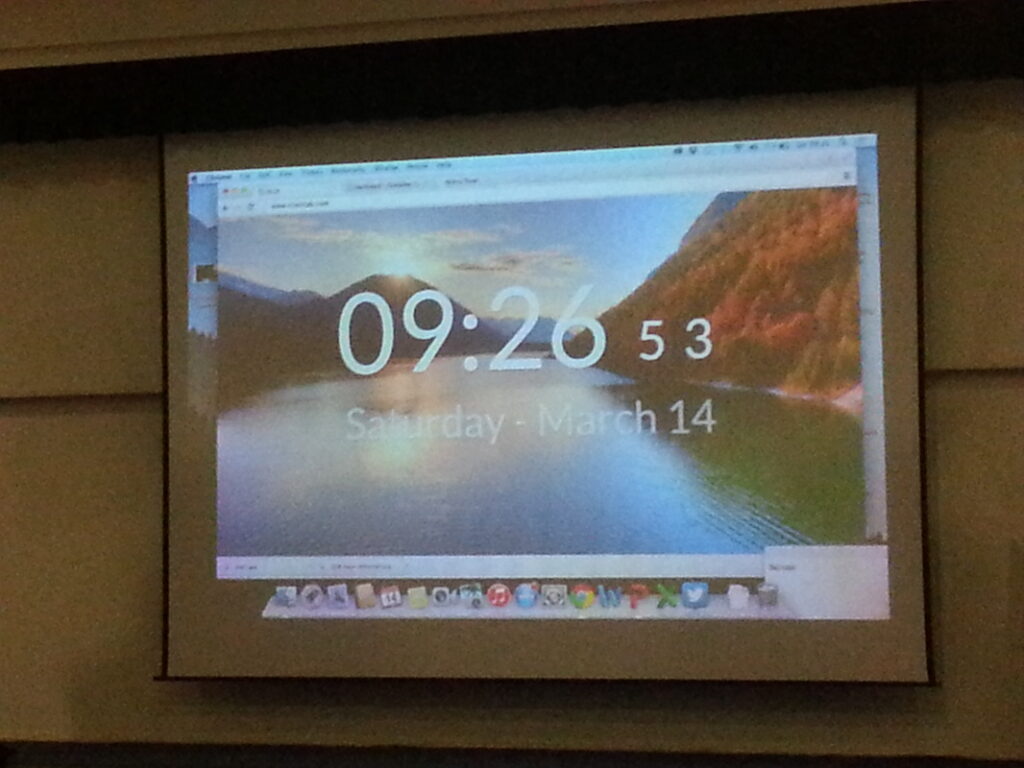
9:15am: Find seats with Becky and meet two of her friends. Lots of chat about all things maths-y and we’re all pretty excited by the Pi Day countdown clock! Get stressed as Internet is not working; finally get something and check out all the tweets so far.

9:25am: Lots of people getting ready with phones and cameras to take a picture of the iconic date/time!

9:26:53am: Conference starts bang on schedule with a countdown and round of applause. Kudos to Mark McCourt for impeccable timing!

9:30am: Andrew Taylor from AQA gives a nice brief history of problem solving in mathematics. Interesting points raised about how to assess problem solving; coursework vs. problem solving exams. Andrew mentions “90 Mathematics Problem Solving Questions” produced in collaboration with the University of Leeds, and I make a mental note to pick up a copy from the AQA stand later.

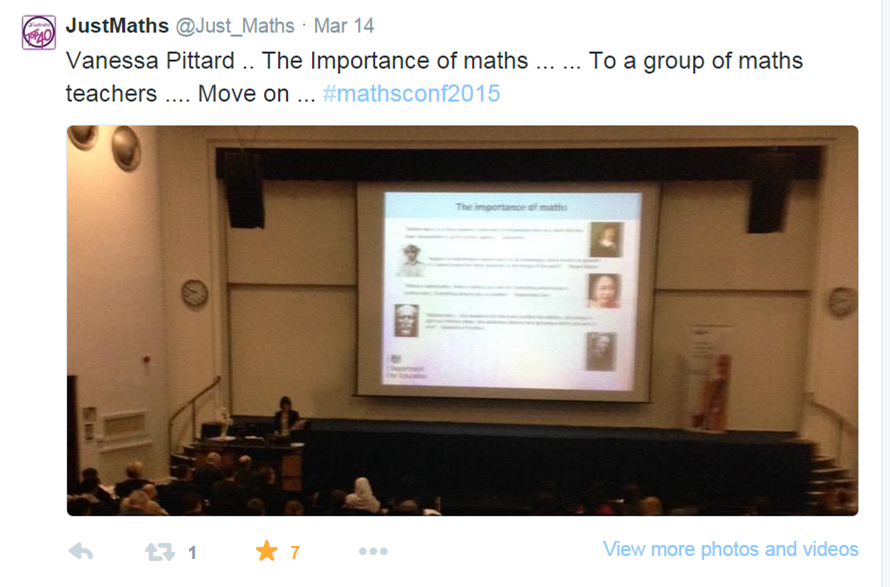
9:40am: Address from Dr Vanessa Pittard (DfE). Heard this before at Celebration of Maths about a month ago so zone out a bit and follow the alternative commentary on Twitter. 

As at CoM, I understand why it’s necessary to have an address from the DfE, but it was still a little soul-crushing to be told how rubbish we are again first thing on a Saturday morning.

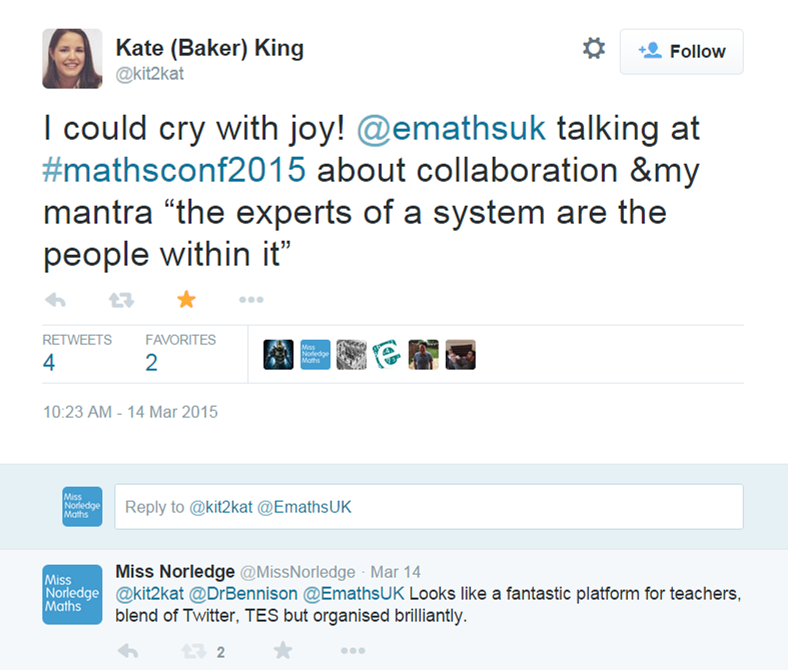
10:20am: Update from Mark McCourt on LaSalle Education’s work with Complete Maths. “Shanghai is not actually a country” gets cheers and applause; Mark points out that our top 50 schools outperform those of both Shanghai and Singapore, but that there’s an issue with coordinating a professional development network of 35 000 maths teachers . @kit2kat summarises it beautifully with this Twitter post:

Mark demonstrates Complete Mathematics and I make a note to myself to investigate it further.

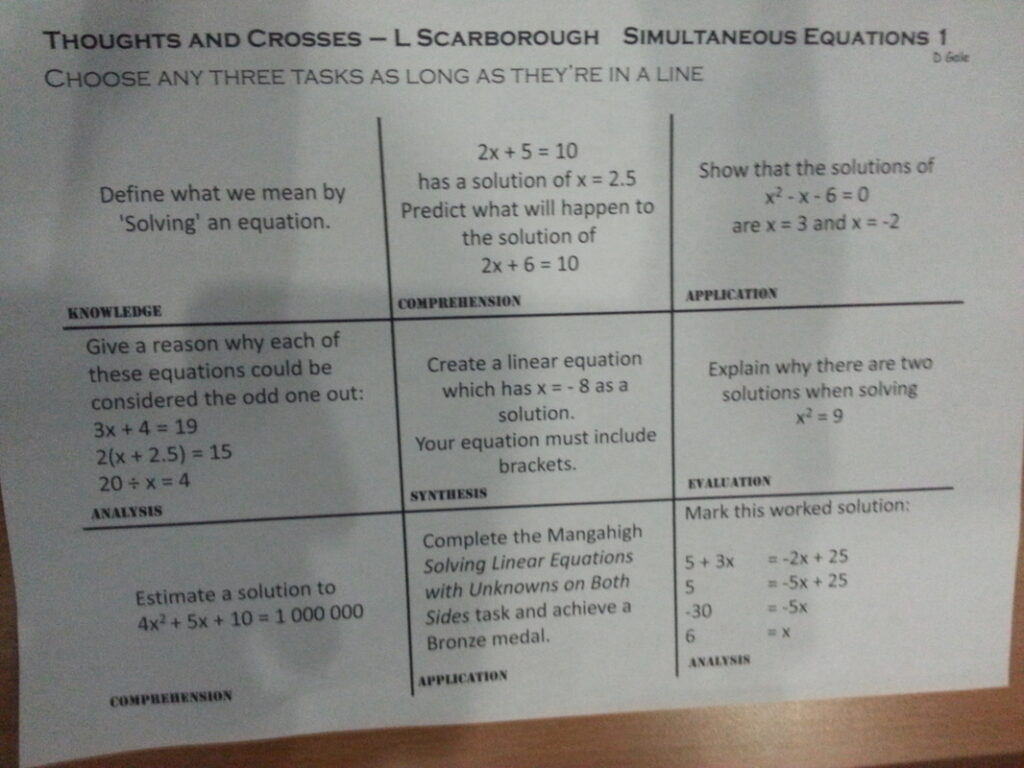
10:45am: Really enjoy my resource speed dating session! A great way to collaborate with colleagues. Pick up a nice way to incorporate lower and higher order thinking into lessons using Bloom’s Taxonomy (although might update it to SOLO taxonomy if I use it in the classroom) and a superb idea for making interactive test papers using Excel. Have brought my algebra tiles with me so share that with a few people.

https://www.tes.co.uk/teaching-resource/differentiation-tool–thoughts-and-crosses-6179959

11:00am: Break! Dash to the loo, grab a coffee and mingle. Barely have time to poke my nose into the exhibition centre, let alone start my treasure hunt, before it’s time for Workshop 1 with Andrew Thomas (AQA).

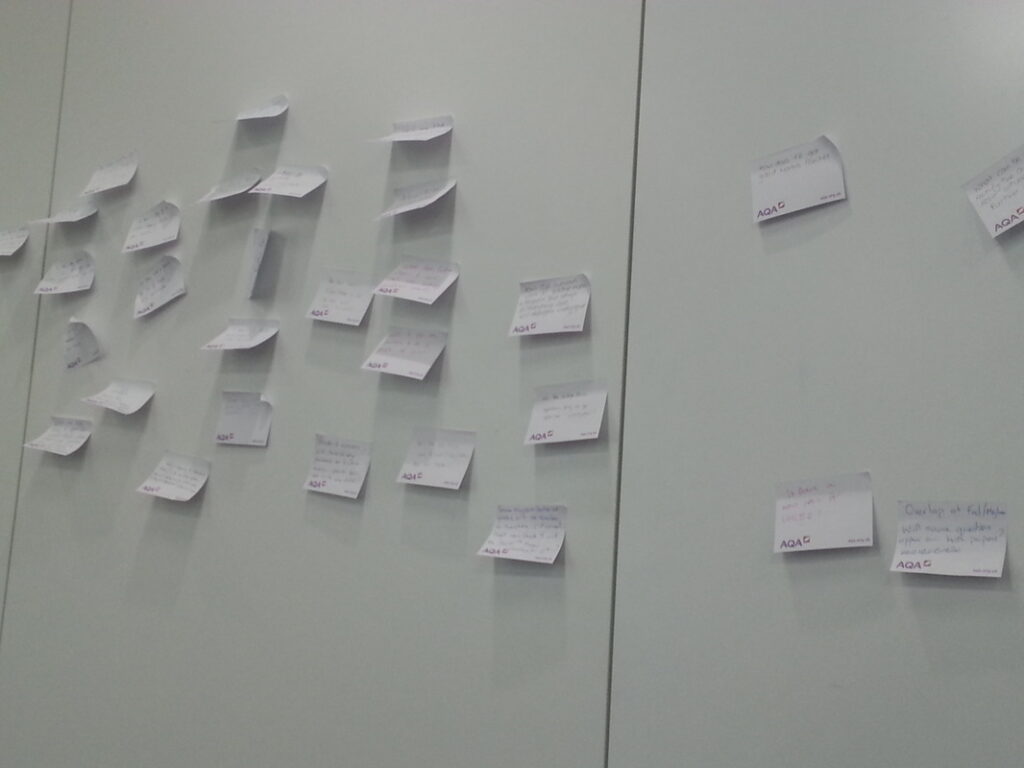
11:20am: Session starts with writing our questions for Andrew on Post-Its, who promises to answer as much as he can. We have lots to ask!

11:30am: First up: what’s going on with SAMs and accreditation? No major news yet; Andrew explains the research project and predicts results early May (!!!) so for my money, still no point making choices on exam boards yet. Interested to find out that research involves using PhD maths students as well as the 4000 Year 11 students I already knew about.

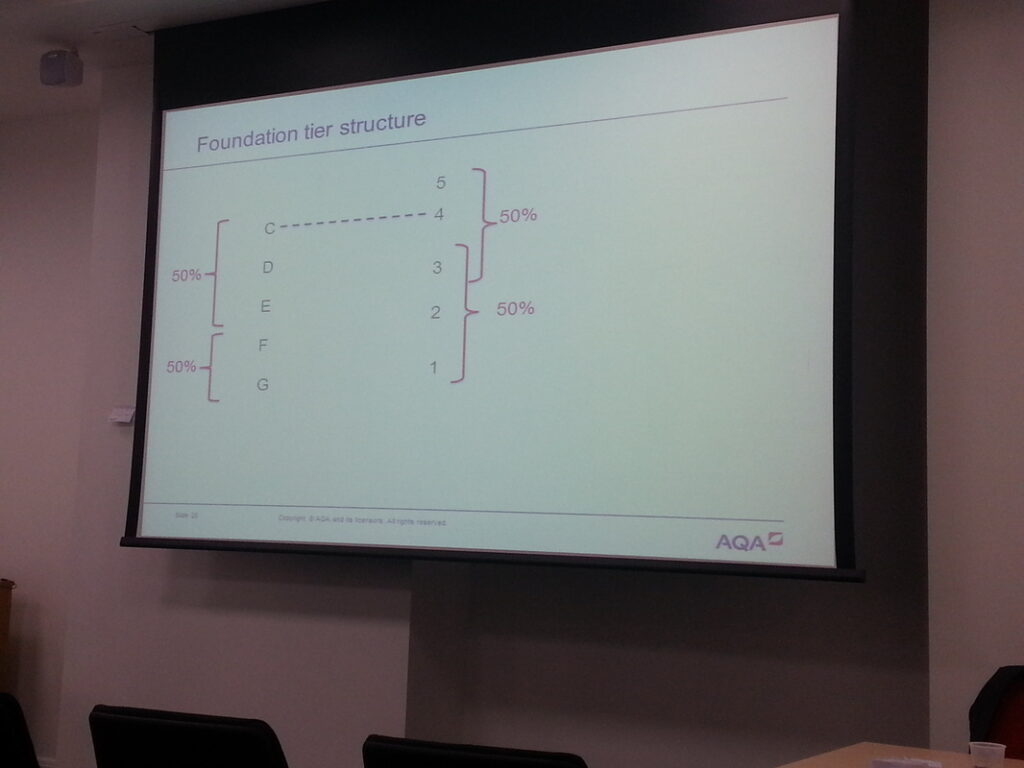
11:40am: What happens with grades and numbers? Nice diagram to explain the mess, and AQA tweet me another helpful one. 

Seeing it as a list rather than a bar scale helps me visualise the whole 1/3 2/3 thing around current grades C and B. Still no solution to what employers will do to compare; arguably not the problem of the exam boards! I predict a couple of years of chaos.

12:05pm: What’s happening with A Level? Andrew does an admirable job of finding all the bits that we kind of know, but basically it’s all still up in the air. 

12:15pm: When will all this change again? Laughs from the audience! Summarises how most of us feel at the moment. I don’t really want to start ranting, but the constant changes are a little difficult to keep up with. Although there wasn’t really anything I didn’t already mostly know about in this workshop, it was nice to hear views from other teachers and work out that everyone, (seemingly including the exam boards), is a bit peeved at the way this has been done.

12:20pm: Lunch! Wolf down a delicious salmon and dill sandwich before dashing round the exhibition. Have genius idea of photographing all the treasure hunt problems and working on them later (didn’t actually find time!). Pick up freebies, including a stack of useful stuff from AQA – and yes, I remember to get the 90 problems resource!

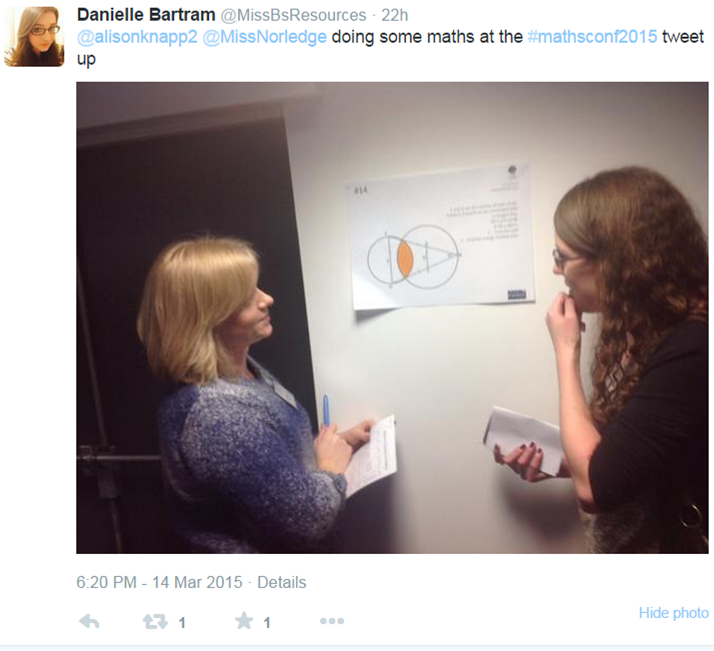
1:15pm: Hard sell from enthusiastic man at the Kumon stand makes me late for the Tweet-up! Rush along to find the room – easy to find by following the noise!

1:25pm: Lovely bit of networking and meeting colleagues. Have a little chat to @MissBsResources, who takes this great photo! Pleased with my “mathematical thinking face” here…

1:43pm: Ooops, late for Johnny Ball’s Life of Pi session! Do that awkward thing of walking into a full lecture theatre late with everyone looking at you and feel like I’m back at uni. Embarrassed! 

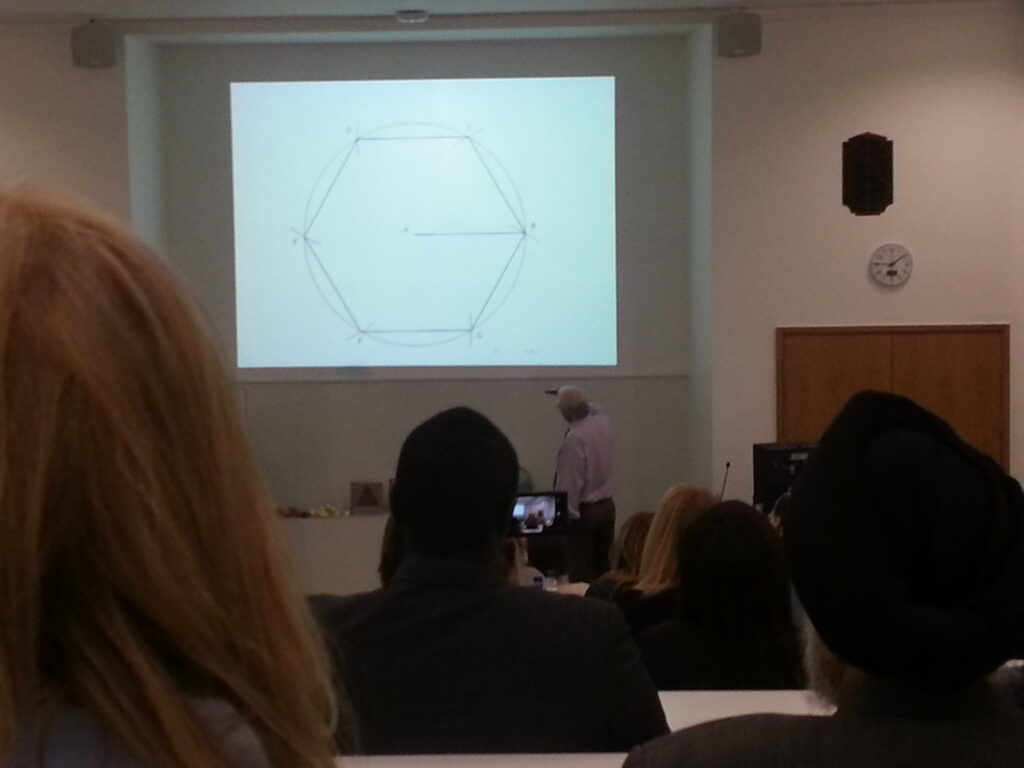
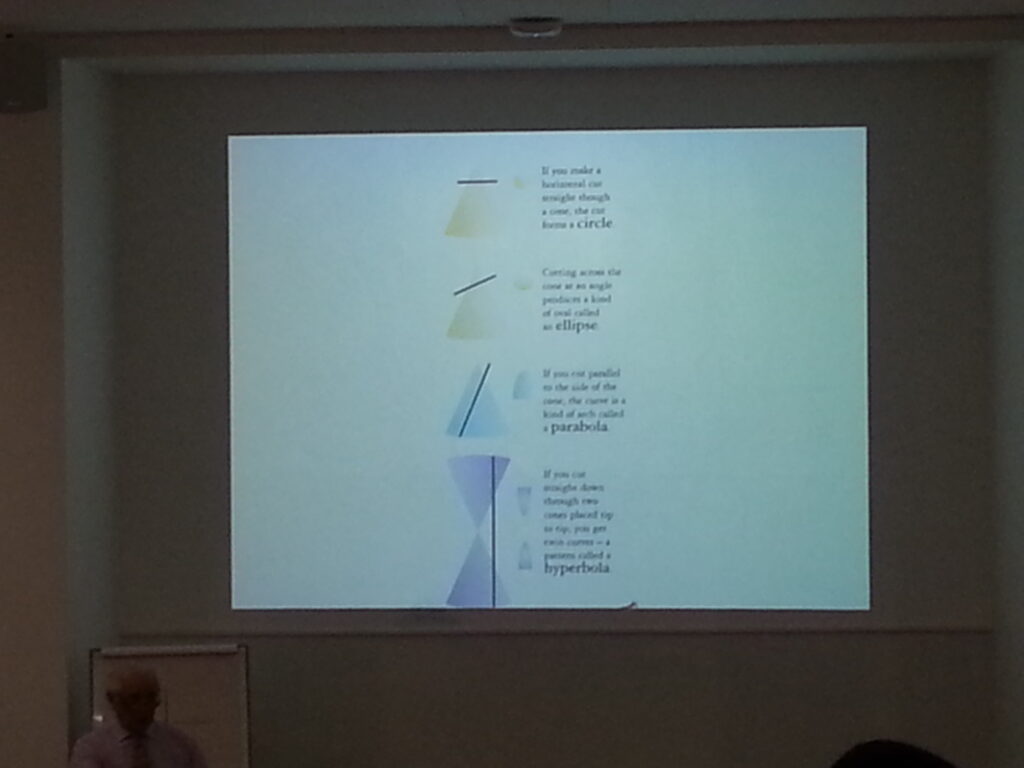
1:44pm: Johnny Ball’s session in full swing and I remember how much I love watching people who really care about maths giving lectures. Key points to investigate further:

Using a hexagon to approximate Pi in the style of Archimedes.
Conic sections and links to circles, ellipses, parabolas and hyperbolas.
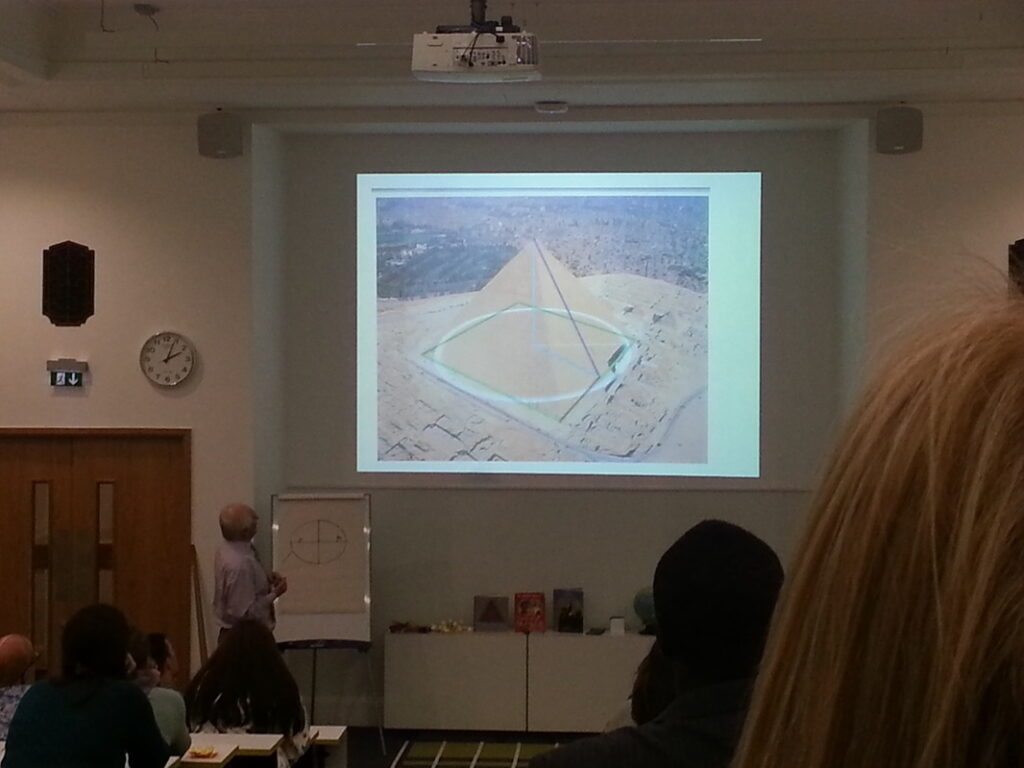
Triangles in the Pyramids
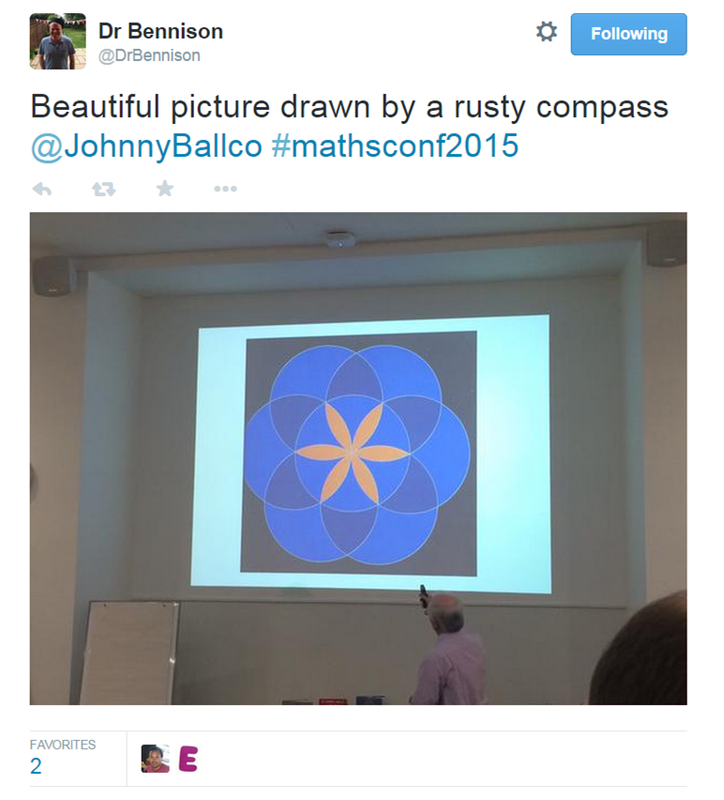
A great way to practise using a compass – how beautiful!
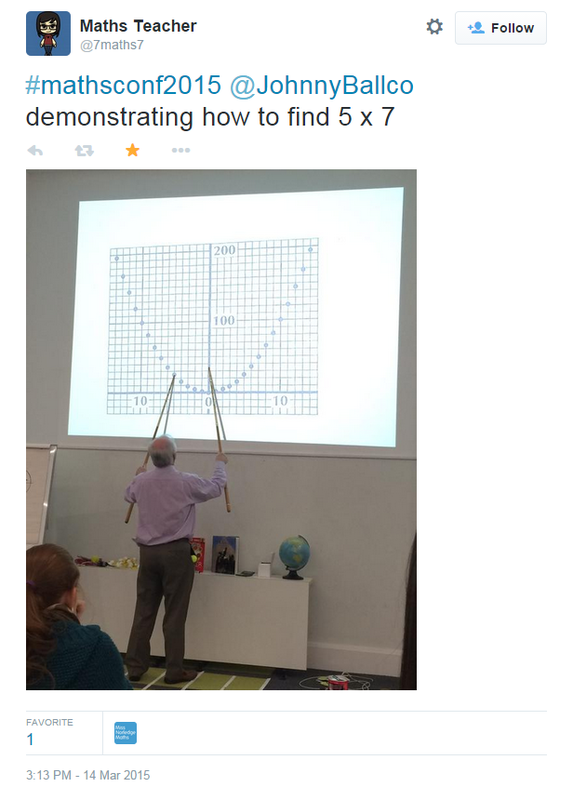
Using a parabola to multiply two numbers – the y-intercept gives the answer!
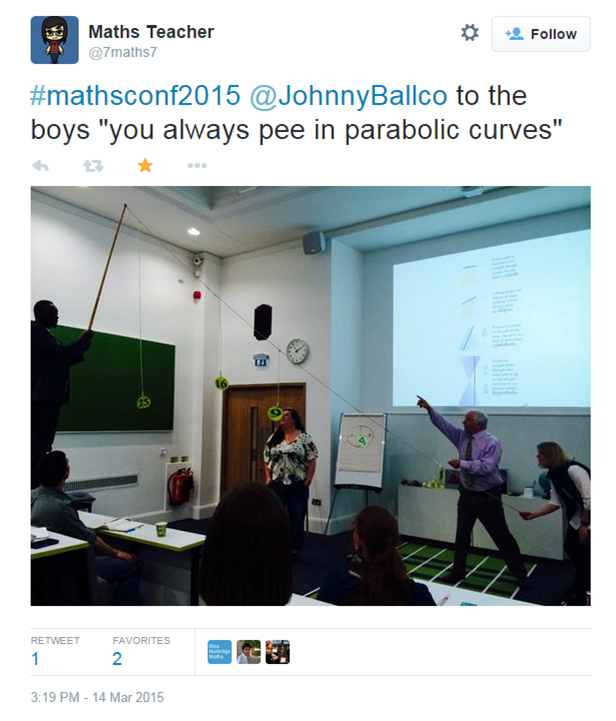
A superb way to demonstrate parabolic motion under gravity – although I may skip the peeing thing with teenagers in the room!

And my biggest takeaway from this session and the entire day – this:

2:40pm: Grab another cup of coffee and network a bit more. Contemplate doing my treasure hunt questions but decide that brain is not working well enough.

3:00pm: Workshop 3: The Great Mastery Debate quickly turns into “the Great Mastery Consensus”! Mark outlines the premise, then Alan, Amir and Bruno set out their stalls. I make a few notes (which I will probably turn into a proper blog post at some point).

3:05pm: Alan’s viewpoint

  • Different definitions of mastery learning.
  • We can teach “outstanding” lessons but pupils don’t retain learning.
  • There’s an infinite number of correct curricula – teach the kids what they don’t know!
  • Mastery isn’t a panacea – needs the right school culture.
  • Cumulative curriculum and good assessment important.

3:10pm: Amir’s viewpoint

  • Change pupils’ mindset of being against maths.
  • Richard Feynmann talks about maths as a toolkit to solve problems.
  • Mastery is the toolkit; get the skills right, then combine using contexts to solve problems.
  • Reduce culture of fear; pupils need to appreciate that they may need to try different approaches.
  • Spiral curriculum embeds disconnects between topics.
  • Good curriculum design faciliates better teaching but won’t make up for poor teaching.

(EDIT: Amir has now written a full blog about the Mastery debate – check it out!)

3:15pm: Bruno’s viewpoint

  • Pupils need to really understand what’s being taught.
  • Discovery approach may be less effective.
  • Learning lots creates a bottleneck – limited amount to what is stored in long term memory.
  • Look for ways to compress learning (understanding) to store more comfortably.
  • Teach fewer topics for longer.
  • Separate concepts on first teaching (area/perimeter, mean/median, circumference/area).
  • Think carefully about examples (minimally different examples and non-examples).
  • Scrutinise misconceptions.

3:30pm: Lots of further discussion; I jot down the following to think about later:

  • Does making learning relevant (real life) mean it sticks longer?
  • Children can’t reason with what they’ve just learned – takes time to sink in. How does this fit?
  • Does mastery have to mean that all pupils follow the same scheme at the same pace? What are the implications for the very highest and very lowest attainers?
  • How can we marry up mastery assessment with whole-school assessment and reporting procedures?
  • How can non-specialist primary colleagues be supported? 

4:00pm: Have to disappear before closing address due to travel constraints. Thank La Salle staff while running out the door and find out that there’s more happening in Manchester in April. Make mental diary note.

7:00pm: Arrive back in Leeds, tired but head buzzing with day’s events. Non-plussed fiance wonders why I’m spending the evening on Twitter reading the hashtag.

10:00pm: Bed! Phew! 

What did you do for Pi Day this year? Read More »