thoughts

Pick of Twitter 24/08/15

It’s a very short one this week as I’ve only been near a computer for about three days! I’ll be blogging tomorrow about how I’ve used Pocket and IFTTT to help to compile this week’s Pick – it’s working well so far.

Blogs and site links

Pick of Twitter 24/08/15 Read More »

Miss, do you enjoy teaching?

I’d put money on the fact that I get asked whether I enjoy teaching by at least four or five pupils every term. I started thinking about this and other related questions when writing my post about my journey into teaching a few days ago. It confuses me that pupils ask this – I wonder if they’re going to lessons where teachers visibly look like they’re not enjoying teaching, or whether they’re just buying into the media picture of what the job’s like.There are other questions that go along with this:

  • “Why do you enjoy teaching?”, with disbelief that I do actually enjoy my job;
  • “Why did you become a teacher?”, with the connotation that I could be doing other things that earn me more money and are easier;
  • “Don’t you find maths boring?”, boring often having at least seven syllables;
  • “Isn’t it boring teaching the same topics all the time?”.

First of all, it’s worrying that the professional status of teachers is low enough that young adults consider that people with good-quality, high-demand degrees actively deciding to become teachers must be off their rockers. Secondly, it’s also worrying but not surprising that most pupils think that I’m either a) mad because I enjoy maths or b) lying when I say that I actually find maths really fascinating – but I think this is a curriculum issue, because I (technically should) never get to teach half of the really good maths stuff.

This aside, my answers usually go along the same sorts of lines:

  • Every day is different – I get up in the morning and, even if I’ve anticipated and planned everything that day, there will be something unexpected that crops up, and even if this is a challenge I have to deal with, it means I don’t get bored.
  • I’m learning all the time – this might be finding a new idea online and trying it in my classroom, cracking an explanation that finally makes a pupil understand how to add fractions or discovering something I didn’t know before from colleagues or pupils.
  • In my opinion, GCSE curriculum maths (at least at Foundation level) isn’t real maths – as much as I try to make what they learn in lessons relevant and interesting to pupils, it’s the tip of the iceberg, and there’s a lot of procedure and method without meaningful problem-solving and application (the cynic in me thinks this is because it’s too difficult to examine). I understand why quadratics are on the curriculum, but pupils don’t, and it’s really sad that there’s limited time to explore why.
  • I don’t find maths boring because I’ve got the bigger picture – I can see why the things they’re learning about are important. The real challenge is communicating this to the pupils.
  • If I had to teach exactly the same lesson in the same way each time, yes, I’d probably get fed up of a topic by the fourth or fifth time round. However, adding in a new resource or idea, or looking for a way to do things differently to get more pupils to understand keeps the interest up for me. Besides which, however “boring” the topic is, it’s worth sticking with it to be able to see the lightbulb moments or the excellent test mark at the end.

Miss, do you enjoy teaching? Read More »

My journey into teaching

As I mentioned in my Pick of Twitter last Sunday, I’ve enjoyed a few stories about people’s reasons for and routes into teaching, so I thought I’d post my own today.I am a first-career teacher; I graduated in July 2009 and by that September I had started my GTP in a local secondary school. Furthermore, I hadn’t always wanted to be a teacher, let alone a maths teacher – I was far better at languages at school, I did my Year 10 work experience at a big law firm, and my ambition at the age of sixteen was to get a well-paid job at a large-multinational company, possibly working in translation.

I started my GTP application statement with the sentence “I have always found mathematics difficult”, which is possibly a weird way to sell myself as a trainee maths teacher. I found GCSE straightforward enough, but really struggled with A Level Maths and Further Maths, compounded by the fact that we did the A Level in Year 12 and Further A Level in Year 13 on half the teaching time; I remember my teacher covering the fairly hefty integration chapter at the end of Core 4 in about three hours, which left me completely mystified.

Despite this, I’d always really enjoyed maths; I liked pattern-spotting and the rush of working through a challenging problem and getting the correct answer. The little bits of mathematics history I got from my dad (not a “mathematician” or maths teacher, just interested in everything) kept me ticking over through the boring bits of the syllabus.

With a vague notion that having a Maths degree would make me infinitely employable, I picked a Joint Honours Maths and German degree, with a year in industry. At this point, my goal was still getting onto a graduate programme for some unspecified big company at the end of my (then) four-year course.

As the first summer break was looming, my mum increasingly started nagging me about getting some form of work experience. I started exploring internship options and reading through the role descriptions – worryingly, none of them sounded like something I’d be interested in anymore. The idea of sitting behind a desk for eight hours a day wasn’t particularly appealing. Furthermore, I’d already decided to switch from Maths/German to Maths/Philosophy at the end of my first year, possibly decreasing my employability on paper but massively increasing my enjoyment and the value for money I was getting out of my time at university.

A few weeks into the summer employment hunt, my mum emailed me a link to the Student Associates Scheme – they offered quite a hefty sum for three weeks spent in a local school. I decided to give it a go, and loved every minute of it. I looked forward to getting up in the morning, enjoyed my day thoroughly, then went home and told everyone who would listen what I’d discovered or learned that day. 

After that, I was looking for any possible opportunity to get back into schools and do more mathematics. I volunteered at my old middle school that summer, I chose a module called “Maths into Schools” during my second year, which linked me with a very challenging comprehensive in the middle of Wakefield, then did some more volunteering at my old high school that summer. It sounds cheesy, but I didn’t feel like I had a choice when I was offered a GTP place after graduation – I honestly couldn’t see myself enjoying anything else more.

I found my GTP year really, really challenging – as I was salaried, I was essentially used as a maternity cover for the year, and had my own classes from October half term. Fortunately, this meant that my NQT year was relatively straightforward.

Following a move to Yorkshire at the end of my NQT year, I’ve now spent four years at my current school, taken on some extra responsibility and set up my website. I still enjoy teaching, but I know it’s important to keep challenging myself; I had a big blip early in this academic year when I stopped looking forward to going to work in the morning (an experience I’d never had before) and half-considered a career switch, but I realised that I’d let myself get bored with the job. Joining Twitter, developing my website further and attending the conferences reinvigorated me, and I’m pleased to say that I’m feeling good about the looming start to this academic year.
My journey into teaching Read More »

I’m back!

Due to the fact that our cruise line wanted to charge nearly £120 per day for the privilege of unlimited Wi-Fi, I’ve been without Internet for most of the last week. It’s been incredibly relaxing, but I do feel like I’ve missed a lot on Twitter – I had far too many notifications when I logged in yesterday, and I have a lot of reading to catch up on with all the other #summerblogchallenge posts. I’ve also gained about thirty new followers this week through tweeting absolutely nothing, which might suggest that I do better when I keep my mouth shut…

I’ve now managed to post all of the photos from my challenge; here’s a quick index:

  1. Infinite mirrors
  2. Archways
  3. Set with playing cards
  4. It’s all Greek to me
  5. Tiling patterns
  6. Triangular bridge
  7. More arches in Ancona

I’ve still not completely crossed anything off my #summer10 list, although I have partially achieved 6 and 8. I’m actually managing to add more stuff, such as exploring Facebook for teaching after seeing @MathedUp’s tweet about it earlier.

I attempted to work through the seven days of Twitter I missed, then gave up and assumed that anything really groundbreaking will reappear in time. One thing I did spot, however, is Jo’s #mathsgems hashtag, where she’ll be posting a few ideas each day throughout August – a great idea for getting the planning juices flowing again! Blogging resuming as usual tomorrow… for now, I’ve got over a thousand more (personal) photos to work my way through!

I’m back! Read More »

Chinese School and the photo challenge

In case you’ve missed the hashtag #chineseschool on Twitter and the blogs popping up everywhere at the moment, the BBC aired the first programme in a new three-part series on Wednesday night. Titled “Are Our Kids Tough Enough? Chinese School”, the programme follows five Chinese teachers as they attempt to teach a group of British pupils using Chinese methodology.
Out of curiosity, I decided to pop it on Iplayer while scrapbooking – here are some thoughts:

  1. The whole programme felt a lot like Educating Yorkshire, which to me seemed high in entertainment stakes but low in any kind of meaningful commentary about the British education system. I quite enjoyed watching Sophie and Luca play up, and I can’t wait for the bit with Josh and the kettle next week. This might possibly be because I’m on holiday though, and am fully aware that I won’t have to deal with any Sophies or Joshes for another four and a bit weeks yet.
  2. The maths teacher saying “sin” instead of “sine” irritated the hell out of me, but I’m just picky about that personally.
  3. I’d like one of those puzzles! I also completely felt for the maths teacher when pupils left their presents on the tables or on the floor.
  4. As Mel mentioned in her blog, the headteacher deciding that he didn’t want the better method to turn out to be the teacher talking and pupils listening because it didn’t agree with his personal ideology was really grating.

There is one thing that’s concerning me slightly, and that’s why this programme exists. If purely as entertainment, that’s fine by me. I think most clued-up teachers will take the whole series with a pinch of salt – see the list of links below for some responses and views I’ve enjoyed. 

However, if the “experiment” done in the series concludes that “the Chinese method is the best”, will that further fan the flames of those trying to transplant Chinese teaching (or, if we’re being frank, just their success with PISA tests) into British classrooms while completely ignoring the cultural influences?

Here are some links to people discussing these issues far more eloquently than me:

In other news, I’m off on my honeymoon for a week as of 2am tomorrow morning and I’ve been too disorganised to pre-blog. However, I have just bought myself a bridging camera and a digital photography book for the holiday, and was planning to try taking some really good photos, so I decided that my mini-challenge for the holiday is to photograph something mathematically interesting each day. 

As I’ve got no way of getting the photos off my camera and onto my blog while I’m away, there are no planned posts until I get back next weekend – but I’ll post them all then!

Chinese School and the photo challenge Read More »

My Twitter history

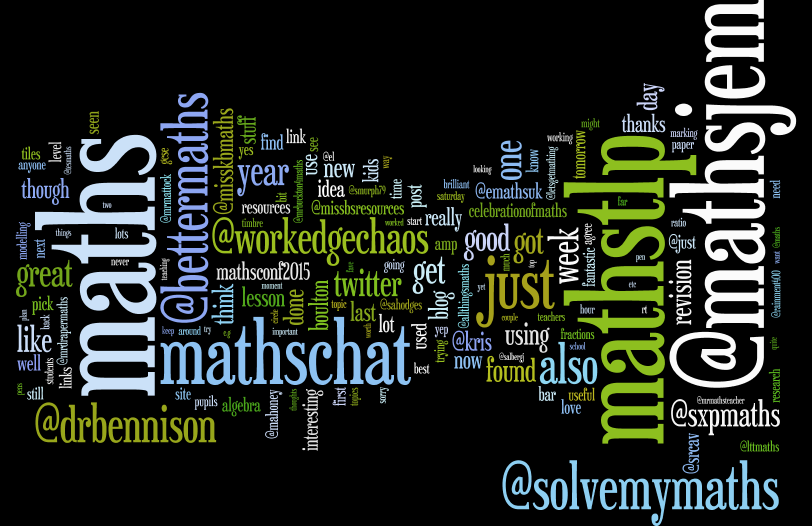
I spent a bit of time playing catch-up with all the #summerblogchallenge posts I’d missed from everyone else today and spotted @DrBennison’s Twitter History post. I’ve seen a couple more Twitter Wordles recently, and quite liked this idea, so thought I’d have a play in today’s post.

I love how big both #mathschat and #mathsTLP appear; I’m obviously using those a lot, which probably also explains why both @mathsjem and @solvemymaths feature so highly!

I’m also quite enjoying the fact that there are so many positive words on there – I may use this to motivate myself in September when I’m getting the post-holiday blues.

My Twitter history Read More »

My #summer10

I mentioned a while ago that I was going to do a #summer10 post at some point; despite the fact that I’m two weeks into my holiday, I’ve pretty much been living and breathing wedding plans and celebrations for most of those, and I realised this morning that I still have nearly five weeks of holiday left, which is incredibly exciting. So here’s my #summer10, the ten things I’d like to achieve in the holiday I have left…

  1. Finish tweaking my schemes of work for next year and share the resources and schemes online.
  2. Complete or add to some more pages on the Resources section of the site, particularly for topics new to GCSE or those that have shifted tiers.
  3. Go into school and sort out my classroom – I’m very excited about getting a much larger whiteboard and having my interactive board shifted to a better place, but this means I’ll need to go in and sort displays and things out again.
  4. Revise FP1 so I can teach without making a complete hash of it this year.
  5. Complete the #summerblogchallenge – I’m exactly one third of the way there now!
  6. Switch off long enough to really enjoy both my honeymoon and a couple of festivals we have booked.
  7. Find some time to paint and make some more goodies for my craft stall at one of the above festivals.
  8. Make a scrapbook for my wedding photos and keepsakes.
  9. Do the odd bit of DIY – this is the thing that’s least likely to be achieved.
  10. Finally, make sure I go back to school in September with a tidy, organised house and classroom, and try to keep it that way until at least October half term!

My #summer10 Read More »

My #summer10 revisited

So right at the start of August I blogged about my #summer10, a list of ten things I wanted to achieve this summer holiday. As it’s the last day of August and I’ve got less than a week to finish all my jobs off, I thought I’d do a retrospective check and work out what I still need to do.

Here’s the list again. Bold is stuff I’ve done, italics are comments.

  1. Finish tweaking my schemes of work for next year and share the resources and schemes online – the important bit (i.e. getting them finished for September) is more or less done. I am still planning to share more stuff, but that’s going to be much further down the line, because… 
  2. Complete or add to some more pages on the Resources section of the site, particularly for topics new to GCSE or those that have shifted tiers – this completely hasn’t happened. Somehow my mojo for finding resources just isn’t the same when I’m not actually teaching! I promise promise promise that there will be more of this in the new (school) year though.
  3. Go into school and sort out my classroom – this hasn’t happened either, but will have done by tomorrow – I was deliberately waiting until this week, possibly through denial that the holidays would ever end!
  4. Revise FP1 so I can teach without making a complete hash of it this year – I’ve done enough to feel like I can teach it now, but I’ll be hunting out resources as I go. 
  5. Complete the #summerblogchallenge – I’m counting this as done because I only have six posts left to go now and I’ll make darn sure I do them!
  6. Switch off long enough to really enjoy both my honeymoon and a couple of festivals we have booked – although there is still one more festival to go (next weekend), I consider this achieved. I’ve definitely had a proper relax this holiday!
  7. Find some time to paint and make some more goodies for my craft stall at one of the above festivals been doing bits and bobs over the last week and finally got finished today!
  8. Make a scrapbook for my wedding photos and keepsakes – within about three days of getting the photos, yep. Priorities? What priorities?
  9. Do the odd bit of DIY – this is the thing that’s least likely to be achieved – absolutely no painting or fixing of any kind has happened as predicted.
  10. Finally, make sure I go back to school in September with a tidy, organised house and classroom, and try to keep it that way until at least October half term! –  well… it’s not particularly organised or tidy at the moment…

With a 60% success rate, I think that’s pretty good going. Hopefully I’ll be able to check off number 3 by tomorrow afternoon and number 10 by Sunday – I’ll keep you posted!

My #summer10 revisited Read More »

Something old, something new…

I’ll admit to having to cheat a little bit on this challenge; this post is one of the few I had to write ahead of time and schedule to post later. I have a good excuse – I’m getting married today, and I imagine that, even though my fiance is very understanding about the amount of time and energy I put into teaching, even he would object if I blogged during our wedding day.

​While I’ve been organising over the summer, I realised that my resource collection has grown exponentially again this year. I made the move to storing resources electronically this year, which has meant I’m drowning in far fewer bits of paper and it’s much easier to find the worksheet I want than rifling through folders. Despite this, I still have my entire cupboard under the stairs full of bits and pieces that need transferring or updating – I think it’s going to be an endless task.

Finding, developing and trying new resources is one of my favourite parts of teaching, which is one of the reasons I started the resources pages on my site- it’s far easier to link to a page at home, then find that again at school, rather than email things to myself, which I then forget about the following year. As above, this project is still unfinished, but I hope to put a big dent in it over the next few weeks. But what makes a good resource?

Something old…

Anyone who knows me is aware that I have a hoarding problem. I struggle to throw anything away – this extends to all aspects of my life, not just teaching resources, and our (fairly small) house is filled with my “junk”. However, some of my favourite and best lessons or resources are those that I’ve had the longest, and I still use them every time I teach a topic. 

For example, I wrote a worksheet for interior angles in polygons for my first observation for my GTP, which makes it about six or seven years old. It was originally designed for a group of Year 9s with high literacy needs, so it’s a write-on sheet with plenty of step-by-step guidance and help to structure answers, but it works every single time I use it, so I continue to do so.

Sometimes you have to be careful though – due to my magpie-like tendencies to keep everything, I do keep some stuff that, quite frankly, is either rubbish or needs serious adapting. I look at resources and think “oh, I’ll adapt that at some point” – I’ve just checked the dumping folder on my computer and there are currently 462 files in there waiting to be updated or changed. With the huge wealth of resources available on the Internet now, it’s easier to just delete or bin a sub-standard resource and find something better.

While I’ve been writing and updating our KS3 and KS4 curricula this year, I’ve been pulling in a lot of “old” resources. Tidying up my storeroom at school, I found a load of pre 1990s textbooks (which makes some of them older than me!). Before I binned them, I had a flick through – lo and behold, lots of Venn diagram questions! They’ve joined the shelf marked “resources useful for new GCSE”, along with a purple box with some superb-looking investigations from Maths O’Level during the 80s sometime. I’m hearing SMILE maths cards being mentioned an awful lot too – they’re all available from the National Stem Centre, and well worth a look.

Something new…

Teaching the same sequence of lessons with no change each year would bore me to death. Even if a lesson works really well, I never teach exactly the same lesson twice. When planning a lesson now, I look at what I used last year, keep the good stuff, strip out the rubbish, then go looking for interesting stuff to fill its place.

I’ve discovered a few fantastic resource websites this year, mostly through Twitter. These are:

  • Resourceaholic (@mathsjem): Jo does a frequent “Maths Gems” post, which picks out some lovely ideas from Twitter and makes sure they don’t get lost in the digital mire. She also has some great resources uploaded and linked – I’ve particularly enjoyed her A Level ones this year.
  • Solve My Maths (@solvemymaths): A great source for stretching problems (for pupils and teachers!) – I’ve now heard this site mentioned on three separate training days.
  • Miss Brookes Maths (@Stacy_Maths): Stacy and I seem to share a common goal, which is to catalogue all the resources on the Internet. It’s been interesting as both our sites have developed this year that she and I have very little overlap in the things we post, which just goes to show what a diverse world of resources we now have to pick from. A massive time-saver with planning.
  • Educating Mr Mattock (@MrMattock): Peter has written some brilliant blog posts with creative lesson ideas to try. Bearings in the hall might get an outing next year…

(I feel the need to add that this is not A LIST… well, it is, but I’ve only listed stuff that’s new to me this year and is primarily about resources rather than general blogs – I may do a longer post about all the other fab stuff out there at some point).

Something borrowed…

As a quick estimate, I reckon about 60-70% of my best or favourite lessons, activities and resources have been pinched from other teachers. I was lucky enough to have a brilliant mentor during my NQT year, who used to start off our mentoring meeting every week by going to his filing cabinet and pulling out a (beautifully) hand-written sheet with a great investigation on to try with a particular class. I’ve still got them in a stack somewhere, and I’m slowly transferring them over to electronic versions to share with more people. This Growing Squares investigation is one of them. The way I introduce Pythagoras’ theorem with most groups was similarly pilfered from an inspirational teacher I worked with on the Student Associates Scheme while I was still at university.

My biggest tip for student teachers and NQTs has to be “borrow what you can” – often, the most experienced teachers have taught their lessons hundreds of times in their careers, and know what works and what doesn’t. Adapt where necessary, but don’t be afraid to use someone else’s stuff (with their permission, of course!).

Something blue!

I apologise for the tenuousness of this link…

About halfway through this year, my classroom was awash with paper. This seems to happen every year, and it’s down to having Year 11, I reckon. At some point, you have to start giving them practice worksheets and booklets tailored to their specific needs, and organising these can be a pain. Something I found very helpful to combat this was copying paper resources onto coloured paper depending on strand – so all of the “Number” resources got copied onto blue paper (similarly, Shape is green, Algebra is yellow and Data is red/pink – I have no idea where these colour associations have come from, but that’s how I see them mentally). This meant that pupils could narrow down which pile of worksheets they needed to look in, and made it much easier for me to put everything away again at the end of the lesson, as all the blue sheets went in one box, yellow in another, and so on.

Similarly, I’ve previously copied non-calculator and calculator papers with different-coloured front pages, so pupils could find these more easily and see links or similarities between papers and questions.

Something old, something new… Read More »

And your starter for ten…

Starters can be a contentious issue; the term “starter” is a hangover from the days of three-part lessons in bite-size chunks, which seem to have fallen from vogue now. However, they are still a key part of my teaching, and today’s SBPC looks at why.

In my mind, my lesson “starters” fall into three categories, and they’re not mutually exclusive. Sometimes it’s appropriate to have a couple of “starter” activities (I’m dropping the quote marks now because I’m irritating myself). I once had a lesson starter that went on for the entire lesson, as it became painfully apparent that the class had completely forgotten to solve simultaneous equations, so my quick prior knowledge check turned into an off-the-cuff revision session.

I remember one lesson observation when I was told off for getting pupils to spend five minutes working on problems similar to those they’d solved in the previous lesson. I was told that they weren’t making measurable progress during this five minutes. I was only a newbie at the time, so didn’t want to argue with my observer, so nodded along, decided that I’d make sure I didn’t do it in observed lessons in future, but carried on doing it as part of my standard teaching practice.

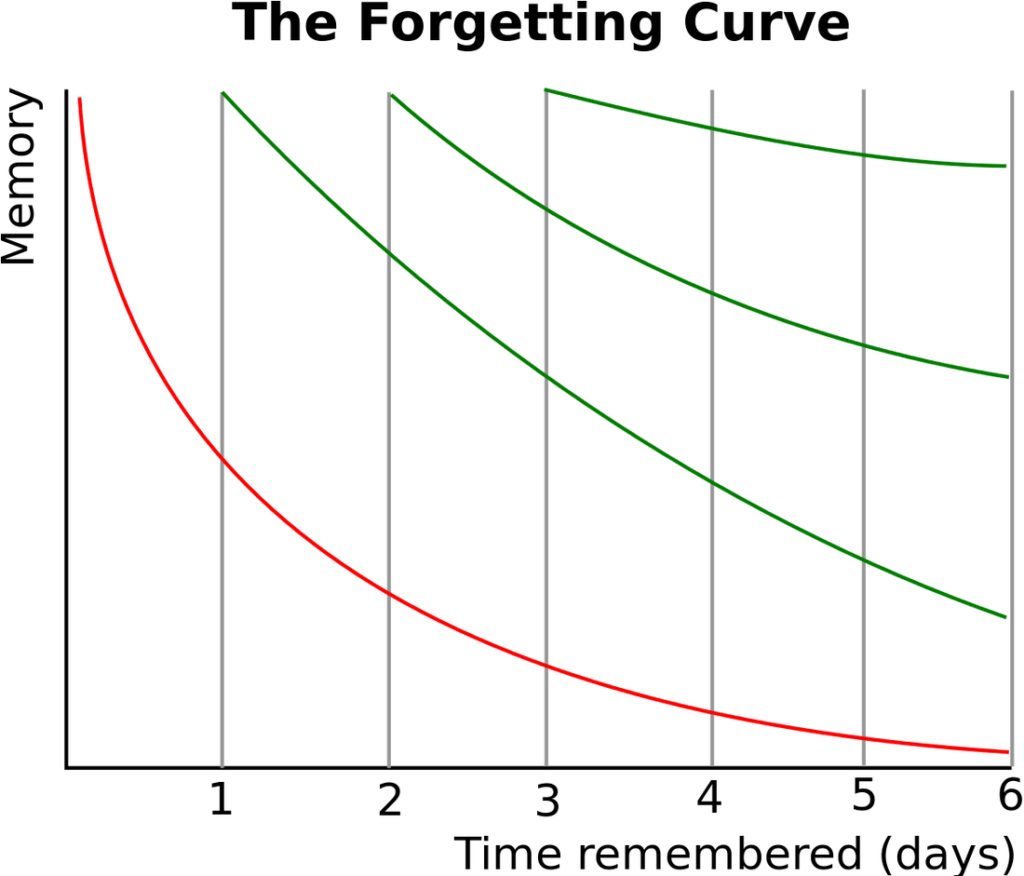
I still think that it’s really important to spend some time each lesson getting pupils to practise skills they’ve already learned. Read about the Ebbinghaus Forgetting Curve and this all starts to make sense (while you’re at it, read this post about blindly accepting research too – it’s good to know that Ebbinghaus is fine). 

Pupils often ask me why I’m “so good at maths”. My response is that I use it every day – there’s not something innate in me that makes me a mathematician. I tell them about how I had to re-learn my times tables when I started teaching – although I’d learned them before, I was very rusty and my recall wasn’t as snappy as I would have liked, due to over-reliance on a calculator at university.

Spaced repetition

If you’re lucky enough to teach a class on consecutive days, they’ve already dropped to under 40% recollection of the previous day’s work. If there’s a weekend in between your lessons, you’re down to around 30%, although the drop-off does decrease as the time period extends. It gives validity to “Miss, I’ve slept since then”, but continued spaced practice is part of beating this curve.

In my mind, there’s no better time to do this than at the start of a lesson. While you’re sorting out who’s forgotten their book and who’s rocking up late, the rest of them can do something meaningful with their time, both in terms of overall progress (which can’t be measured meaningfully over five minutes) and in preparation for the learning they’re about to do, which is almost definitely going to link to what they did last lesson.

Whetting the appetite

Sometimes it’s appropriate to pick a short activity that leads into the learning for the lesson. This could combine with the spaced repetition activity, but might need to be something different. It might explain why the learning for that lesson is particularly relevant to real-life (avoiding pseudo-contexts, of course), or generate a discussion to lead into the main chunk of teaching.

Here are a few examples:

  • Starting off a lesson on square numbers by getting pupils to build squares out of linking cubes – this is then a springboard for discussion about why they are called square numbers and links to area;
  • Asking the class to think of or bring in examples of percentages in real-life, making the relevance of the topic you’re about to teach clear in their minds.
  • Showing a picture for discussion and asking them to identify any maths they can see in it, making sure the topic you’ll be doing is prominently featured – this helps to build links to other strands of mathematics.

A segue into the non-curricular

These are my favourite type of starter. They often get featured on particular dates, such as getting the pupils to sum the numbers from 1 to 100 on Gauss’s birthday, but occasionally I throw things in to keep everyone focused on the point we bother learning maths in the first place – not just to get a grade C (5?) but because it’s such an historically rich, fascinating subject. Let’s face it, the curriculum can end up pretty dry at times, and sometimes a nice puzzle or problem that’s never going to crop up on the syllabus but is interesting and challenging to do keeps me and the pupils awake and enthused.

Unfortunately, I’m really bad at not letting this type of “starter” take over my entire lesson. I once ended up teaching Year 7 about radians instead of doing whatever we were supposed to be doing on Pi Day, due to a great discussion we were having about the number of degrees in a circle, and I gave up trying to fit Fermat’s Last Theorem into a starter and just planned a whole lesson around it instead. But never mind, there’s always the next lesson!

And your starter for ten… Read More »