Pedagogy

Rally Coach

During my NQT year, I worked at a school that was big on cooperative learning and using Kagan structures. I confess, I was never a huge fan – all the jazzy names got a bit complicated and all seemed to have the words “Round” or “Robin” in them. Interestingly, that fad seems to have fallen by the wayside now – I’ve not heard anyone talk about it for a while, in UK schools at least.

However…I love Rally Coach. I’ve not touched many of the other cooperative learning strategies for a good few years, but I still use this one. It’s a fantastic way to jazz up those “do 10 questions to remind you about last lesson” starters. 

Students work in pairs. They choose who is A and who is B, and are given a setย of problems to do. For any pesky groups of 3, two As and one B works fine.

Student A tackles their first problem, while B watches and either praises if the question is done correctly or coaches if A gets stuck. Once A has done their first problem, students switch roles and B does their first question while A praises/coaches as necessary. Students continue to alternate in this way through the problems until they have finished. 

Depending on how organised I am, I either put the problems on the board, or create a worksheet. I much prefer the latter as it has two major benefits:

  1. I’ve found that giving one worksheet between two means that students actually do the activity properly, rather than just rushing to answer their set of questions – as they are sharing the same sheet, they can’t do the problems simultaneously (although I have seen one pair of students try and fail hilariously).
  2. Students can tear the worksheet in half at the end of the activity and keep their problems; particularly useful if they have corrected or written on each other’s work!

However, we all have photocopying bills and a finite amount of time. The activity works adequately on a board or even with problems from a textbook.

The emphasis is on peer coaching and using independentย learning skills (e.g. prior knowledge or notes from previous lessons). It takes a bit of training to get them doing this properly, but it’s worth doing. The first few times I run a rally coach with a new class, I get them asking me straight away rather than each other – I just refuse to answer until they get the message! Once we’ve done it a few times,ย I tell students to put deliberateย mistakes in if they think their partner isn’t fully engaged and listening toย what they’re saying.

Rally Coach Read More ยป

Effective examples in the digital age

Picking apart and reworking my lessons from last year, I noticed that I almost exclusively model worked examples by handwriting “live” rather than pre-typing. I don’t recall making a conscious decision to do this, but following a discussion with my husband this weekend about print vs digital media, I thought I’d think more critically whether either style has any considerable advantage.

There are some interesting studies about reading information via print or digital media; this paper from theย Research in Learning Technologyย journal looks specifically at educational materials and this article fromย Phys.orgย summarises some of the preferences people have for different media – generally, we prefer printed media for longer, more involved reads and digital media for shorter reads. I also foundย this studyย examining handwriting vs typing inputs for students when solving equations; the authors conclude that the only real difference in this scenario is the speed at which students completed the task, with typesetting algebra taking twice as long as handwriting solutions. However, I’ve not been able to find anything on the modelling of worked examples in Maths, so this blog post is written with the caveat that this is all personal theorising and is not research-based

Advantages of written examples

1) Less time taken to prepare lesson materials

Time-gains while planning are significantly in favour of handwritten examples, particularly as questions become more complex towards the top end of GCSE and into A Level, and when complex algebra is involved. However, as handwriting recognition tools such as Microsoft Office’s Ink Equation Tool are becoming increasingly effective, it might be interesting to see whether this remains true in five or ten years’ time.

2) Teacher’s thought processes are more visible to students

One advantage of working “live” is that the teacher can model thought processes more easily, verbalising each step in the working. This process is also instantly adaptable to the class – the teacher can speed through stages that students are confident with, or elaborate in more detail if a step requires further explanation. 

3) Teacher can model layout and presentation of mathematical working

Again of particular importance for top-end GCSE and A Level, as problems and solutions become more complex, students increasingly need guidance with how to present their work in a coherent manner. Watching a teacher model this directly may be easier to translate to their own work than looking at a typed example.

4) Teacher can include student input more easily

When I complete worked examples with a class, I tend to ask for input from students at each step and see what they can work out logically or infer from prior knowledge. The rigidity of a pre-typed example makes it more difficult to include student responses, as many of them may go slightly off-script from the pre-planned work.


Advantages of typed examples

1) More critical selection of illustrative examples

If I’m going to typeset solutions, I make damn certain the example I’m using illustrates a key point or highlights a common misconception. The need to work efficiently means I then select an example which serves many purposes and has decent mathematical weight. It also means that the numbers work properly – while I usually check all the examples I prepare in my lesson materials, occasionally the odd blooper slips in – the star culprit is quadratics that don’t have real roots. While this can form the basis of an interesting discussion, it can also wrong-foot a class and damage confidence in the teacher.

2) Final solution can be presented with greater clarity/use of colour

While there are losses in the step-by-step process, the end product is often more coherent when digitised. There are times when I’ve stepped back from a worked example and actually looked at what’s on the board – and because I’ve documented my thinking process or expanded on certain points, the solution can end up looking mathematically messy or sometimes confusing to students. I also have a tendency to use arrows and random bits of annotation which get very scruffy when handwritten, and my handwriting itself has deteriorated significantly over the last ten years as I get less and less daily practise.

3) Diagrams and graphs can be incorporated more easily

Unless I am specifically modelling graph-plotting with Year 7, I no longer draw graphs by hand. It’s tedious and time-consuming, and incredibly difficult to do when working right up against a whiteboard! Using a tool likeย Desmosย is now pretty commonplace, but if I’m doing this I will often prepare graphs in advance rather than plot “live”, as I can make sure that the graph is scaled appropriately. Diagrams or pictorial representations always look better when done digitally – for example, your standard “counters in a bag” when working with tree diagrams.ย 


This year I’m probably going to carry on handwriting most of my examples – I enjoy the process of working through problems collaboratively with a class, and I think typeset examples lose some of this. However, I am going to reconsider selecting some gold-standard examples for each topic to typeset; at GCSE, our students have small exercise books that are used to take important notes and write down illustrative examples, and these would seem the ideal candidates for a bit of deeper thought and clearer presentation.

.

Effective examples in the digital age Read More ยป

#mathsconf13

#MathsConf13 took place last Saturday, and as usual, was another fantastic day of cheap CPD. Sadly, I missed the London conference in the summer, so I was really looking forward to this one. It definitely didn’t disappoint, despite being a bit of a struggle at nearly 8 months pregnant!

One highlight of the day was the keynote from Matt Parker; I have to confess to spending the first few minutes wondering why this bloke looked so familiar until I realised that I’d seen him in the superb Numberphile videos.  He was highly entertaining, but also gave a few decent ideas for use in the classroom, such as thinking about images as RGB spreadsheets and creating a mega-Menger sponge or a fractal Christmas tree.

My three speed-dates were as follows:

  • Catching up with a colleague from my old school – I know, this isn’t really what speed dating is for, but we did have a good chat about their decisions regarding GCSEs and A Levels!
  • Paul (@PaulRodrigo2718 ), who showed me his method for scaffolding problem-solving questions at GCSE.
  • Richard (@TickTockMaths), who shared the absolutely superb dudamath.com, which I’d not seen before but has so much going on that its potential for use in the classroom seems massive.

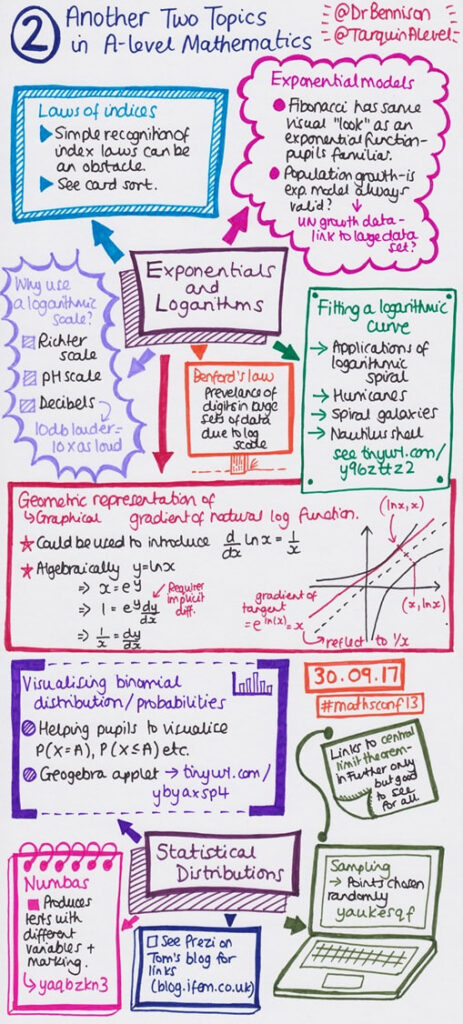
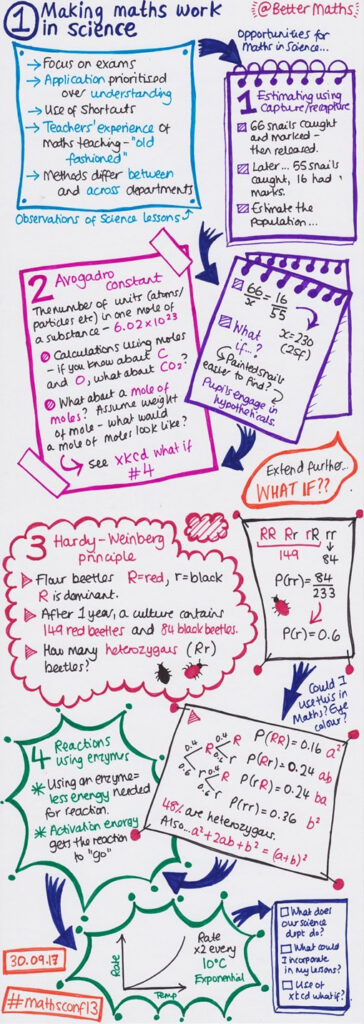
Rather than attempting to blog about each workshop (I still haven’t finished my #mathsconf7 round-up – now unlikely to ever happen!), I decided to make the most of my time off by doing a bit of relaxing colouring-in – so this conference’s workshop posts are in “visual blog” format. I attended:

  1. Making Maths Work in Science with Luke Graham (@BetterMaths);
  2. Another Two Topics in A Level Mathematics with Tom Bennison (@DrBennison) and Ed Hall (@TarquinAlevel);
  3. Things to Do With your Large Data Set with Stella Dudzic;
  4. Problem Solving – Getting to Grips with the Overarching Theme 2 in the New Maths A-level with Dan Rogan.

EDIT: Reviewing this post, I am aware that I also failed in my attempt to visually blog two of the four workshops. I did, however, publish a book of AS Maths visual notes instead, so I think that might be a valid excuse for once.


#mathsconf13 Read More ยป

#mathsconf7 Session 2 – 10 things you should know about the new Maths A Level

Session 2 at #MathsConf7 was delivered by Christine Andrews, Andrew Taylor and Gary Wing, and looked at the developments and questions about the new Maths A Level for AQA. This blog is just my interpretation of their workshop, and shouldn’t be taken as gospel, although I’ve tried to reproduce accurately what was said. It’s also worth remembering that these materials are still in draft form, and have not been accredited by Ofqual yet.

The session looked at many more than the titular 10 issues, and provided a lot of food for thought – I’m looking forward to teaching the new A Level, but it will be hard to mentally move away from the modular system.

Teaching and examining using the “large data set”
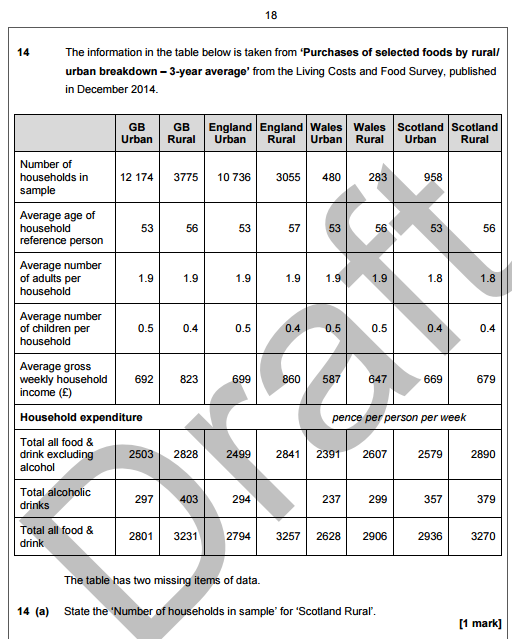
Many of the Statistics questions will now be based on a “large data set”; AQA have chosen Family Food, which is published by the Office for National Statistics every December. Christine clarified that this selection would not change through the lifetime of the specification, but that the updated version would be used every year, and examination questions would be set using the most recent set of data; I took this to mean that exams in summer 2018 would use data published at the end of 2016. Christine also highlighted that teaching using the data set would not be compulsory, but that familiarity with the scenarios and language used would be advantageous in an exam situation (see example below: Paper 2, Q14 from the AS Level papers, available here). This approach would certainly make the teaching of statistics more coherent, and give lots of time for real in-depth analysis of one problem, as opposed to skimming over the surface of many different scenarios. Gary highlighted the opportunities to investigate these data further using technology such as Excel and MatLab.

Use of calculators; are pupils expected to purchase/use a graphical calculator?
Calculators used for the new specification materials are expected to have an iterative function and standard statistical calculations. The normal and binomial tables will no longer be provided in the formula booklet, so pupils will need to be familiar with use of calculators for these topics. Gary said that more reasonably-priced calculators are currently being developed, but we have no idea when these will hit the market.

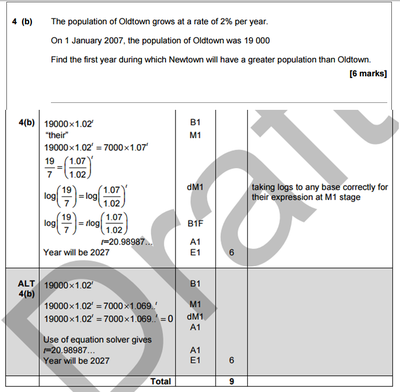
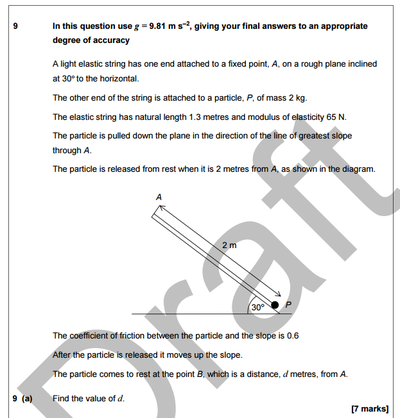
Use of the equation solver on a calculator will be credited in the mark scheme if used well – such as using a calculator to solve a quadratic at the end of a mechanics problem (see examples below, Paper 3 Mechanics, Q9 from A Level Further, available here and Paper 3, Q4b alternative solutions from A Level). In such scenarios, the final solution would be worth one mark, and pupils are expected to use their calculators to do this; any marks for calculations like this have now gone.

Pupils should use the wording of the question as an indicator of whether a calculator solution is appropriate; “show that” would require pupils to demonstrate their method without using a calculator.

With regards to graphical calculators, Texas apparently have one out now and Casio are aiming to produce one by the end of November.

For Further Mathematics, calculators are also required to compute using 3×3 matrices. Gary highlighted that pupils studying FM may well want to invest in a graphical calculator, but Christine clarified that AQA would ensure that those who didn’t have graphical calculators would not be disadvantaged in an exam.

Further Maths Paper 3 – choosing options
Andrew clarified that pupils should not attempt all three papers (Discrete, Mechanics, Statistics) in a timed exam, as this would disadvantage pupils. The decision about which papers to sit would be made at the point of entry, and is not a choice on exam day. Pupils sitting the exam will get the correct two papers out of three and use the examination time to answer these two papers.

Curriculum planning for AS Mathematics, A Level Mathematics and Further Mathematics
The AS and A Level are not linked (so results in AS will not count towards the final A Level qualification), but they are co-teachable.

When delivering A Level Mathematics and Further Mathematics, it’s possible to deliver either side-by-side or in sequential order. AQA has permission to offer examinations for A Level Maths after the first year of teaching, so pupils could sit the full A Level after the first year, then sit Further Mathematics in the second year.

AS Further Maths will only require content from AS Maths, with the exception of radian measure, and can also be sat in June 2018.

Weighting of Pure and Applied in AS and A Level
Both A Level Mathematics and A Level Further Maths are weighted 2/3 Pure, 1/3 Applied – in the case of the single A Level, this is essentially 1/6 Mechanics and 1/6 Statistics.

AS Further Maths is weighted approximately 50/50. 50% of the content is prescribed and focuses on pure mathematics – Andrew explained that this had come from end-users such as universities and industry, who prefer confidence with pure mathematics over applications. There is a small amount of prescribed mechanics (simple and damped harmonic motion for application of differential equations). AS Further Mathematics offers more opportunity for pupils to study Mechanics and Statistics in more depth without completing the full A Level FM.

Topics appearing on certain papers
Papers will become more like GCSE, where any topic can be examined on any paper. This has been done to avoid fragmenting the A Level and providing pupils with a more holistic experience. Emphasis should be on developing a body of mathematical knowledge rather than learning particular topics for particular papers.

Textbooks
Textbooks are being produced by Cambridge, Oxford and Hodder, for (hopeful) publishing next spring. These depend on accreditation of specification materials. AQA plan to only endorse those that produce a full range of texts for Maths and Further Maths.

Practice papers and resources
AQA plan to produce comprehensive teaching guidance and a route map for teaching the new specifications. There will also be two additional sets of specimen papers, one after accreditation and one secure set early 2018, and a set of topic tests and an eLibrary of resources.


When this was published on my old site, AQA added the following comment:

Thanks for this great summary Miss Norledge, weโ€™re glad to hear youโ€™re looking forward to teaching the new linear A-levels.

We thought weโ€™d add a little more information where itโ€™s possible we didnโ€™t go into sufficient depth in the 50 minute session on the day.

Data set: The Subject Criteria (https://www.gov.uk/government/publications/gce-as-and-a-level-mathematics) from the Department for Education requires students to โ€œbecome familiar with one or more specific data set(s) in advance of the final assessmentโ€, so while it is not compulsory to use the data set in your teaching, the GCE Subject level guidance for Mathematics document (https://www.gov.uk/government/publications/gce-subject-level-guidance-for-mathematics) published by Ofqual states โ€œquestions/tasks should be likely to give a material advantage to learners who have studied, and are familiar with, the prescribed large data set.โ€

Curriculum planning: For AS Further Maths, as well as radian measure, students will also require compound angle formula from the A-level Maths content.

Weighting: AS Maths is also weighted 2/3 pure and 1/3 applied. The inclusion of simple and damped harmonic motion in the compulsory content is only on the A-level Further Maths, not included in the AS.

If readers would like any further information about the new A-levels in Maths and Further Maths from AQA, you can email us maths@aqa.org.uk or call us on 0161 957 3852.

#mathsconf7 Session 2 – 10 things you should know about the new Maths A Level Read More ยป

#mathsconf7 Session 1 – Avoiding misleading assumptions

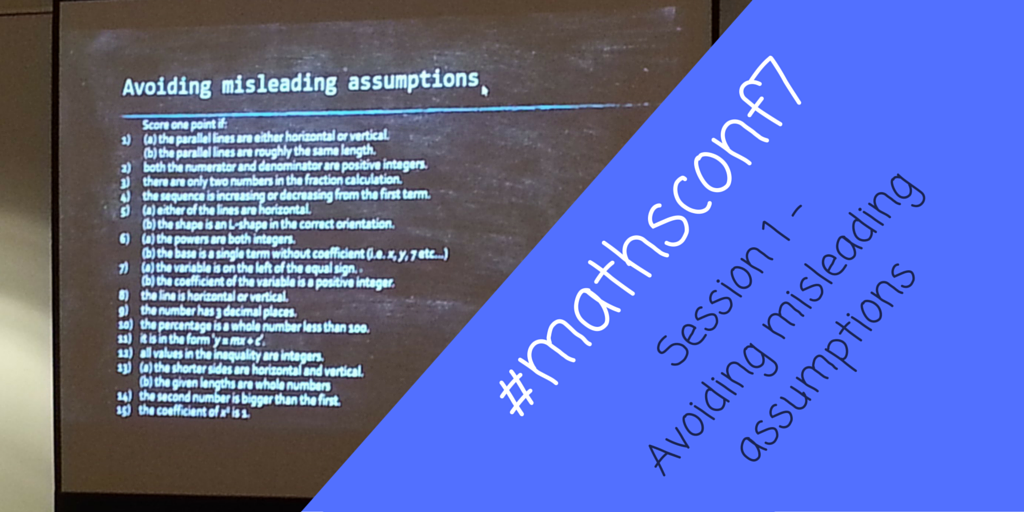
Peter Mattock’s session at #mathsconf5 (Concrete Approaches to Abstract Mathematics) was great and gave me a lot of takeaways, so signing up for this one as my first session seemed like a no-brainer. I wasn’t disappointed; this time, Peter looked in depth at fifteen topics that can lead to misleading assumptions by pupils, and challenged us to come up with examples that “broke the mould”.

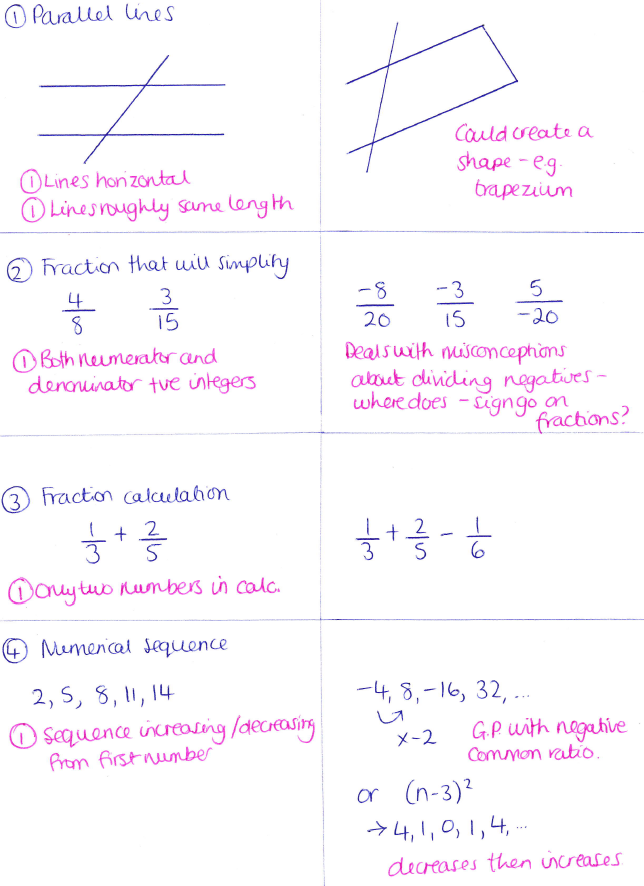
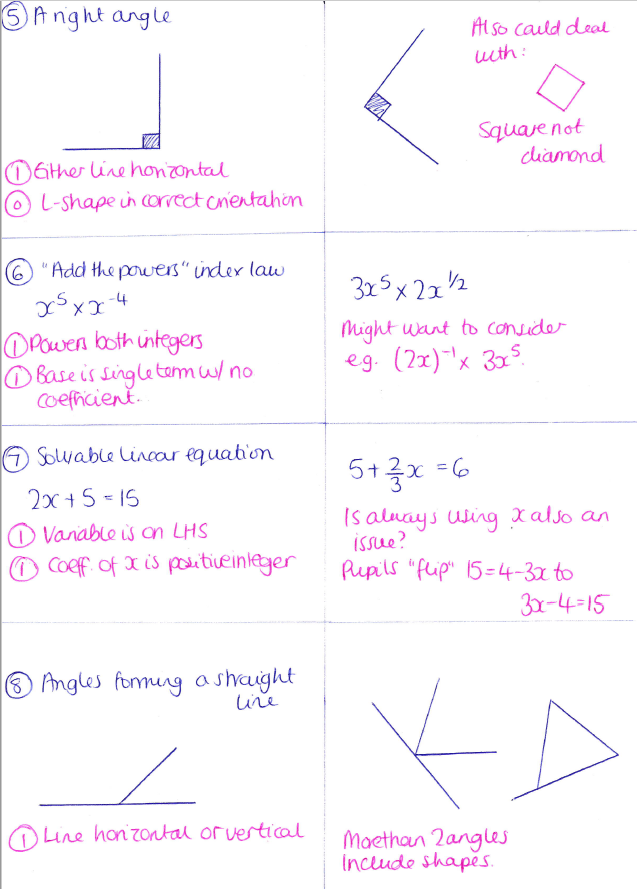
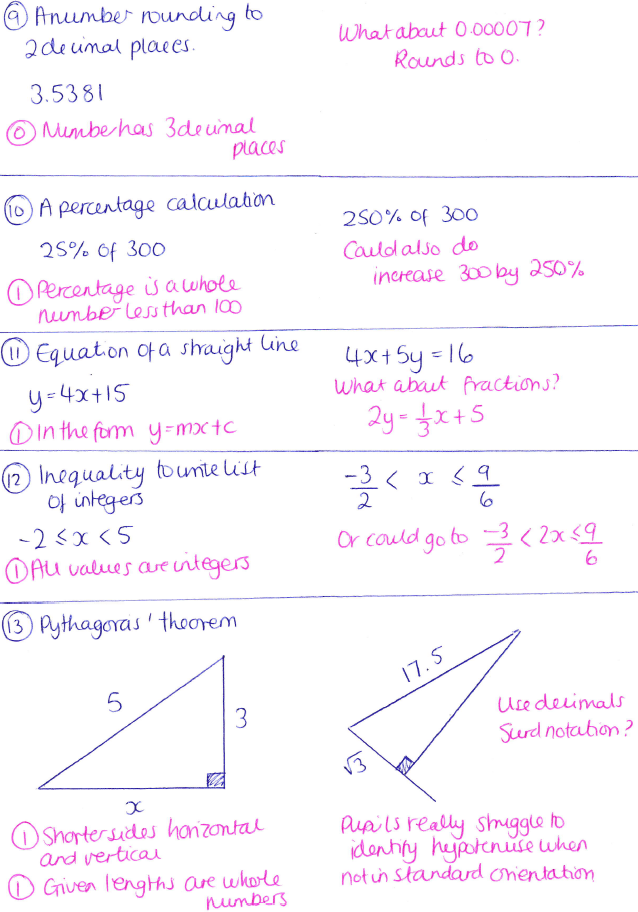
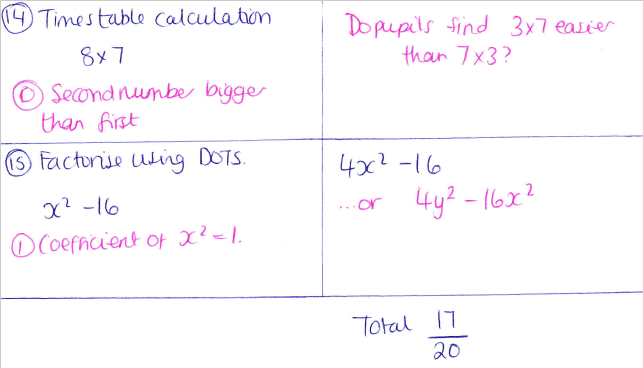
We started with a little game; Peter asked us to come up with examples we could use to teach particular topics, such as a solvable linear equation or a diagram for teaching parallel line properties. I could sort-of see where this was going, but I decided to embrace the task as it was designed and go for my first idea for each example. We were then awarded points for the predictability of our answers – I scored a whopping 17/20 on my first go with some completely textbook examples. Peter then asked us to improve these examples to come up with a problem set that would score zero. I’ve neatened up (but not censored!) and scanned my notes below, with the original example on the left and improved examples on the right.

Happily, I’d predicted a few of these as I was working through them. The issues around linear equations in particular caused considerable consternation with my Year 10s a few months ago – they seemed perfectly happy to solve 2x + 5 = 15, but were really confused by 15 = 2x + 5. Many of them decided that they preferred to re-write the equation if it was “backwards” before solving, which worked fine when dealing with all positive terms, but re-writing something like 15 = 5 – 2x caused some of them even more issues, with 2x – 5 = 15 being the most common error. 

Personally, I think I sometimes avoid these more complicated problems, particularly when trying to boost confidence with pupils who struggle with mathematics, but this is something I need to work around for myself – pupils need to see more “unfamiliar” examples, particularly now we’re entering the realms of a new, less predictable GCSE. 

Peter highlighted the importance of being aware of limitations on our own thinking; while I had predicted some of these assumptions, I hadn’t thought of tilting a simple parallel line diagram or presenting a right angle in a non-standard orientation from the off – this is something I would address later on, often in the context of problem-solving or multi-step questions. However, maybe there is room for this when introducing a new concept, possibly presenting more examples of the right angle L-shape but in non-standard orientations, and specifically pointing out to pupils that these are all right angles.

#mathsconf7 Session 1 – Avoiding misleading assumptions Read More ยป

#mathsconf7: A round-up and Mike Askew’s keynote

As I promised my first #mathsconf7 blog before the end of Monday, I thought I’d better crack on, which means turning pages of tiny scribbled notes on an old Osiris pad into something a little more coherent.

Much like @taylorda01, I’ve spent a lot of time in Leeds over the last decade (three years of university, followed by two years travelling up and down nearly every weekend, followed by a further five years living there and working in Yorkshire) and have never been to the Royal Armouries, but I concur with him that it worked well as a venue, and the unrelated event going on in the Leeds Dock area certainly added a bit of a party atmosphere every time I walked from New Dock Hall to the main Armouries building.

I wandered around the exhibition area for a bit, attempting to drink a coffee while picking up freebies from the various stalls. I was super-pleased to get my hands on one of @OxfordEdMaths pun pens to go with my badges from last time; I also got a fantastic free A Level poster. It was also great to see that @CambridgeMaths are still offering free, no-commitment evaluation copies of their new GCSE textbooks, so it’s worth checking them out at future conferences – I picked up a full set of GCSE AQA and Edexcel resources at #mathsconf3 last year.

โ€‹Mark and Andrew’s opening address was brief, but set the tone for the day, with the only mention of the political climate being an incitement to get #mathsconf7 trending above #EUref. I don’t think we reached our goal of trending first worldwide, but we at least got to number 3, giving another indicator of how powerful these events are for bringing the maths teaching community together.

I thoroughly enjoyed the keynote from Mike Askew, which was a mini-workshop in itself. Mike set up the address by highlighting key recommendations from research into mathematics teaching, evaluating each before seguing into a discussion of problem-solving models. I particularly enjoyed the way he completed his list before presenting the level of evidence for each, reminding me that I have a duty to think critically about what I’m told and not accept things because “an expert” has recommended them.

The recommendations each offered significant food for thought, and although there was nothing new here, it’s nice to be reminded of important principles at the start of a day like this.

1. Space learning over time
I completely agree with this principle, and many teachers and planning documents subscribe to this notion. One point on this was a comment from Mike that seemed to imply that “current mastery ideas” and spaced learning are incompatible – I would disagree, and wholeheartedly believe that a workable scheme contains elements of both. I detest use of “mastery” as a buzzword; as many commentators have pointed out, “mastery” is the way that good mathematics teaching was done until introduction of the National Strategies, and isn’t new or revolutionary. For my money, a good scheme of work should allocate large blocks when introducing a big new concept, but that doesn’t mean that this concept will not be revisited in other contexts later on – i.e.  when working on area of 2D shapes, include problems requiring pupils to multiply fractions and decimals as well as positive integers.

2. Interleaved examples and problems
This is something that I don’t feel most GCSE textbooks have got right. Most exercises are presented with a few examples at the top, then a large chunk of problems, requiring teachers to carefully guide pupils through the exercises and making independent learning quite difficult. The Edexcel series of A Level textbooks on the other hand have excellent worked examples with full explanations, and often include pointers in exercises referring pupils to the specific example that might be useful in that case – it would be good to see more of this earlier on in pupils’ education.

3. Combine graphics with verbal descriptions
4. Connect abstract and concrete representations

I jotted down a couple of key points from this linked pair of recommendations; firstly, Mike suggested that graphic representations should be accompanied by verbal descriptions rather than lots of written text, keeping the image clean and allowing for discussion. Secondly, Mike pointed to evidence that โ€‹the thinking that understanding develops from concrete to abstract is flawed; young children are capable of engaging in abstract mathematical thinking (a point that tied in nicely with my third workshop choice, “A Golden Age?” from@dannytybrown), while adults and more advanced learners don’t get rid of concrete representations completely.  I’ve seen evidence of this in my secondary practice (see this blog on completing the square), and Mike highlighted an example from his experiences as a university student when tackling higher-level concepts – despite being able to follow an abstract procedure, he had limited understanding compared with peers who could ground these concepts in concrete imagery.

5. Quizzes
Mike described the American process of setting “non-threatening” or low-stakes quizzes, both as a pre-assessment at the start of a unit and to re-expose pupils to concepts later on. Pre-assessments seem to be more a part of standard practice than they used to be, so it was interesting to see during Mike’s reveal of the evidence levels later on that there was low evidence that this actually increases pupils’ attainment. It was, however, interesting to see that quizzes as a means to re-expose pupils to content did have significant impact.

6. Ask deep explanatory questions
Mike used this as a springboard for his discussion about problem-solving and reasoning. Without deep questions, pupils only really experience a shallow, procedural version of mathematics. He highlighted the idea of posing a question at the end of the lesson and allowing pupils to “sleep on it”, with the suggestion that the brain will unconsciously continue to work on the problem.

Mike then discussed a few points around problem-solving and reasoning. This quote from โ€‹Development of Maths Capabilities and Confidence in Primary School (DSCF-RR118) seemed to strike a chord with many people:

โ€‹Mathematical reasoning, even more so than childrenโ€™s knowledge of arithmetic, is important for childrenโ€™s later achievement in mathematics

This is further elaborated in the document as follows:

Mathematical reasoning and knowledge of arithmetic (as assessed in year 4) make independent contributions to childrenโ€™s achievement in mathematics in KS2 and 3. While both are important, mathematical reasoning is more important than knowledge of arithmetic for achievement in KS2 and 3. 

Mike highlighted the implication that skills in arithmetic are not a predictor of problem-solving skills (and vice versa), then drew the distinction between direct and indirect objects of learning. The direct objects of learning are the topics we teach, and what pupils are most likely to identify when discussing their mathematics – “we did fractions this week”. The indirect objects (can’t be taught directly) break down into a list of three proficiencies:

  1. Fluency
  2. Problem-solving
  3. Reasoning

โ€‹Mike then discussed the importance of ensuring that tasks planned to develop problem-solving capabilities don’t “decline” into procedural or fluency-based tasks and that teachers should be aware of “taking thinking away” from pupils by immediately diving in to help when pupils get stuck. He offered the suggestion that slow thinking is accompanied by emotional discomfort and tension, and that we’re almost hard-wired as teachers to remove elements of discomfort and tension from our classrooms – in removing this tension, we also remove the problem-solving element and the task declines to a more procedural activity. Pupils should be given long enough to think carefully about the problem and be allowed to struggle – but crucially, should not be allowed to think unsuccessfully for long enough that they get fed-up and disheartened with the task.

We should also think carefully about the sorts of problems we select for our pupils; this is what Mike called the ABC of problems.

1. Authentic problems
These are problems that pupils could conceivably encounter in their current circumstances – Mike offered the example of “plan a school disco”. The issue here is that authentic problems require authentic solutions, and realistically, we tend to “find a way around” such problems without engaging in much deep mathematical thinking. 

2. Believable problems
โ€‹These are problems that pupils could believably encounter at some point in their lives. Mike highlighted the issue with predicting such scenarios, and what’s believable or relevant for one pupil may not apply to others in the class; constructing such problems is very difficult.

3. Curious challenges
I loved the terminology used here, and immediately thought of Don Steward’s work. Rather than invent contexts and problems which may not be relevant to pupils, we look instead to provide them with challenges that hook them in – these may or may not be related to a “real-life” scenario. Mike offered a particularly excellent example that I’m looking forward to using with pupils:

Mike also offered a couple of rubrics for planning and developing lessons to enhance problem-solving skills. The first of these was around the teacher’s duties during such activities:

  1. Choose the tasks – we use our expertise to select tasks as above;
  2. Set them up – give the tasks a narrative or story;
  3. Orchestrate discussion of solutions – this is where the teacher should be most active during a problem-solving task, and focus should be on the mathematical content behind the problem, rather than just hearing voices. The teacher’s job is to look for the mathematically significant answers and draw these out.

The second plan offered was how to get pupils to engage with this discussion process. Mike cited a study looking at pupils’ reactions to discussion in upper primary – pupils thought it very important to have their say on the mathematics they had discovered, but frequently did not see the importance of listening to others. Suggestions included:

  1. Repeat and revoice – ask a pupil to repeat what another has said;
  2. Rephrase – ask a pupil to explain another’s answer in their own/different words;
  3. Build on – ask a pupil to add to a point raised by another;
  4. Agree/disagree – ask a pupil their opinion and give an explanation.

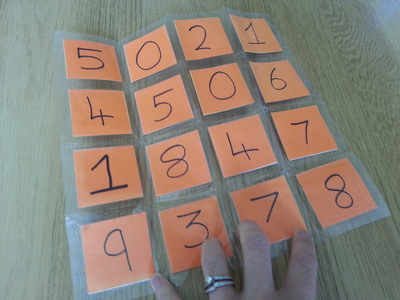
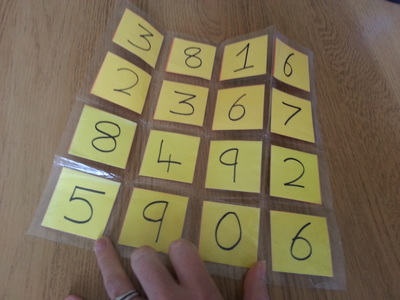
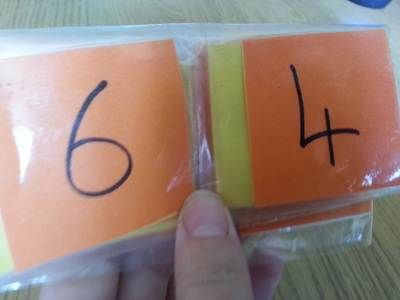
Following Mike’s address, we all engaged in the usual “speed-dating” activity to share resources. I’d brought along a simple idea I nicked from a colleague last year – a double-sided plastic mat with single integer values. It’s a gimmick, but an engaging one – I’ve used it for quick-fire questions and ask pupils to fold their mats to show the correct answer – the kids seem to love it! For example, you could ask pupils to fold and show you a square number:

Vicky shared a great idea for a hands-on approach to introducing angles in parallel lines; she described how the DT department has constructed a solid model of the parallel lines diagram from coloured Perspex, with two angle shapes tha slotted in. Pupils then used this to discover where angles were the same and developed rules from this.

Kate (@KateTarno) shared her department’s idea of attaching clear, raised Perspex to the tops of pupils’ desks. These then functioned like mini-whiteboard paint, and pupils were encouraged to use these for working out. She also explained how worksheets could be slotted underneath the Perspex, both saving on reprographics costs and providing an easy way for pupils to alter their work when working on diagrams.

Unfortunately I didn’t get my third date’s name and have subsequently lost the paper resource, but she shared a tangram-type template including most quadrilaterals, great for making 2D shape properties a little more interesting.

My workshop choices for the rest of the day were as follows:

  1. Avoiding Misleading Assumptions (Peter Mattockโ€‹)
  2. 10 Things You Should Know About the New Maths A Levels (Christine Andrews, Andrew Taylor and Gary Wing)
  3. A Golden Age? (Danny Brown)
  4. More Interactive Problem-Solving Models (Matt Dunbar)

Individual blogs on each of these will be coming over the next week or so!

#mathsconf7: A round-up and Mike Askew’s keynote Read More ยป

Fractions with Cuisenaire rods

โ€‹As per instruction, I am attempting to finish strong, and I had another really interesting lesson with Year 7 using the NRich Cuisenaire environment today, so I thought I’d go out in style with that.

Last Tuesday we did plenty of work with whole numbers and algebraic notation, and I was really keen to explore some fractions with them today; we completed a big unit of work on fractions before half term, but some of them didn’t do so well when I assessed them, so I need to keep coming back to this with them.

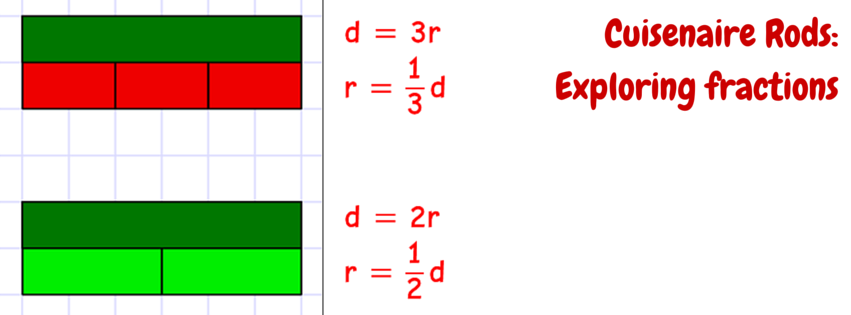
โ€‹A key issue that we’ve been trying to work around is the meaning of the numbers in a fraction; we’ve reinforced this loads with bar modelling, but the Cuisenaire stuff links in so nicely that I decided we’d take the opportunity to attempt some fractional expressions.We started with a quick refresher, then we had a go at the first activity here, comparing one rod to another. We looked at links both ways, so wrote 6w = d first, then w = 1/6 d. It took a lot of annotating and re-explaining for them to completely get the idea, and I think I need some more problems along these lines to make sure they are really confident. The links to later work on solving equations and inverse operations are really clear though!
โ€‹
Next, we had a look at situations where the two Cuisenaire expressions weren’t the same length. I wanted them to focus on just comparing part to whole here, so we only really talked about y = 5/6d, but at some point we’ll go back and explore d = 6/5y further. This links so well to mixed numbers and improper fractions, as well as later work using proportional reasoning and scale factors.

We then had a go at the second task (scroll downย on previous link), getting them to write statements to compare different sizes. I need to develop this further, because the level of difficulty ramped up too much for some of them. The couple who got it straight away were happy to continue to find their own expressions, and developed some quite complex ideas!

I’m definitely adding Cuisenaire rods and the NRich environment to my repertoire – the pupils are finding them really engaging and they’re a good stepping stone on the way through algebra tiles to abstract representation. Just got to keep tweaking these lessons and make some more resources now!

Fractions with Cuisenaire rods Read More ยป

Cuisenaire rods and introducing algebra

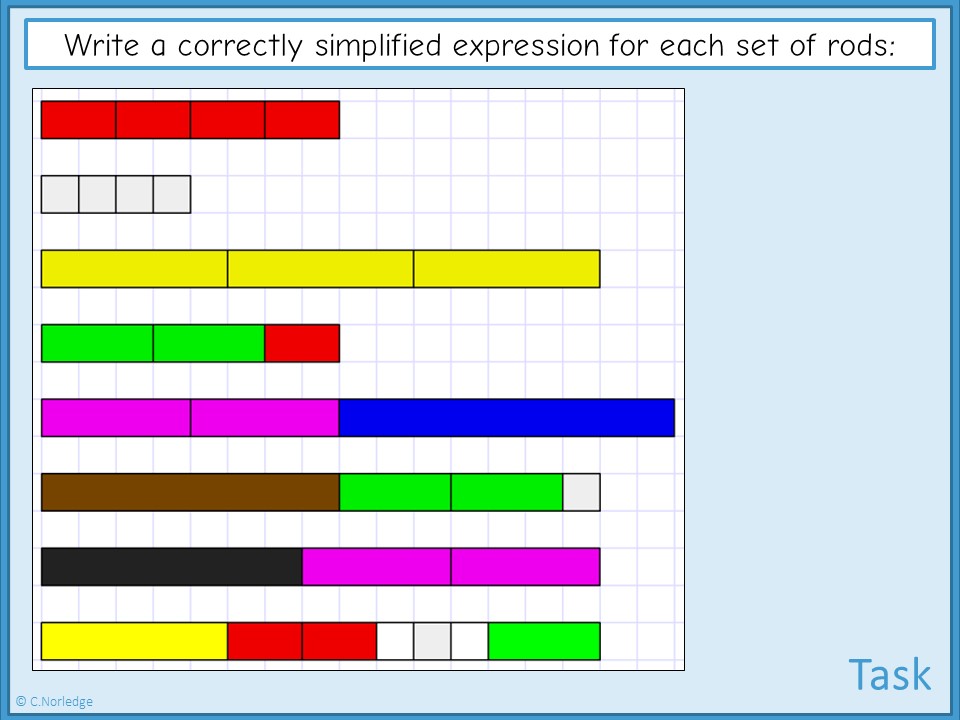
So I had one of those lessons today that reminds me exactly how great this job can be. I snuck in an extra blog over half term aboutย using Cuisenaire rods to introduce algebraic expressionsย with Year 7, and I guinea-pigged the lesson with them today – it workedย soย well, and I imagine would have been even better if we’d actually had sets of Cuisenaire rods rather than working on square paper.

We started by playing around with theย Cuisenaire interactive from NRichย – none of them had used the rods at primary, so I thought it was probably important that we got used to the basics. I started by building a couple of bonds to 10, then getting the pupils to explain what was there. They started by using numbers, referring to “the eight block” and “the two block”, but quickly started describing them as “brown” and “red”, and saying things like “brown plus red” quite naturally.I prompted them towards writing down “sentences” for the blocks we built together – so “brown + red = orange”. Once I’d written a couple out in full, someone suggested we just use initials, so this became t + r = o (brown is “tan” in Cuisenaire language – yeah, that threw me too).

โ€‹I gave them some square paper and got them to build some more expressions equal to one orange (i.e. 10). They would have happily done this all lesson if I’d let them!

A few pupils had gone for 10 white blocks make one orange, but we had a big mixture of notation, including 10(w), 10 x w, w x 10 and just 10w. Interestingly, no-one wrote down any incorrect notation when simplifying (like writing w to the power 10, which normally happens if I do algebra without manipulatives). We quickly got to grips simplifying the rest of their expressions too.

โ€‹Next up, we had a go at the task I’d written (here) – they found this really straightforward, but weirdly started introducing 1s in – so writing 2g + 1r instead of 2g + r. We had a quick chat about that.

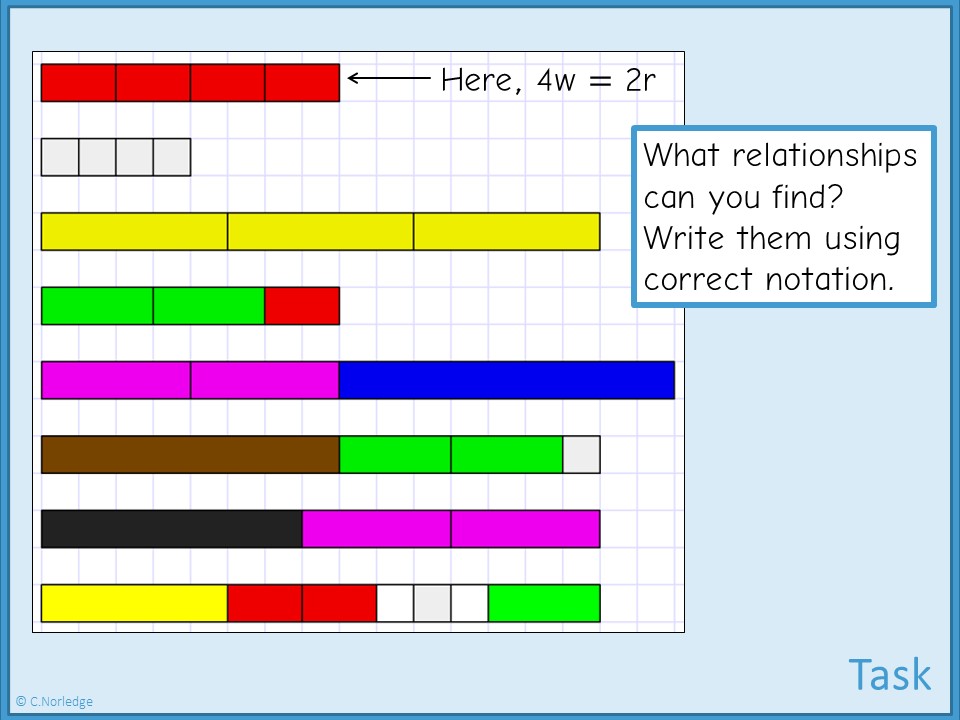
I wasn’t planning to do any work with equations, but as we had a spare ten minutes, I just asked them to spot any “relationships” – I didn’t use the word “equation”. They came up with loads:

A couple of really interesting things came up here. Firstly, the four-part equation (5th line down) seemed really natural to most of them, and they were comfortable with the fact that if A = B and B = C then A = C and so on. Secondly (and it’s boxed because we talked about it quite a lot), the last two equations came from the 1st and 4th rod pictures – there’sย soย much scope here for further work on equations!
โ€‹
(Header image: By Celcom, CC BY 3.0,ย commons.wikimedia.org/w/index….)

Cuisenaire rods and introducing algebra Read More ยป

Cuisenaire rods for algebraic expressions

I’ve spent quite a bit of time so far over half term working on the resource areas of my site – one topic I was keen to get a few more resources for was writing algebraic expressions and using correct algebraic notation, as I’m teaching this to Year 7 after half term and my collection was looking a little sparse. 

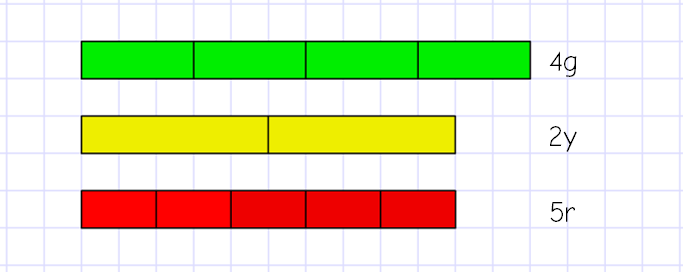
Today I’d also found a link to the Cuisenaire Rods manipulative on the NRich site, which is absolutely fantastic. I remember discovering a dusty old box of rods in the resource cupboard during my NQT year, digging them out and then not really doing anything relevant with them because I didn’t have a) the time or b) the experience to work out how to use them without just confusing the pupils more. I’d always been determined to go back and check them out properly though, particularly with the links to the work I’ve been doing with algebra tiles. โ€‹Obviously the first thing you can do with them is just use them to illustrate multiplication as repeated addition and get pupils to have a play around writing expressions for these:

While making these examples, I realised how easy it is to accidentally create equations – from this picture, we have 2y = 5r and a visual link to y = 2ยฝr. Similarly, there’s 2g = 3r, giving g = 1ยฝr. Depending on how comfortable pupils are with fractions and inverse operations, you could delve even further into writing r in terms of y and g – but that’s a blog for another day, I think!

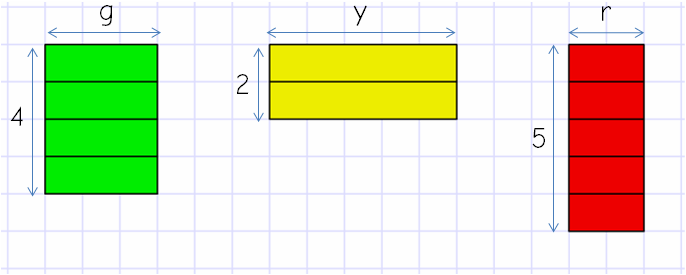
Stacking the blocks one under the other clearly links repeated addition, multiplication and area:

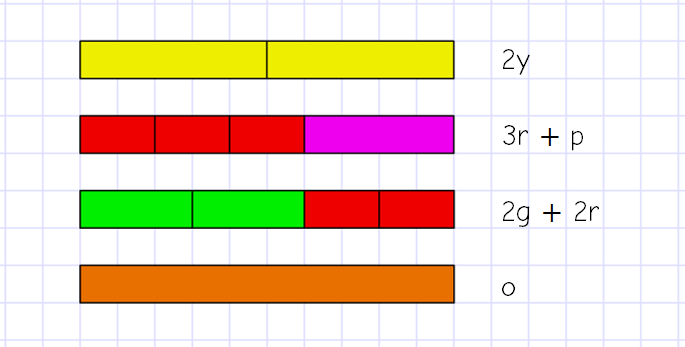
This can then develop easily to multi-rod (variable) expressions:

I’ve deliberately picked sets of rods that are 10 long, and I’d envisage that a further discussion about the equations we could make would happen in a classroom situation. Off the top of my head, you can spot 3r = 2g, p = 2r, 2y = o and then other relationships by picking fractions of one amount or another.

Unfortunately, without delving further into work on equations, you can’t really represent subtraction or division. Despite this, I think using the rods might be a great way into a topic that pupils find really difficult – I’d probably have a play with these for a couple of lessons before moving on to algebra tiles and introducing squares.

Also unfortunately, I am no longer at the school with the dusty box of Cuisenaire rods in the stock cupboard, and as far as I know we don’t have any kicking around anywhere at my current place, so I’ll be playing with the manipulative only. However, I am pretty tempted by this funky set of fridge magnets on Amazon…!

EDIT:ย I’ve nowย written a resource to test outย when I get back to school; I’m probably going to leave the second slide to start with, as I don’t want to muddy the waters by teaching equations and expressions at the same time.ย 

(Image credit: By Celcom, CC BY 3.0, https://commons.wikimedia.org/w/index.php?curid=9511548)

Cuisenaire rods for algebraic expressions Read More ยป