Year 9 and I have been working on algebraic expressions this week, and the lesson I taught yesterday was successful enough to deserve a “Lesson of the Week” post.
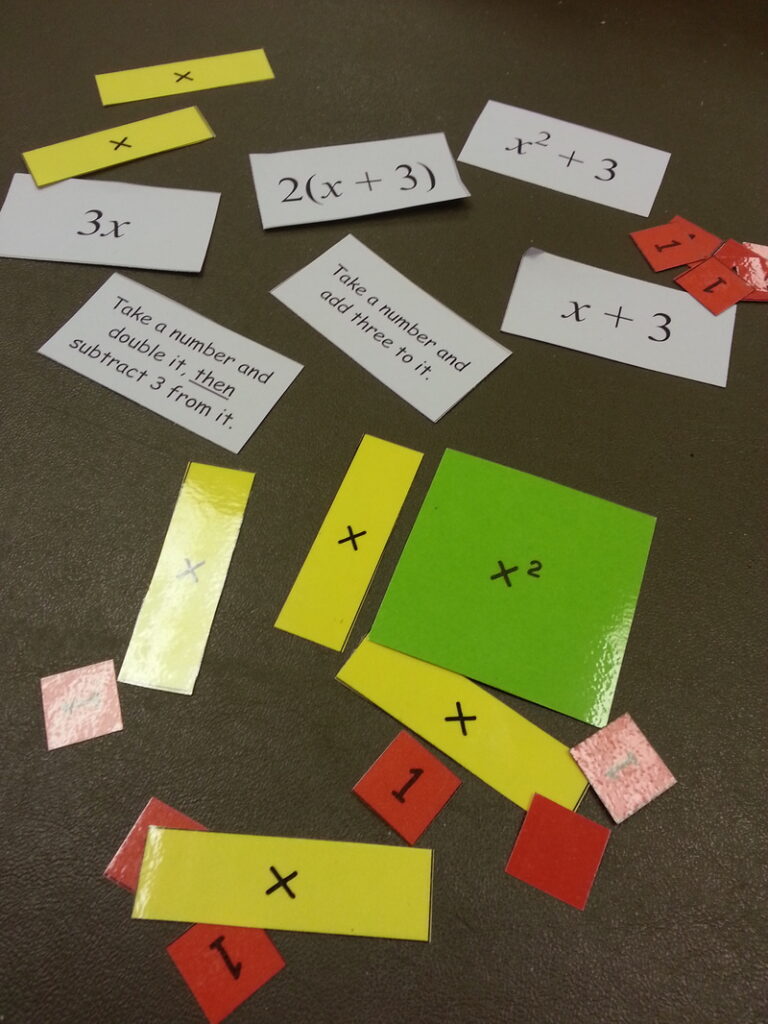
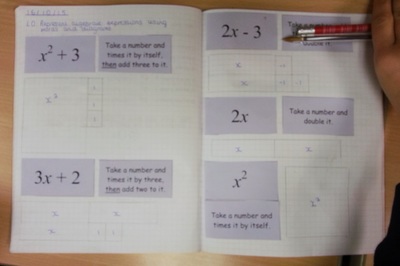
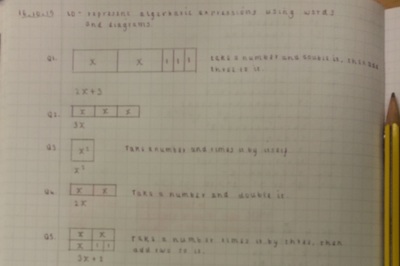
We did the Standards Unit card sort earlier in the week, which was far more successful than usual, possibly because I attempted to structure the activity far more than I have done before. After a starter on area of a rectangle, the pupils sorted out the diagram set first, copied these into their books and worked out the area using their own terms before then matching the words and algebraic expressions.
Yesterday, I’d photocopied this great resource from Tim Buckton and was planning to use it as a straightforward ten-minute cut and stick, but as I had a spare half-hour of PPA before the lesson, I decided to plan and try something a bit different.
I’d not used algebra tiles with this group before, so I decided that this was an opportune moment to introduce them (you can read more about my love of algebra tiles here). I’ve found that some pupils can be quite resistant to using manipulatives at KS4, so I’m trying to get the tiles in early so my class are used to them to support all our work on algebra.
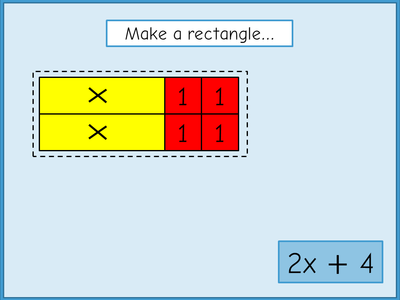
I started the lesson with a quick introduction / explanation of the tiles, with a couple of example diagrams. In order to emphasise the area links (and for later work on factorising), I demonstrated making a tile arrangement into the “best” rectangle I could.
After we’d done this bit, I gave each pupil a pack of tiles and the card sort, spacing them out one per desk so they didn’t get all their cut-out bits and diagrams mixed up with their partner’s.
The activity worked really well in terms of engagement for most, and I had lots of discussions with individual pupils revealing and quashing lots of common misconceptions.
We addressed:
x + 3 is not the same as 3x
x^2 is not the same as 2x
The interpretation of 2(x + 3) as “2 lots of x + 3” – physically finding x + 3, then finding another lot, then putting the two lots together.
I’m planning to explore the area idea in a little more depth next week.
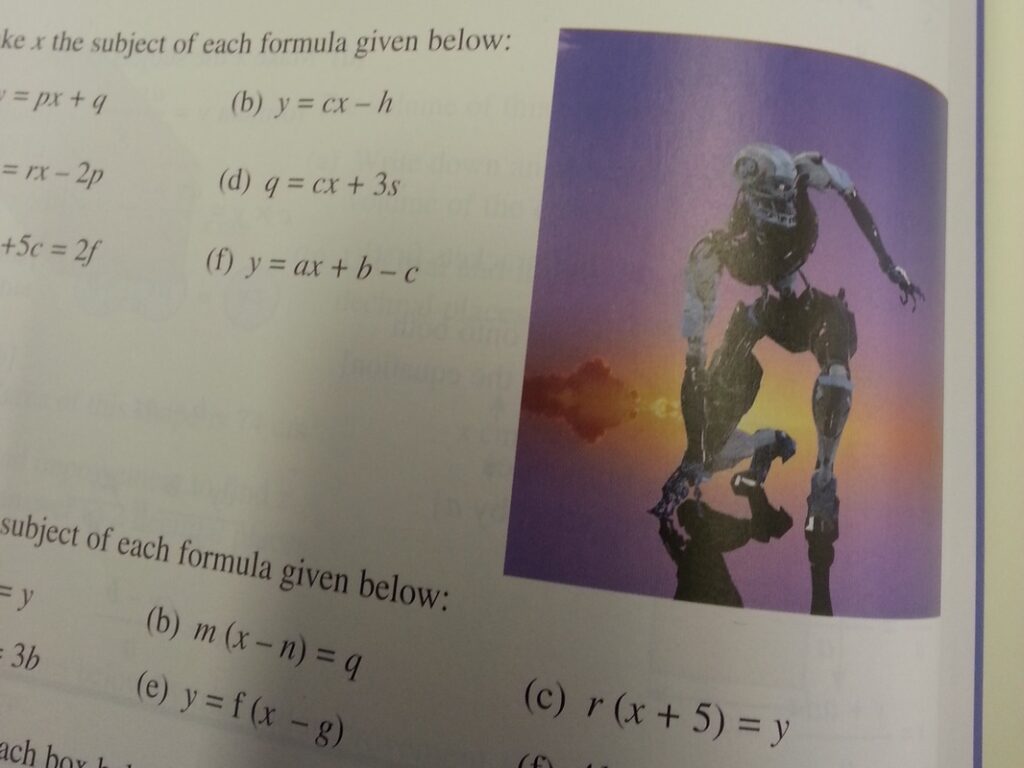
This picture completely mystified my Year 10 class this week…
To put things into context, we were working on a standard set of simple rearrangement (for them) of formulae, with absolutely no real-life context (contrived or otherwise) mentioned in the questions. The textbook authors appeared to have just plonked an image of a scary-looking skeleton (reminds me a little bit of something from Terminator?) right in the middle of the exercise.
I’ve been thinking quite a bit about the design of resources since attending Amir Arezoo’s workshop at #mathsconf5, and I did promise a more in-depth post at some point, so I figured that Terminator/Skeleton was as good an excuse as any. The workshop was titled ‘Design Cues for Great Resources’ – I do love excellent quality teaching resources, and making teaching materials is one of my big passions, so signing up seemed like a no-brainer.
(I apologise in advance for the atrocious quality of the images in this post – by Workshop 3, my phone had properly died, so I was taking these using my tablet, which isn’t the greatest…)
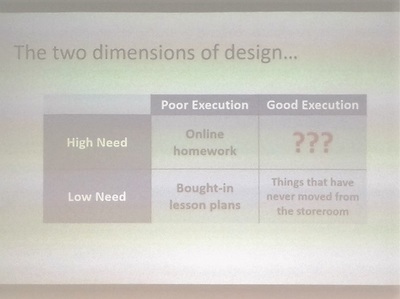
Dimensions of Design
This look at the dimensions of design (everyday on the left, teaching-specific on the right) was really interesting. The High Need/Poor Execution box contains all the necessary evils – we all know how many issues there can be with online homework, but it does make marking significantly more manageable and usually offers at least some independent support for pupils if they get stuck. I’ve moved away from using quite so much bought-in online homework this year, as I decided it was more trouble than it was worth – but that’s fuel for another blog post.
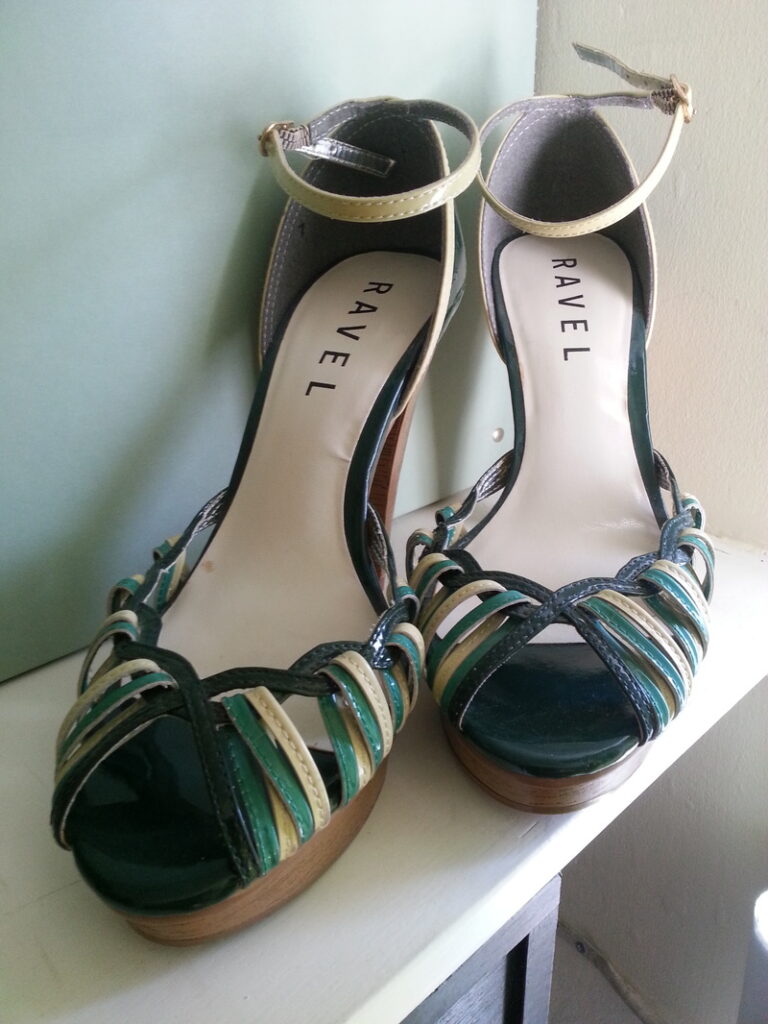
Something that I felt had implications for me, both as a teacher and a sharer of resources was the classification of bought-in lesson plans in that Poor/Low box. The parallel with high heels is so perfect that I had to break off typing this to go and take a picture of this pair of shoes.
I saw these in TKMaxx about four years ago. I tried them on – they were a little high, but I thought I could cope. At a price of less than £10, I decided they were too beautiful to leave in the shop.
They have sat in that position on a shelf in my house since about a week after I bought them – I’m lucky that they’re green, and complement my lounge so well, otherwise they’d have gone in a box in my wardrobe long ago. I physically cannot wear them for longer than about five minutes, not because they make my feet hurt, but because they are so high that I end up walking like a baby giraffe, completely contrary to the chic, sophisticated look I was after.
My computer is similarly filled with the teaching equivalent of these shoes – resource packages which seem amazing, but when you actually try to use them, they’re completely unfit for purpose in your specific setting with your specific pupils.
Every year I try to save complete lessons or even topics on my computer, thinking that I can just use that lesson as it is next year, but inevitably end up pulling it apart, reshuffling, adding in or taking away as appropriate. This year I’ve started saving tasks rather than lessons, which has made planning much, much easier, and any of my new uploads on here will be organised in a similar way.
Visual Design
The picture I took for this bit isn’t even worth putting up, as you can’t read it, but I was pleased to know that I’m not the only one who’s slightly OCD about how my resources look. All the way through university, my friends used to laugh at me because I had to write up my lecture notes in neat at the end of every lecture, using a particular pen and outlining definitions and lemmas in a particular pen. Maybe it’s just me, but I really can’t revise from messy notes, and I similarly can’t teach from badly-formatted resources.
The key features that Amir highlighted were:
Colour
Typeface
Use of spacing/formatting
Imagery
Badly spaced or formatted question sets really annoy me – consistently modelling the correct way to write a fraction seems a little pointless when a resource insists on writing it as 1/3 rather than placing the numerator above the denominator (yes, I’m annoyed now that I can’t do it properly on here either!).
I use questions on the whiteboard far more frequently than I use textbooks, because it’s much easier to set exactly the work that you want to – I think it’s incredibly important to space questions so that pupils aren’t confronted by an intimidating wall of words or symbols. Twenty questions looks far more approachable in two neatly-spaced columns of ten than in one squashed list of twenty.
Typeface is another big one for me; although I genuinely do not understand the hate for Comic Sans in teaching resources, I know that a lot of people really don’t like it, so I’m designing a lot of my newer (shared) resources in a less contentious font. I did agree with Amir’s point about consistency of font use – too many different fonts on a resource, and it starts to look confusing and cluttered.
The thorny issue of images brings us back to the picture at the start of this post – I’m a firm believer that images, unless directly relevant to the topic you’re teaching, or adding something to the instruction, need to stay firmly off teaching resources. In my experience, rather than engage pupils, they actually create more distraction as pupils either a) end up thinking about or processing features of the image, rather than the mathematics or b) get completely distracted and start talking / thinking about wider contexts. I used a resource once that had a Simpsons character on the plenary slide… never again. The resource was superb, but about half the class got distracted by Bart at the chalkboard, and I then had to pull them back to the task again.
Instructional Design
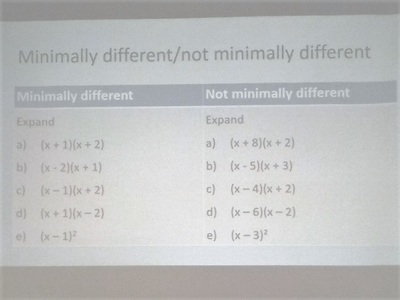
Both of these ideas are things I’d like to investigate further – I’ve seen the idea of minimally different questions mentioned in a few blogs, but finding pre-made resources is difficult, and creating a set of problems like this requires significantly more time and effort than “making some questions up” or using a question generator. The left-hand list for expanding quadratics would certainly remove some of the cognitive load for pupils still struggling with quick recall of multiplication tables, while simultaneously getting them to think very carefully about the impact of directed numbers and symbols.
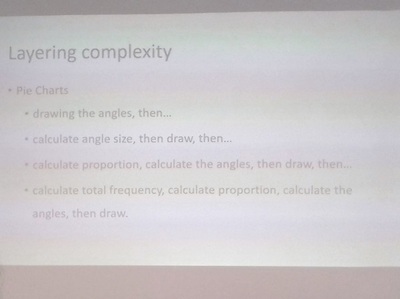
I really want to try this approach to teaching pie charts, and also start to look for other areas where complexity can be layered gradually, rather than giving a long method for pupils to try to follow all at once. I think this is done naturally to some extent with topics such as solving equations (begin with one-step, then move to two-step, then unknowns both sides), but I’m going to keep my eyes open for other content areas I can try this.
Use and economy of language is an important consideration (particularly pertinent when choosing exam boards); I’m guilty of setting problems that contain a lot of useless or irrelevant information, because I think I’m getting the pupils to practise their problem-solving skills. Realistically, I know from experimenting with Year 7 last week on ‘wordy’ problems that they’re usually very capable of working out what’s irrelevant and removing that, and are actually getting hung-up on the mathematics involved. Couple this with the fact that all the pupils who struggle with literacy are having to work significantly harder, and I think I’m going to be using a lot more context problems like the set on the right from now on, particularly when my focus is on them developing their mathematical and problem-solving skills.
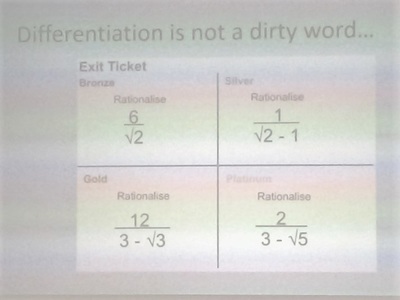
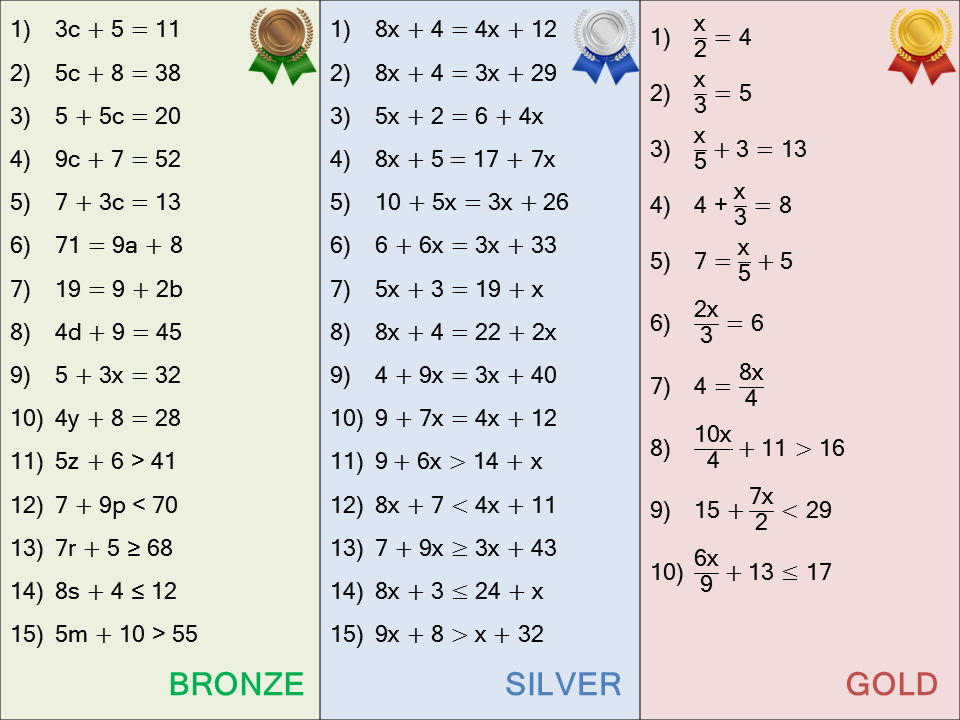
Finally, the idea of using bronze, silver and gold to differentiate rather than red, amber, green has already made its way into my teaching. Our move to some mixed ability this year means an increased amount of differentiation, with some pupils consistently working on what I used to call the “red” activity. It’s not made a perceptible difference in the classroom, but I certainly feel much better talking about “the bronze questions” rather than “the red questions”. Here’s one I used for linear equations and inequalities this week:
As I mentioned in my blog about #mathsconf5, I’ve recently acquired a Microsoft LifeCam for my classroom and I’ve been playing with it rather a lot this past week. I need to take some photos of the setup in my classroom, but it’s basically a small portable plug-and-play webcam with accompanying software to take pictures, videos and audio. So far, I’ve only used it to take pictures during lessons, but even that has been incredibly powerful, and my pupils have shared some brilliant work and ideas.
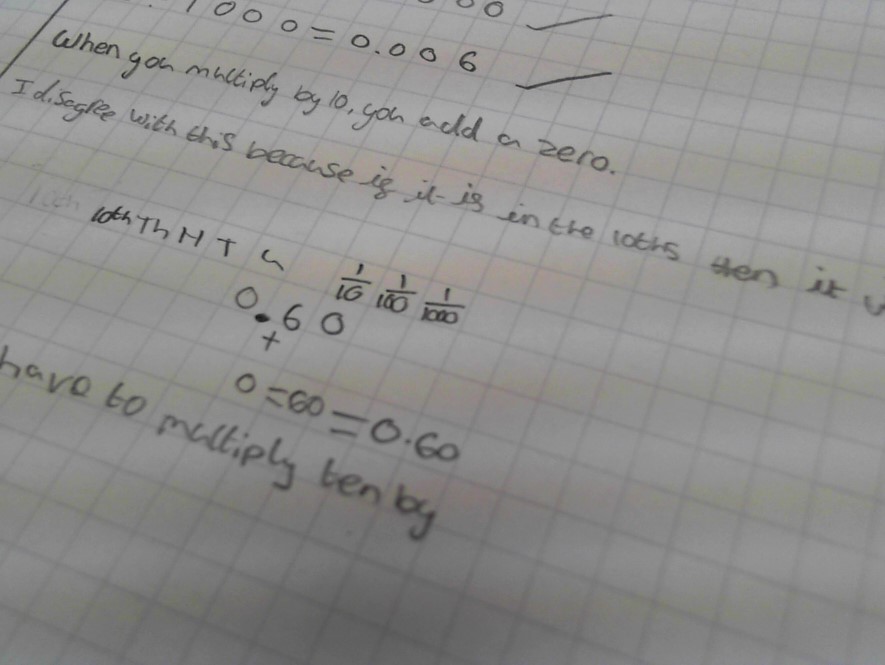
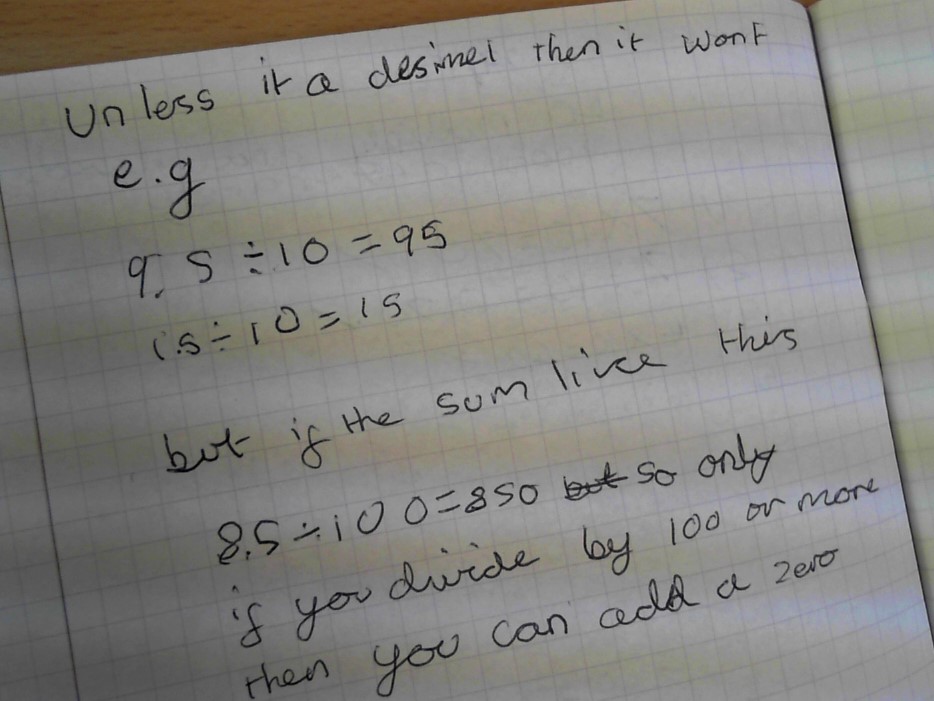
Multiplying and dividing by powers of 10 – Year 7
Amy says “when you multiply by 10, you add a zero”. Is she correct? Explain.
At the end of a lesson about place value and multiplying/dividing by tens and hundreds with Year 7, I asked them to write a short response to the above question. You can get the resource here.
I usually get pupils to do this activity when we work on place value, as it exposes a lot of misconceptions. Being able to take pictures of pupils’ responses and immediately put them on the board meant that the discussion was much richer this time around.
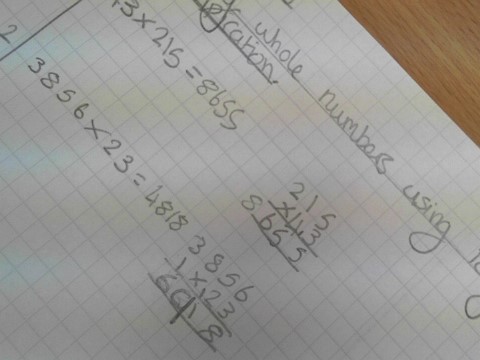
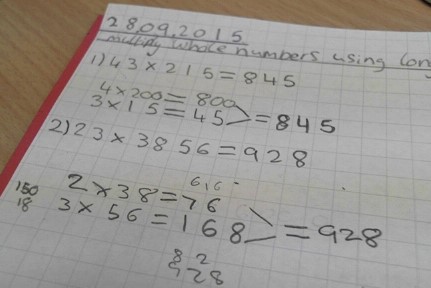
Written multiplication methods – Year 7
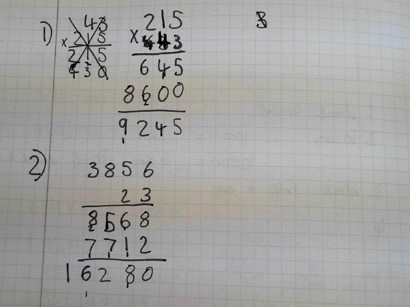
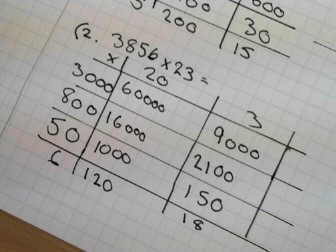
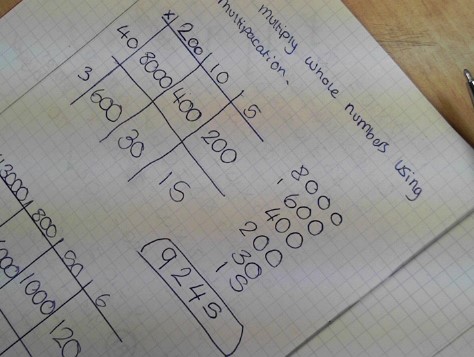
These ones come from the same class – we did some work this week on multiplication methods. I asked them to tackle two multiplication problems using the methods they already knew (you can read about my approaches to multiplication methods here), then asked for pictures of their work, trying to capture all the different methods.
It was great to play spot the misconception with this one!
I also pulled an example of long multiplication and the grid method for the same question onto a PowerPoint slide pretty much instantly, then we annotated the similarities and differences between the methods, trying to “spot” one in the other.
Improper fractions and mixed numbers – Year 8
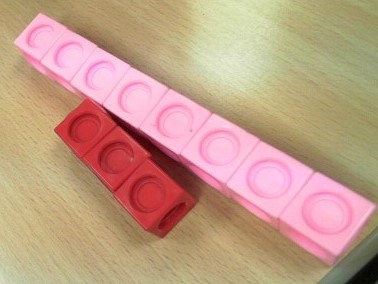
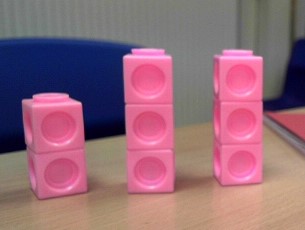
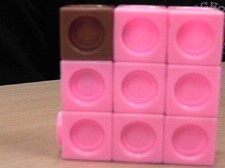
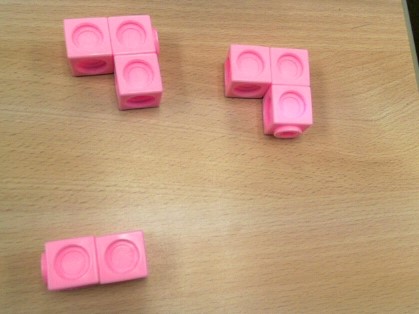
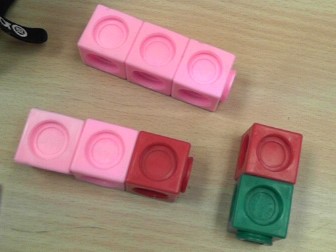
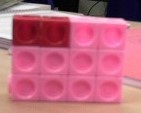
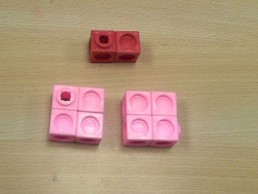
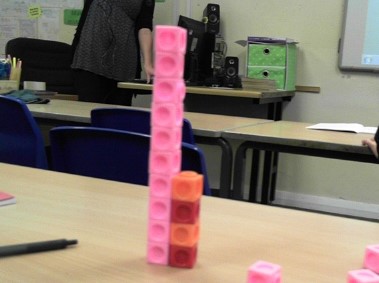
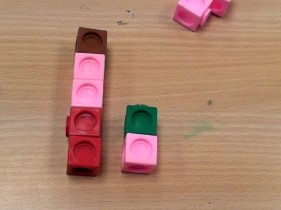
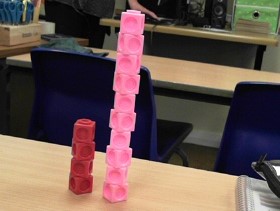
Reviewing improper fractions and mixed numbers using multi-link cubes with Year 8 seemed to cry out for using my LifeCam – I asked them to build models of 8/3 and 10/4 using the cubes, then we used the photographs to discuss the similarities and differences between each pupil’s model. I then used pictures of their models to illustrate a key point in today’s lesson about adding mixed numbers.
8/3
8/3
I thought this array representation was really interesting.
This is me trying to hold the cable really high in the air to avoid garroting pupils – a wireless camera would really be an ebi!
We had a great discussion about this pupil’s interpretation of 10/4 and how she’d arrived at her representation.
Subtraction using regrouping – Year 8
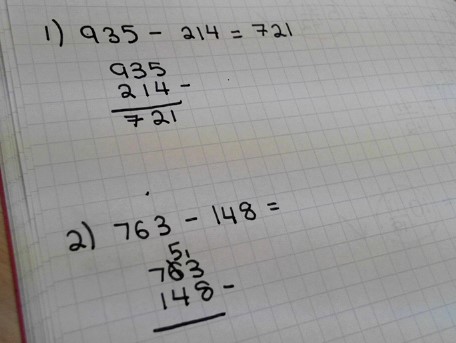
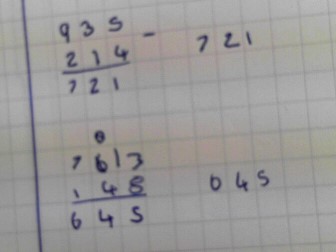
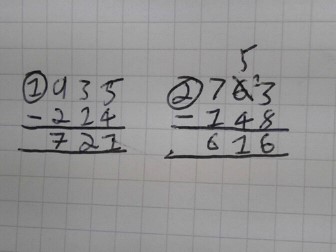
Finally, I decided to give subtraction of mixed numbers using regrouping a go, so I got the pupils to tackle some whole-number subtractions first, so we could discuss the strategies they’d used.
Another powerful feature that comes out of this is that pupils seem much more willing to check and correct their work when they see a peer’s solution than mine on the board. The pupil with the incorrect answer here quickly spotted what he’d done wrong and explained how to correct it to the class.
A couple of people asked me at #mathsconf if these were expensive; my response is I have no idea what we paid for the ones we have in school – it may be that they can be purchased more cheaply in bulk. The one I linked at the start is pretty reasonable (RRP about £45), particularly as the picture quality goes up to HD, the camera functions fairly well in very low light conditions, focuses quickly and is pretty “shake” resistant when taking pictures. I can’t comment on the audio or video specs currently, as I’ve not played with those yet, but watch this space!
This is likely to be a short-ish blog, with more detailed posts about the really good bits later this week. I don’t know if it’s just me, but spending seven hours in a hot leisure centre has given me the worst headache, and I really want to be curling up on the sofa with a cuppa and a film now. However, I am a) determined to win the blog war this time and b) need to jot down the basics before I forget, because my handwritten notes are pants, so here we go!
Bigger or just better?
I arrived late (as per), then didn’t have a badge, then ran to my seat with a coffee just as Mark was starting the opening address – maybe this is why I felt like we’d got onto the speed dating session before I’d even had time to breathe. I certainly feel like we spent a lot less time listening at the start, possibly because there were five rather than four workshop to cram into the day.
The packed programme aside, I also felt like there were more people in the room than either of the previous two, and there seemed to be less no-show badges than usual. Clearly the word’s getting round that mathsconf is the place to be, and even the fact that it’s no longer free didn’t seem to be putting people off. The atmosphere was amazing again; seeing all those teachers and other professionals giving up a Saturday to talk maths education really is ace.
I also felt like I got at least one takeaway from every workshop I attended, and a couple of them were really good – but more later.
Speed dating
I cheated and found a picture of my latest teaching toy on the Internet – our History department gave me a Microsoft LifeCam to play with this week, so I talked to people about that (there’s a blog with pics planned soon). I picked up some fab ideas, including
A great prime numbers “Say what you see” activity/lesson from @TheNerdLP, which I took a picture of but my phone is dead – she promised a link Tweet-out though;
Using “Hot Potato” questions at the start of a lesson – give pupils ten questions on the board, their timer starts as soon as the first person enters the room. After a certain time limit, get all pupils to stand up and (differentiating the questions) throw a soft ball to each in turn, getting them to give an answer. Unfortunately I forgot to get the name of this date!
As my badge had gone AWOL and I had no idea which workshops I’d signed up for, I decided to go with the flow and just see what I fancied.
Workshop 1 – Effective Differentiation: Support, Stretch and Challenge (@MissBsResources)
As Danielle berated me at the last #mathsconf for having never been to one of her workshops, I decided to pop along to this first. The room was rammed (due both to the popularity of her session and a labelling mix-up), but I snaffled myself an eager-beaver seat at the front.
I scribbled down a few nice ideas during her talk, and there’s certainly a lot of ideas here for new teachers. I really liked:
Writing a learning objective in the format “Be able to… so that…”, including a real-life link where possible, so that pupils understand the relevance of their learning;
The “learning journey” cards that explicitly told pupils what they would be looking at in a two-week section with differentiated objectives;
Making pupils read the question, rather than copying the steps of your example from the board, emphasising command words (I have posters), otherwise they’ll be unable to apply skills in exams;
Adding a “Red Herring” problem in to stretch the top end with topics that are typically hard to stretch, such as using a graph showing positive correlation (number of bees and ice-cream sales) but no causation;
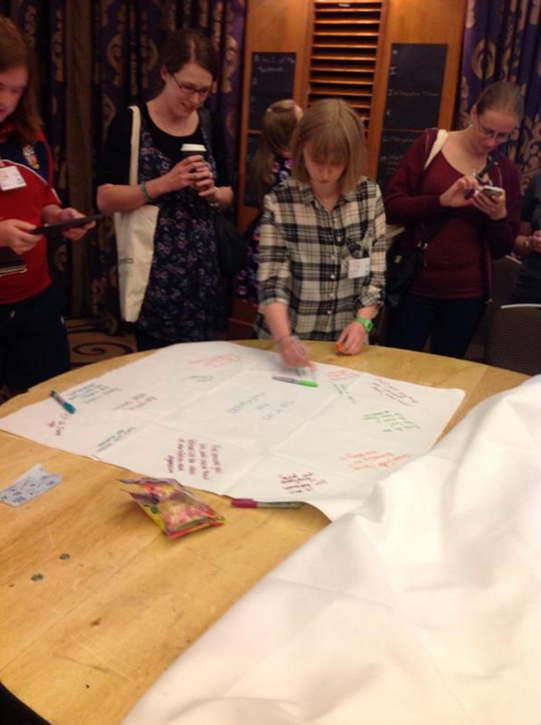
My physical notes for this were quite short, mostly because we spent lots of the session playing with bits of paper. We started by trying to fold different shapes out of squares and circles, which we all got really involved with; @mathsjem took this picture of our table.
Jenny had a few nice suggestions for using the shapes we’d made, including:
Classifying shapes using Venn diagrams made from hula hoops;
Proving or reasoning about observations about lengths and properties;
Finding the area as fractions, perimeter, using Pythagoras;
Using A-sized paper to fold and find the perimeter of a kite (with A Level students).
I got my circle theorem turned into a badge, which was pretty awesome. I did get a few weird looks when I accidentally wandered round Asda still wearing it though…
Workshop 3 – Concrete Approaches to Abstract Mathematics (@MrMattock)
I really enjoyed Pete’s session; it was stuffed with takeaways and he was really entertaining to watch and listen to. I’m trying out one idea for solving equations this week with Year 10, so will blog about the successes (or otherwise) of that later in the week, but rather than explain all the great ideas, I’ve just been on his blog and pulled out the relevant posts:
Mean average – why you shouldn’t talk about “adding, then dividing”;
Finally, this approach to adding and subtracting directed numbers, which I’m going to try next time I teach this topic.
Workshop 4 – Design Cues for Great Resources (@WorkEdgeChaos)
Give me a workshop with ‘Resources’ in the title and I’ll be there, so the Sh****ai talk got ditched so I could go along to this instead. I hope Amir intends to blog about what he said in this workshop, because I’m pretty sure I can’t remember or explain what he was on about as eloquently as he did. I scribbled a load of cue-words down, but my biggest takeaway was that resource design should be about creating something that fulfills the necessary teaching or learning requirement, rather than worrying about pupil engagement or having fun. I’ve added this to my hit-list of things to blog about later, and I have a few photos to upload when I dig my phone out.
I was really chuffed that Amir mentioned one of my resources in the session, and not just to call me out on my use of Comic Sans!
Workshop 5 – Resources for Teaching AS Maths (@mathsjem)
As Jo’s one of my favourite ideas people on Twitter (she’s in my Pick of Twitter every week without fail), I decided to go see her rather than Kris Boulton’s “Stories of Maths” workshop/talk in the main hall. I caught the last bit of Kris’s talk about the origin of the word sine, and it really sounded great, but I don’t regret picking Jo’s workshop for a second – it filled a very necessary gap in my current teaching practice, namely that my A Level teaching, while perfectly functional, is not the most exciting or varied on the planet.
I’m not going to preempt Jo’s blog on this, as I’m sure she’ll do her material far better justice. I really enjoyed some of the puzzles we worked on and looked at, so look out for a few blogs from me soon about how I get on with using these in the classroom.
Despite the fact that I said this was going to be a short post, I’ve been at it for long enough to drink three cups of tea, eat a load of pizza and half-watch half a comedy show – I’m still feeling far too enthusiastic and keyed-up at such a great day (my headache’s also dissipated now, which is a bit of a bonus). I only feel like I’ve scraped the tip of the iceberg of things I’ve picked up from today, and I haven’t even gone near reading most of the rest of the #mathsconf5 hashtag.
I’m sure I’ll be trying lots of new things or reinvigorating old ones over the next few months – keep checking the blog for updates if you want to see how things have gone!
Last year, I solemnly vowed that I wasn’t going to use textbooks in my maths lessons. I started the year with a variety of card sorts and problem-solving activities. I even arranged my tables in groups rather than rows from the word go to encourage collaboration. The first few weeks went well, but by half term I was exhausted and the novelty of Tarsia puzzles and Standards matching cards was wearing off for the pupils.
I spent the second half-term really unwell – I ruptured my eardrum and went deaf for a week and a half, then spent three weeks with the most painful sinuses I’ve ever experienced. I dragged myself to the Christmas holidays in a very sorry state. I don’t think this was anything to do with the brave new classroom I was foolishly attempting to create, but I realised that if I wanted to remain functional enough to be in school, I’d have to be a little “easier” on myself in terms of lesson planning.
I really felt a little guilty getting the textbooks back out of the cupboard in November, because I feel like “textbook” is a dirty word in mathematics teaching for some people. There’s an implicit idea that a teacher who uses a textbook is somehow lazier or less pedagogically secure than a teacher who doesn’t, and I guess this is why I went off half-cocked on my “textbook ban”.
Over the last twelve months, though, something has shifted in my mind with regards to my teaching practice. Maybe it’s ever-increasing experience, or maybe it’s because I’ve played around with so many different ideas and pedagogical theories, but I’m now much more comfortable in doing what I know works for me and the pupils in front of me. I quickly realised that my idea of working purely with physical resources and no textbooks wasn’t something that I thought was a good idea, it was what I thought I should be doing – I’m not sure where I got this notion from, as we don’t have any kind of policy in our school about the use or otherwise of textbooks.
The school I worked at in my NQT year didn’t have class sets of textbooks; this was both freeing and really, really scary, as I spent a lot of time sourcing resources from elsewhere. While I felt like it challenged me to look for other options than a textbook (I discovered a dusty set of cuisenaire rods in the storeroom and had a lot of fun with them), our photocopying budget was astronomical. As a department, we spent a lot of time doing the old-fashioned cut-and-stick to splice together worksheets from a variety of old books and sources** – this had the advantage of creating a worksheet that did exactly what we wanted for that lesson, but meant that each lesson took an extra 15 minutes to resource.
At one point in the year, someone suggested getting round this problem by printing booklets of 10 Ticks worksheets by level and hard-binding them…
Even in the “textbook ban” lessons last year, pupils still worked on problems in their books. I’d get them to record their working and answers for the Tarsia puzzles we were doing, and I’d still put problems or questions on the board for them to do. After I ditched the stupid idea that every lesson could be a card sort, I went back to carefully selected worksheets and (as the year went on) picked problems out of the textbook.
I suppose that’s the real problem with textbooks – they never do exactly what you want them to. We may as well bin the “teaching” and “examples” steps in them – I’m yet to see a decent UK GCSE textbook that pupils could actually use to teach themselves maths with any depth of understanding. In fact, if we ripped all those bits out, it would make the flipping things much easier to carry around and give out!
What I really want out of a textbook (and I haven’t found it yet) is a set of practice exercises that are chosen and written really really super-carefully. Some textbooks are completely illogical, with thirty easy problems, then a few “hard” ones at the end, which have usually been made more difficult by putting negatives or fractions in, rather than by actually increasing the difficulty or level of thought into the topic actually being learned.
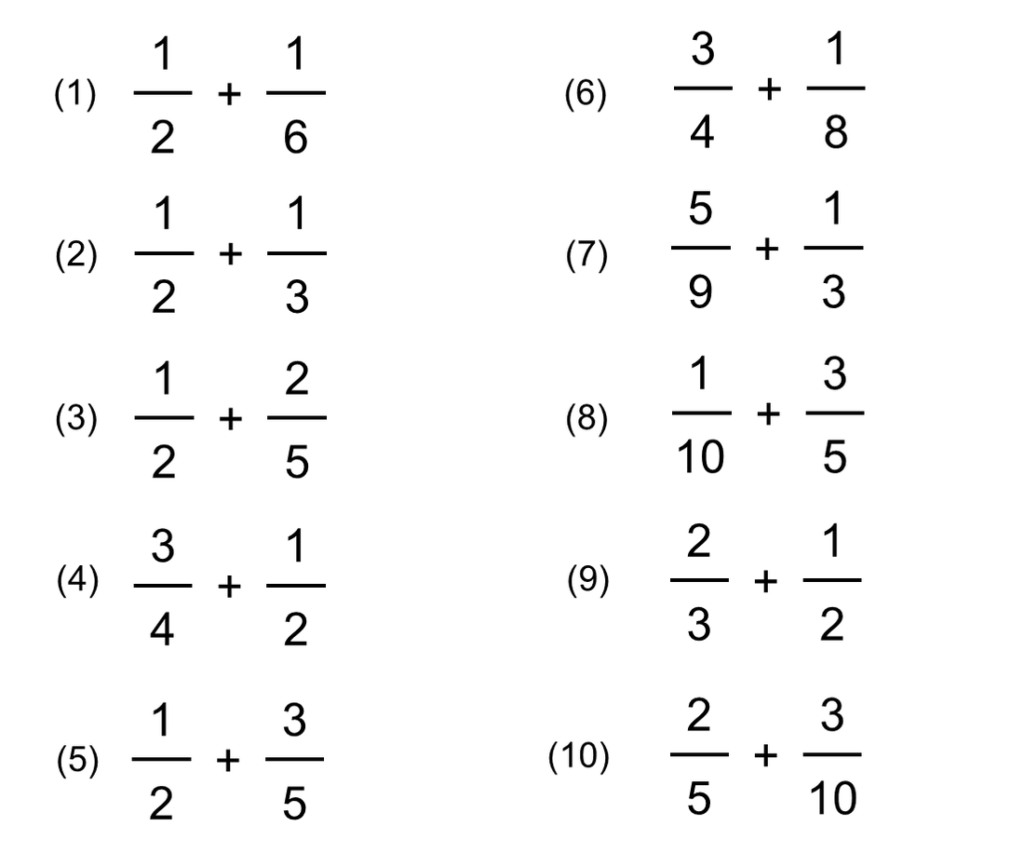
The reason all this waffle happened today is because I had a major faff trying to source some suitable adding fractions questions for my Year 9s. We’ve been working with bar modelling, and spent nearly a week playing with Which is bigger, so I wanted ones with sensible denominators. I also wanted to avoid them using “THE METHOD” to get a common denominator, namely multiplying the two denominators given, and actually engage their brains to think if there was a smaller common denominator first. Both sets of GCSE textbooks, even the Foundation book, gave two worked examples using the cross-multiply method, then within two questions pupils were expected to work with a common denominator of 24, which is all well and good for those who can work with equivalent fractions, but awful for the ones who can only do it using a bar at the moment.
See, now this is what I’m talking about! Sensible denominators, with most one as a simple multiple of the other – encouraging pupils to pick a sensible LCD rather than cross-multiplying (those who didn’t had a lot of cancelling down to do).
I really like how improper fractions crop up as early as question 4 – they shouldn’t be treated as somehow “more difficult” just because the fraction happens to have a total over one whole.
I guess if there’s any conclusion to this piece of brain dumping, it’s that UK textbooks need to be better. We replaced ours a few years ago, and I wasn’t hugely impressed with what was out there – it always feels like selecting an “it’ll do” rather than “oh wow this will really improve my classroom practice”.
The second part of the conclusion is that, even in their not-perfect form, there’s still room for a textbook in the maths classroom. Some exercises are great. Some are passable if you carefully select questions. Sometimes you need to remember that book A is brilliant for topic B, but you may as well ignore it for topic C.
This year’s policy is a healthy mix – we’ve done problems together, worked examples, worksheets, problem-solving, different approaches, modelling and yes, I even got the textbooks out for one lesson last week. It would be really nice to have the perfect book; unfortunately, as that doesn’t exist, I’ll make do and mend…
** EDIT: I feel I need to add a clarification here following a comment on Twitter about copyright theft – the books were used as sources of information and (in some cases) syllabus guides when they were up to date. Questions came from licensed material and sites such as the TES or worksheet generator websites.
I’ve been super-lucky this year to get a top-set Year 10 group on my timetable – I’m feeling dead happy about this because:
I taught them in Year 7, and they’re a great group – very enthusiastic about maths, a bright bunch and some fantastic personalities;
I haven’t ever taught a top set at GCSE (because I teach A Level) and new experiences are always reinvigorating;
I get to teach all of the new GCSE Higher content and explore all that;
I’ll get to do the FSMQ with them in Year 11 (yet another new experience).
However, I had a mild panic when it came to planning their first lesson this week; having chatted to their Year 9 teacher, I discovered that they know quite a lot of typical (old) Higher content already, particularly the algebra stuff. However, I wanted to make sure that they’d really got it (linking in with our Mastery curriculum) and also begin to work on their problem-solving and reasoning skills a bit more.
The mild panic was induced by the fact that I had no idea where to pitch the lesson – I’m so used to working with C/D pupils at GCSE that I had no concept of what these pupils could do and how quickly. However, the first three lessons seemed to work really well; I’ve really enjoyed them (and I hope the pupils have too!), so thought they should be my lesson(s) of the week.
Starting with graphs
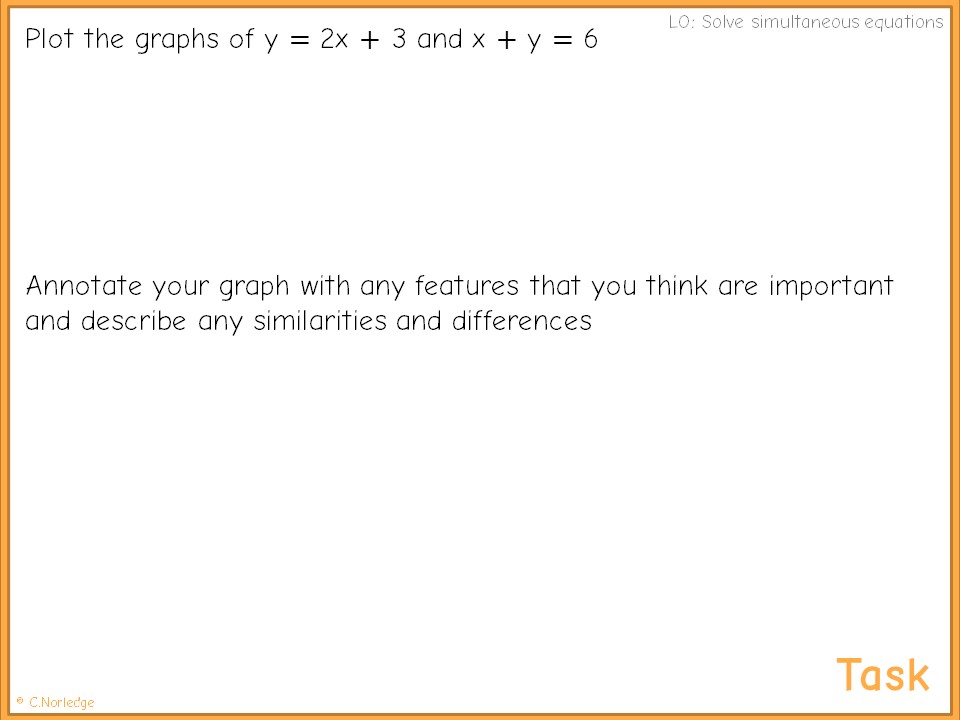
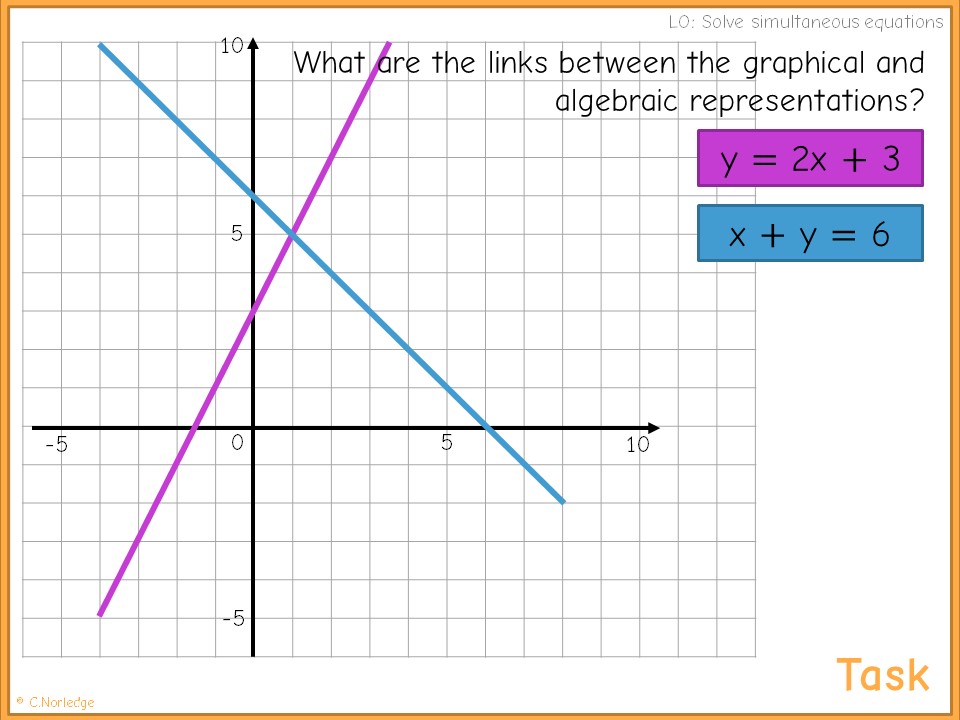
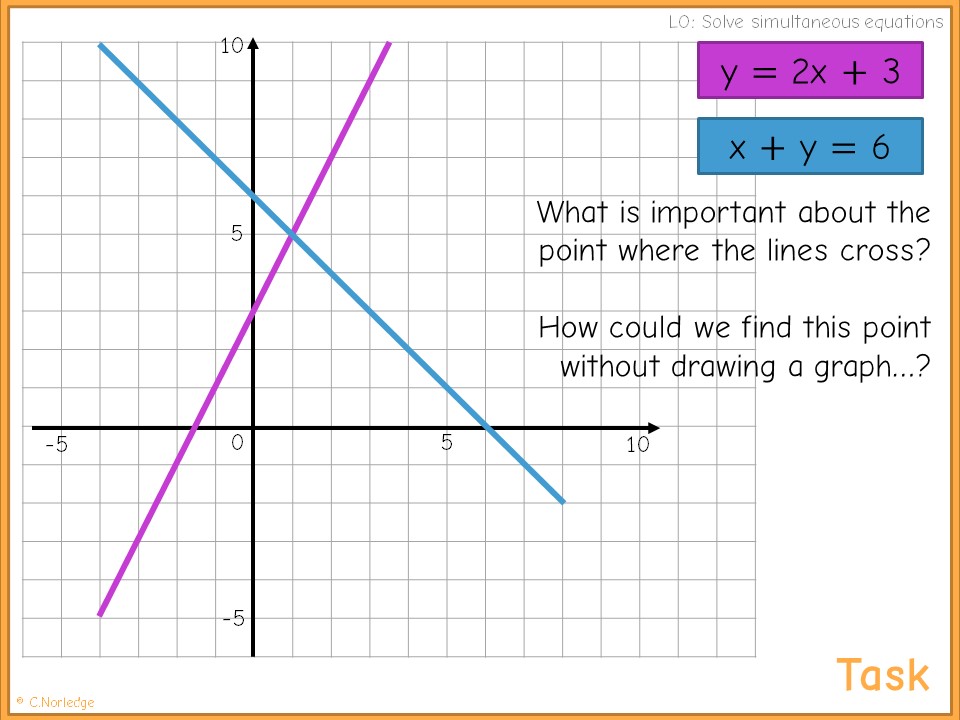
After going briefly through expectations (nice not to have to do a huge spiel on this as I already know them!) and GCSE changes, we spent about thirty minutes working on a graph of two intersecting lines.
I got them to draw the graphs (thereby checking that they could actually do this quickly and accurately – a couple did need reminders!), then annotate any features they could spot. We had a class discussion about what they could see, and talked about gradients and intercepts, intersection point, why this was important, the different forms (y = mx + c and ax + by = c), constants and coefficients – I was looking to make as many links as possible and probe for prior knowledge at the same time.
Moving to algebraic methods
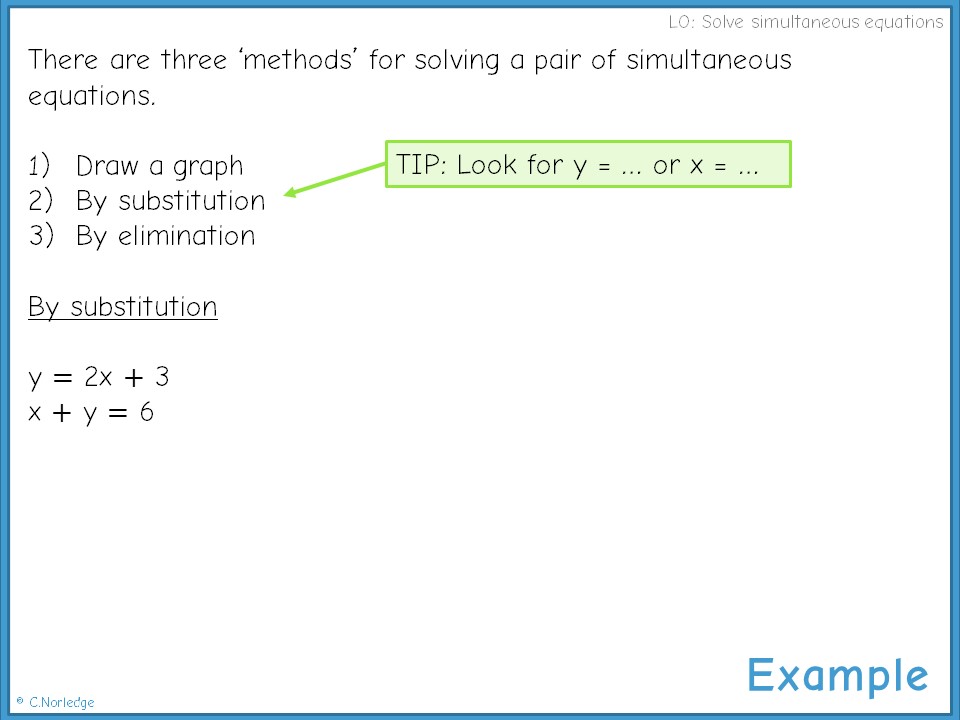
At the end of that lesson, I asked them to show if they could find the intersection point algebraically – when I checked the books, about half of them had made a decent attempt at this using substitution. We started the next lesson with a chat about advantages and disadvantages of graphical solutions, then talked about the other two “methods” they remembered.
I wanted to get away from the idea that they’d do this type by method x and this type by method y, so we talked about how they’d see these “methods” in revision guides, but really it’s just sensible use of the algebraic rules they already know.
The pupils then did some practice problems – I’d picked questions that ramped up gradually and threw some fractions and negatives in. They got on with it with limited assistance, which gave me time to circulate and check they were doing things like showing their working correctly.
The unsolvable question
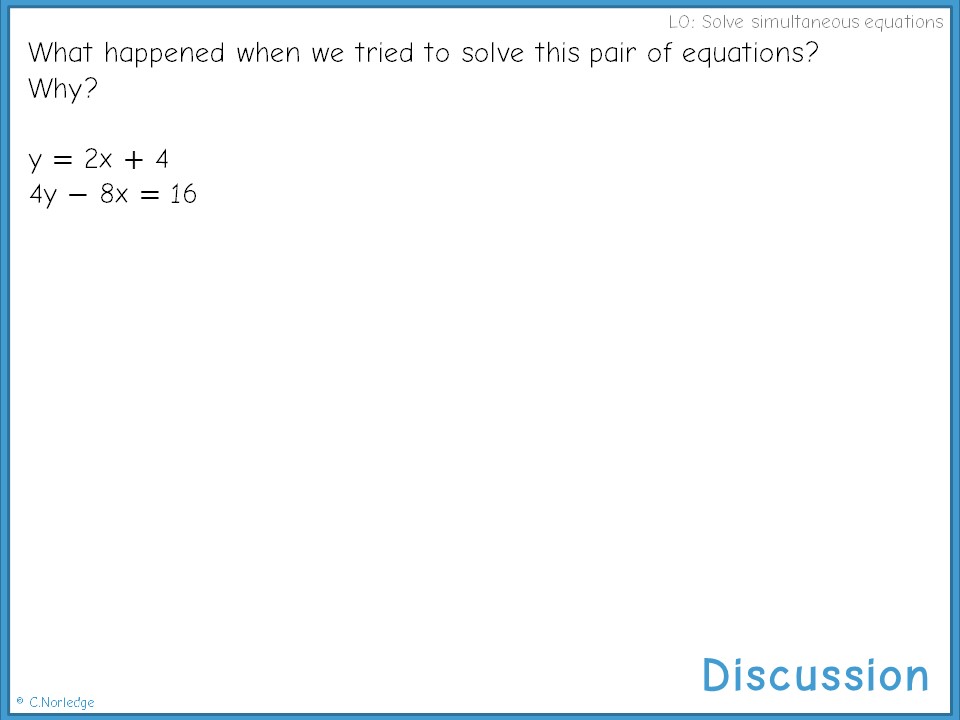
The final question in the set of problems was this one – the pair represent the same straight line, so this was an ideal final question for getting any early finishers to really think about what was going on. Some of the very fast workers are great at applying methods quickly and accurately, but need to work on thinking carefully and analysing what’s going on mathematically, and it was quite funny to watch the frustration that occured when the problem kept reducing to 16 = 16.
This led into an in-depth discussion in our third lesson about exactly what was going on in this situation; we had suggestions that the lines were parallel (as we’d discussed previously that parallel lines won’t have an intersection point), then someone realised that the second rearranged to give the first.
I used the Desmos Graph tool to demonstrate putting both on the graph, then we considered what would have happened with a pair of parallel lines – getting a contradiction rather than a trivial fact like 16 = 16.
My lessons with this group so far have run rather like A Level lessons (aimed at a slightly lower level) – lots of discussion, taking important notes, practise and modelling my thought processes and reasoning. Whether this works well as a model for getting this group to improve their problem-solving and reasoning skills, we’ll see as the weeks go on! I’m planning to start the next lesson with Matchless from Nrich to see how they tackle that.
We’re going to do some more work next week on modelling and using simultaneous equations (I’d normally start with this if pupils have no prior knowledge), then probably onto a similar treatment of one linear, one quadratic with links to graphs.
Starters can be a contentious issue; the term “starter” is a hangover from the days of three-part lessons in bite-size chunks, which seem to have fallen from vogue now. However, they are still a key part of my teaching, and today’s SBPC looks at why.
In my mind, my lesson “starters” fall into three categories, and they’re not mutually exclusive. Sometimes it’s appropriate to have a couple of “starter” activities (I’m dropping the quote marks now because I’m irritating myself). I once had a lesson starter that went on for the entire lesson, as it became painfully apparent that the class had completely forgotten to solve simultaneous equations, so my quick prior knowledge check turned into an off-the-cuff revision session.
I remember one lesson observation when I was told off for getting pupils to spend five minutes working on problems similar to those they’d solved in the previous lesson. I was told that they weren’t making measurable progress during this five minutes. I was only a newbie at the time, so didn’t want to argue with my observer, so nodded along, decided that I’d make sure I didn’t do it in observed lessons in future, but carried on doing it as part of my standard teaching practice.
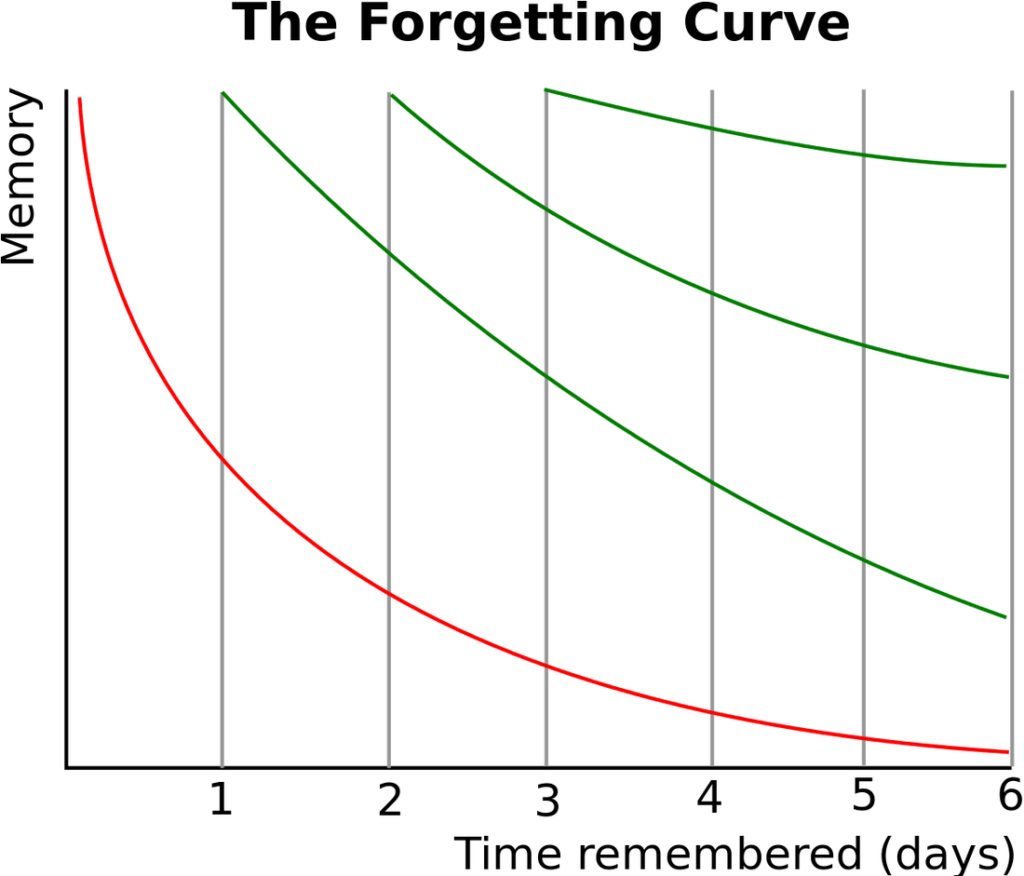
I still think that it’s really important to spend some time each lesson getting pupils to practise skills they’ve already learned. Read about the Ebbinghaus Forgetting Curve and this all starts to make sense (while you’re at it, read this post about blindly accepting research too – it’s good to know that Ebbinghaus is fine).
Pupils often ask me why I’m “so good at maths”. My response is that I use it every day – there’s not something innate in me that makes me a mathematician. I tell them about how I had to re-learn my times tables when I started teaching – although I’d learned them before, I was very rusty and my recall wasn’t as snappy as I would have liked, due to over-reliance on a calculator at university.
Spaced repetition
If you’re lucky enough to teach a class on consecutive days, they’ve already dropped to under 40% recollection of the previous day’s work. If there’s a weekend in between your lessons, you’re down to around 30%, although the drop-off does decrease as the time period extends. It gives validity to “Miss, I’ve slept since then”, but continued spaced practice is part of beating this curve.
In my mind, there’s no better time to do this than at the start of a lesson. While you’re sorting out who’s forgotten their book and who’s rocking up late, the rest of them can do something meaningful with their time, both in terms of overall progress (which can’t be measured meaningfully over five minutes) and in preparation for the learning they’re about to do, which is almost definitely going to link to what they did last lesson.
Whetting the appetite
Sometimes it’s appropriate to pick a short activity that leads into the learning for the lesson. This could combine with the spaced repetition activity, but might need to be something different. It might explain why the learning for that lesson is particularly relevant to real-life (avoiding pseudo-contexts, of course), or generate a discussion to lead into the main chunk of teaching.
Here are a few examples:
Starting off a lesson on square numbers by getting pupils to build squares out of linking cubes – this is then a springboard for discussion about why they are called square numbers and links to area;
Asking the class to think of or bring in examples of percentages in real-life, making the relevance of the topic you’re about to teach clear in their minds.
Showing a picture for discussion and asking them to identify any maths they can see in it, making sure the topic you’ll be doing is prominently featured – this helps to build links to other strands of mathematics.
A segue into the non-curricular
These are my favourite type of starter. They often get featured on particular dates, such as getting the pupils to sum the numbers from 1 to 100 on Gauss’s birthday, but occasionally I throw things in to keep everyone focused on the point we bother learning maths in the first place – not just to get a grade C (5?) but because it’s such an historically rich, fascinating subject. Let’s face it, the curriculum can end up pretty dry at times, and sometimes a nice puzzle or problem that’s never going to crop up on the syllabus but is interesting and challenging to do keeps me and the pupils awake and enthused.
Unfortunately, I’m really bad at not letting this type of “starter” take over my entire lesson. I once ended up teaching Year 7 about radians instead of doing whatever we were supposed to be doing on Pi Day, due to a great discussion we were having about the number of degrees in a circle, and I gave up trying to fit Fermat’s Last Theorem into a starter and just planned a whole lesson around it instead. But never mind, there’s always the next lesson!
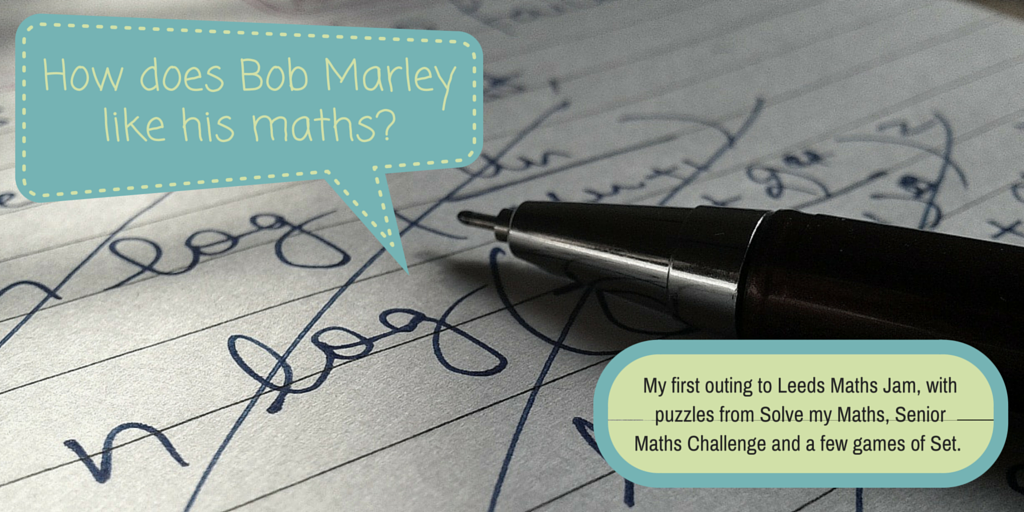
Not sure if that really works, but I enjoyed my first Maths Jam so much last night that I thought it would make a great topic for my SBPC post today.
If you don’t know about Maths Jam (I didn’t until Beth (@MissBLilley) invited me along at the last maths conference), it’s a monthly get-together for “maths enthusiasts” in your local area, which understandably attracts a lot of maths teachers. It’s also something I wish I’d found out about a lot sooner, as I’ve been back in Leeds for over four years now, and would have really enjoyed going along to these as I was settling back in and making new friends.
Warning: This post contains spoilers for a couple of problems from Solve my Maths.Anyway, I trotted merrily off to the White Swan at 7pm and played “Spot the Maths Teachers”. Luckily, Dave (@dmh10), one of the organisers, spotted me, otherwise I’d have been wandering round in circles for hours.
We kicked off with this great puzzle from the Senior Team Maths Challenge – it’s formatted so that half the team have the across clues and half have the down, so encourages collaboration. All the other puzzles are available here, and I’m definitely going to be using these next year, along with the Junior versions.
The competition should take 40 minutes – I reckon we took longer than this, but there was a lot of duplicated work going on. Something I really need to work on is confidence in my own answers – I noticed I was doing what some pupils do in my classroom. I’ve got a fixed perception of my ability in maths – I’m good, but I’m not amazing – and I can get quite insecure about whether my answers are correct when surrounded with people I perceive as being “better” at maths than me!
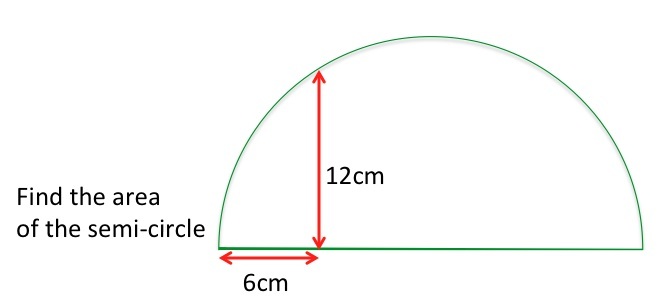
Next up, we started working on some problems from Solve my Maths, all themed around circles as today is Pi approximation day, dontcha know?
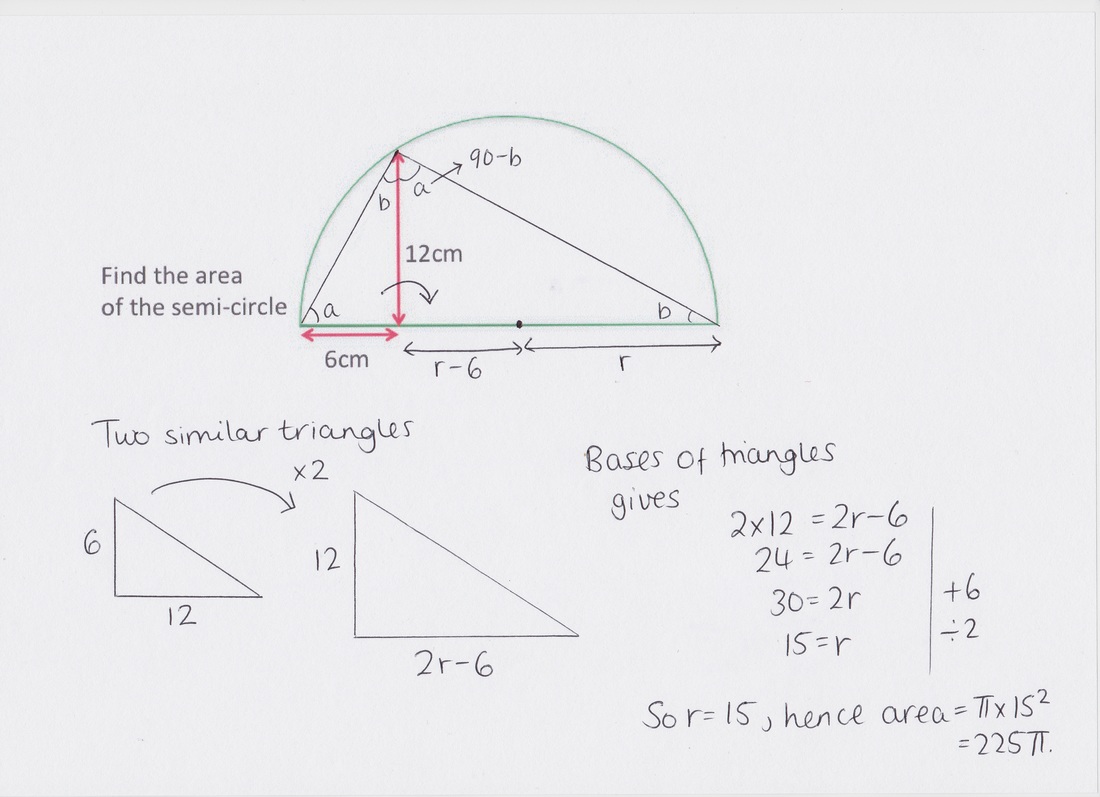
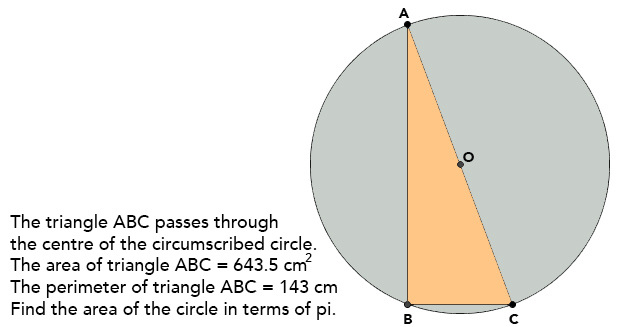
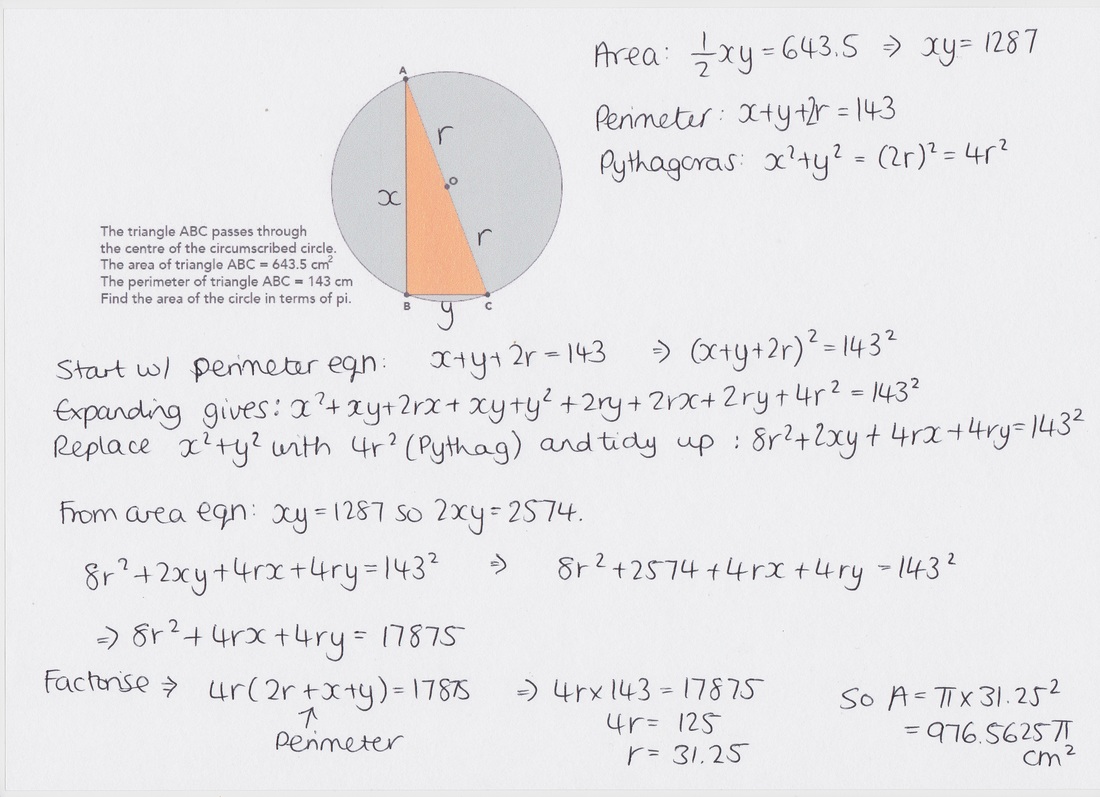
I started with this one, as I’d done it recently on a training day, but forgotten exactly how. After a bit of fiddling and use of similar triangles, I got an answer I was happy with – note I’m posting the tidy solutions only! You can click to make it bigger rather than squinting…
Other than an unnecessary use of Pythagoras to find the hypotenuse, which I then didn’t use, I got my solution pretty quickly. Buoyed up by my success, I decided to tackle another one I’d seen on the same training day, but not done.
This is one of the most frustrating problems I’ve ever done – both Dave and I were working on this simultaneously for about an hour. I used 5 pieces of paper, Dave used 8, and I spent at least 40 minutes rewriting the same set of equations. Problems like these are like annoying itches though – every time I put my pen down and admitted defeat, I’d picked it back up within a few minutes and was redrawing the diagram for the millionth time.
Interestingly, we both arrived at a completely independent solution within minutes of each other. Mine wasn’t terribly elegant, but it worked. Again, this is the tidy version… at one point, I ended up trying to solve 17875x – 286x² – 268082 = 0, and even then it didn’t give me the correct answer.
To finish the evening off, we had a few games of Set. It’s nearly impossible to explain without a physical demonstration, but once you get your head round it, it’s great fun. I’ve got a copy on its way from Amazon, and I’m planning to inflict it on some friends tomorrow evening, and also give it a go in school next year.
I then spent an hour playing an app version, Trio, on my tablet rather than going to bed. I love the summer holidays!
In answer to this tweet… definitely not me! Of the three of us who actually attended, both Jo and Amir beat me to posting their blogs, which gives me the dubious honour of third place. Travelling all the way to London for this conference was definitely worth it, but really took it out of me, with the consequence that I spent from 4pm until 8pm in bed yesterday and couldn’t face blogging for the two hours of evening I actually had before going to bed properly.
Anyway, I thought I’d better get a bit of a blog done before I forget everything that happened – I may do some more in-depth blogs on individual workshops later on as the mood takes me.
I’ll also add that I didn’t spend loads of time taking pictures, unlike last time. Every time I wanted to capture something, there was a picture of it popping up on Twitter anyway, so I didn’t bother. Also, other people’s commentary is far more interesting to follow. I also managed to not save my notes from the second half of the day (flipping Polaris Office app) so I’m running on memory for most of it.
Also, easy to find and close to the Tube, which got bonus points from a non-native.
We started off with another little chat from Andrew Taylor from AQA, followed by a session of speed dating. I cheated a bit this time – I forgot my algebra tiles, so just shared the great Flash Maths, which I’ve been using lots recently. I found out about the superb Educreations app, which lets pupils create their own videos on tablets (if only we had them…sigh) and did a bit of paper folding with the colleagues on my table. My final star-crossed date showed me a fantastic cupcake takeaway homework idea, which I’ll share once he’s emailed me the link.
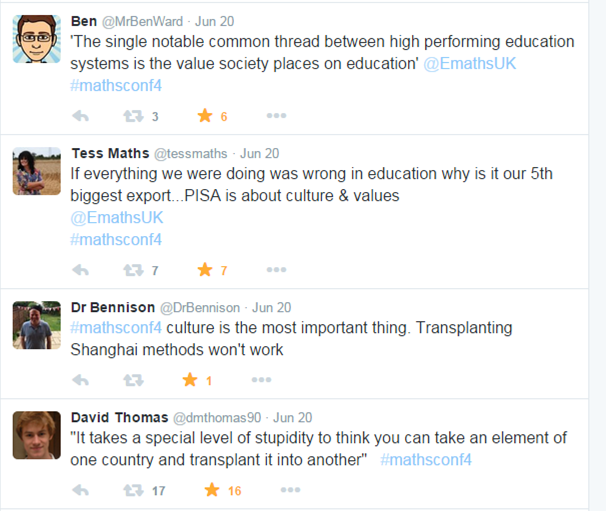
Mark’s introductory speech was entertaining and thought-provoking as usual, with a forensic look at PISA and what actually goes on in high-performing jurisdictions. Here are a few of my favourited sound-bytes from Twitter:
One thing that really stuck with me was Mark’s story about a headteacher who’d visited a school a few miles away and seen some ideas he liked, but realised that he would have to adapt these ideas to work in his setting, and that they wouldn’t just work “off the peg”. This made me think a few things:
Yes, I do this all the time, and so do loads of other teachers. It’s rare that you can take a resource and just use it as it is, as it’s been developed with a specific group of pupils in mind, and the chances are, those pupils didn’t respond to the lesson or resource in exactly the same way that yours will.
I’ve done this a lot this year with our work on the Mastery Pathway – I spent a lot of time over the summer writing a scheme that would work for our pupils, even though a lot of the groundwork had already been laid for us. I’m now re-adapting based on our experiences this year, and the chances are that we’ll end up with a scheme superficially similar but hugely varied to the other schools in our area running exactly the same programme.
Do all these resource packages bought into schools actually help? Having spent the last two weeks clearing out my storeroom (the physical one at the back of my classroom), I’ve thrown away a couple of bespoke packages we bought in years ago and didn’t really use, because they weren’t properly fit for purpose with our pupils.
We as a profession need to be really, really careful about messages we get from the media and elsewhere about the efficacy of intervention strategies and “new” teaching methods.
If you’ve got a spare hour or so, this paper (Why do East Asian children perform so well in PISA? An investigation of Western-born children of East Asian descent), mentioned in Mark’s talk and convenientlytweeted by Tim Stirrup, is really worth a read.
Workshop 1 – From Euclid to You (@eL_Timbre)
I signed up for Emma’s workshop because it seemed like a great opportunity for a bit of a geek-fest – I love mathematics history, I love books and was intrigued by the Doctor Who theme. I wasn’t disappointed – we had a lovely trawl through the history of mathematics, supplemented by some readings from Emma’s extensive library and a great choice of mood music. She’s put the full presentation on her blog, so definitely check it out.
I didn’t bother writing a lot down for this, as I was enjoying the ride too much, and was sorry that we didn’t get all the way through before it was time for coffee.
Here are a few bits I’ll be thinking about more:
Old books are great! In the aforementioned storeroom-clear-out, I’ve unearthed a pile of GCSE textbooks that are older than me. They are now sitting on the shelf marked “Sources for new GCSE”…
People have been moaning about the state of maths education since maths education started – quite comforting.
I really really need to use the history of maths more in my lessons.
Workshop 2 – Best of the US (@Craigos87)
This workshop was absolutely fantastic, with loads of ideas I’d either forgotten about, or not seen before. It deserves its own blog to do it justice, so I’ll be writing one in the near future.
During this session, I finally got to meet some fellow Tweeps – it was great to talk to @MissBLilley, @DrBennison and @MrReddyMaths in real life. I also kind of met @BetterMaths, but didn’t realise who he was until I saw a picture of him later in the day!
Lunch and Tweet-up
Food got a thumbs up, but the Tweet-Up was one of the highlights of the day
I picked up some O Level maths questions from @mrsdenyer and said hello, then popped over to the back table to try and assemble a QR cube (I needed a few hints).
I enjoyed reading the Top Tips for Tweachers (see photo proof), but didn’t have the courage to add my name to THE LIST.
I managed to have a quick chat to @MissBsResources (she’s a busy lady over the next few months – I really need to get to one of her workshops), but missed some of the other Tweeps on my “say hi to” list – there’s always the next conference!
Workshop 3 – Teaching New GCSE Content
This session from Sarah Flynn was an in-depth look at some of the new GCSE content and exam problems from the Linked Pair Pilot, which I’ve now heard mentioned by a few people as a good source for exam preparation for our current Year 9s – great, as it seems we’ll be whistling for the SAMS a little while longer yet.
There were no real surprises here for me, as I’ve been living and breathing the new GCSE spec in the last three weeks of my gained time as we try to work out exactly what order we’re doing things in with Year 10 next year. However, it was really good to sit and have a discussion with colleagues about what we might face with the additional level of challenge in some of the new content.
A few things we discussed:
Levels of literacy, particularly in explanation of mathematics, may be a barrier to some pupils. We’ll need to do a lot more work on explaining and interpreting, particularly with graphs. I’ve been doing more of this in my teaching for the last two years so continuing to do this is going to be a priority for me.
It’s great to see more (sensible) applications of quadratics, such as interpreting a maximum point in the context of a question on area, and use in modelling a particle falling under gravity.
Teaching Venn diagrams might be quite fun, if we can get our heads round how to draw that squiggle thing.
This is probably going to get some more blog space later on, as I keep plodding my way through planning and resourcing more of the new content.
Workshop 4 – Learning Design (@EMaths)
The premise of this session intrigued me, and I was really looking forward to it. The idea of taking a topic and examining it really closely, picking apart exactly what pupils should be learning and the best way to get that across, is probably the one thing that would improve my teaching the most, and it’s a real shame that we don’t get more time to do this.
However, what I actually ended up doing was having a trial of Complete Mathematics. Don’t get me wrong, I didn’t get sucked into a sales pitch – I was genuinely interested, ever since seeing a little of it at #mathsconf3. Unfortunately, I was very impressed with the software, particularly features like the ability to generate assessments based on the previous x weeks of learning, and do the job of constructing the schemes of work I’ve spent hours on over the last few months, which makes it even more of a pain that the price tag puts it way out of our grasp.
I don’t like getting political about teaching – let’s face it, there’s not a lot of point getting worked up about things you can’t really change – but it’s a shame that there’s not something like this freely available to all teachers. It would go a long way towards pulling together all the collaborative networks currently available, and save a boatload of time. But, hey-ho, I’ll keep it on my wishlist in case I find some spare change down the back of the sofa.
I’ve written quite a few posts recently about using ratio tables extensively in my teaching for proportional reasoning. Following the explosion on Twitter about Edexcel’s non-calculator paper last Thursday, I thought it might be time for a critical evaluation on my part of just how useful (or not!) they are in tackling any or all of the proportional reasoning problems on the most recent paper, particularly if we should see this as an indicator of things to come, as @El_Timbre suggested in this brilliant blog post on Sunday.
I’m approaching this from the point of view of pupils aiming for a grade C, as I’ve had borderline groups for the last two years, and no top GCSE sets for about four, due to having plenty of A Level Maths on my timetable already, so I’ll admit that my pedagogy and knowledge of grade A/A* topics at GCSE is fairly limited.
Q1b Percentages from a stem and leaf diagram
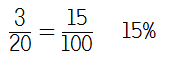
I posted about how useful Year 11 found ratio tables for converting fractions to percentages back in May, and I was happy that at least three pupils mentioned to me after their exam that they’d used this strategy on this question to get the correct answer.
I’m still pretty convinced on dealing with fraction to percentage conversions with ratio tables, but I can see that it might be a little unnecessary here. I’d like to think that once pupils had got the fraction 3/20, they would spot that 20 goes into 100 five times and multiply the numerator accordingly.
Q4 Plant comparisons
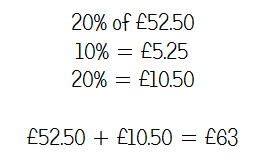
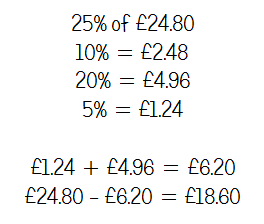
Overall, I thought this was a nice little problem-solving question. It involves pupils working out a percentage, then deducting this from the total cost. Again, I know that most of my groups have found ratio tables useful for structuring their working out, but 20% is a fairly simple percentage, so I can see some pupils not bothering.
Q9 John’s conference
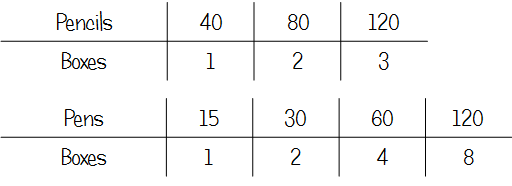
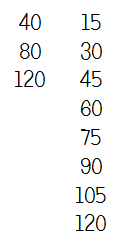
As the Twitterverse astutely observed, why not get people to bring their own pencils? However, assuming John doesn’t want to put people out, this was a fairly straightforward LCM problem. I quite like the ratio table approach here as it tidies up listing the numbers somewhat, and might avoid any silly errors with miscounting the number of boxes at the end. It also allows pupils to double up to 8 boxes of pens without having to write down each number up to 8 x 15, again eliminating potential for slips in calculations.
Q10 Mary’s conservatory
I’ve been trying to encourage my Year 11s to scrape every single mark on the Higher paper, and split problem-solving questions where possible. Many of these area/problem solving questions include a percentage calculation that can be done without needing to find the area first.
In a similar vein to the plant comparison question, the only benefit of a ratio table here is structuring working out – I don’t think it adds anything in terms of making the calculation more straightforward.
Q11 Karl’s game
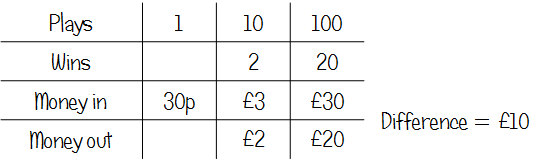
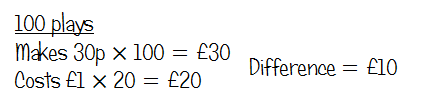
Again, a table offers a bit of help in terms of structuring working out here. If pupils get used to constructing these for themselves, it’s conceivable that they’d find this useful to put in what they know, then work out anything else that they can. It might help them to make the link between 10 plays in part (a) and 100 plays in part (b).
Q14 Raksha’s journey
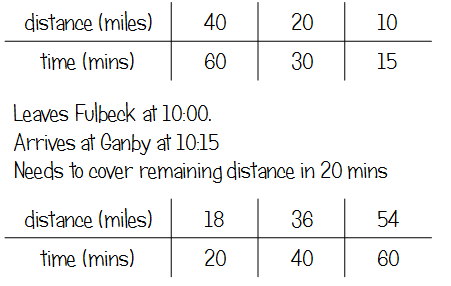
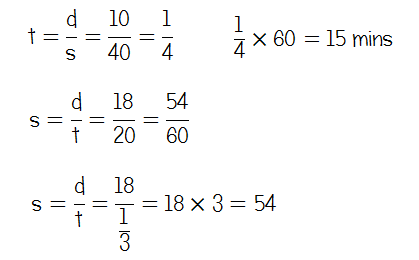
This is the first question I met that really convinced me that a ratio table was the superior method or way to structure working. From conversations with pupils (and reading on Twitter), I know that those who applied the sdt formula got really confused with units – there needs to be an appreciation that the time is given in minutes but speed given in miles per hour. Structuring using a table kind of avoids these errors in the first part of the calculation, and makes it clearer to see what you need to do in the second part to get an answer in miles per hour.
Q15b Does the point lie on the line?
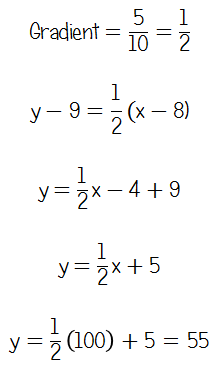
This question pulled me up short a bit – I’ve avoided this with my Year 11s this year in favour of cherry-picking easier marks – but when I was doing the paper, I immediately used the “A Level” formula y – y1 = m(x – x1). I went back and checked over the current and new GCSE syllabi, and finding the equation of a line given two points seems to be listed as new spec only, but, as I said at the top, I have limited experience with teaching A/A* topics and related pedagogy.
According to this site, it’s a new topic coming to Foundation and Higher, so there are obvious implications for teaching next year.
Chatting to a few pupils in top sets, many of them either found the gradient, then substituted in one point to find the y-intercept, or, overwhelmingly, used a sketch.
A colleague suggested that the approach she had used was getting them to work out the gradient from the two points, then work out if the third point gave the same gradient.
However, I started to think about making this question accessible for borderline pupils who (let’s face it) won’t have as developed algebra skills as those aiming for As or A*s.
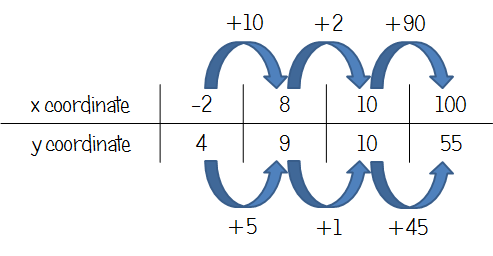
Now, obviously this isn’t really a “ratio” table, as we’ve got a linear relationship, not direct proportion. However, if we look at the change in x and change in y for the two points we’ve been given, it’s clear that the increase in x is double the increase in y.
From here, it’s not too difficult to get from 8 to 10 and then 10 to 100 with the x coordinates, resulting in a y coordinate of 55, proving that the point (100, 56) is not on the line.
Whether or not this is an acceptable way to “show how you work out your answer” remains to be seen!
I’m not meaning this to be a passionate argument for the use of ratio tables – they work really well with some pupils for basic percentage calculations, and (I think) have stopped some of mine from just panicking in an exam and working out “something”, then going from there. I think use for SDT and DMV may prove really useful, particularly for those that struggle to rearrange formulae.
We use cookies to optimize our website and our service.
Functional
Always active
The technical storage or access is strictly necessary for the legitimate purpose of enabling the use of a specific service explicitly requested by the subscriber or user, or for the sole purpose of carrying out the transmission of a communication over an electronic communications network.
Preferences
The technical storage or access is necessary for the legitimate purpose of storing preferences that are not requested by the subscriber or user.
Statistics
The technical storage or access that is used exclusively for statistical purposes.The technical storage or access that is used exclusively for anonymous statistical purposes. Without a subpoena, voluntary compliance on the part of your Internet Service Provider, or additional records from a third party, information stored or retrieved for this purpose alone cannot usually be used to identify you.
Marketing
The technical storage or access is required to create user profiles to send advertising, or to track the user on a website or across several websites for similar marketing purposes.