Pedagogy

A year of Mastery

Reflections on a year of teaching the Mastery pathway (mastery mathematics) at Key Stage 3. Inspired by this evening’s #mathschat “How do you develop mastery from Year 7? What’s first for a new cohort”, and feeling slightly restricted by the 140 character limit in a tweet, I thought I’d take some time to write a …
A year of Mastery Read More »

Exploring proportional reasoning

Tonight’s post is another quick one about using ratio tables, this time for solving proportional reasoning problems. I’ve previously blogged about using them for percentage calculations and converting fractions to percentages, so thought that a post on general proportional reasoning was long overdue! Note: The ideas detailed in this post took a good few lessons to work through, and …

Exploring proportional reasoning Read More »

Teaching rounding

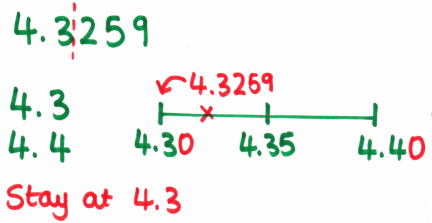
1. Crack place value firstThis might seem like a no-brainer, but teaching rounding on top of an insecure understanding of place value is a recipe for disaster. Before pupils can get their heads around rounding, particularly to a given number of decimal places, they need to understand why 0.43 is bigger than 0.413, otherwise the …

Teaching rounding Read More »

From bar modelling to ratio tables – tidying up percentages

It’s no secret that I’m a big fan of bar modelling to get pupils to really think about the calculations they are doing. It’s a great way to introduce work with percentages too, and solidifies the link between percentage and fraction calculations. One particular advantage is the flexibility it affords – I had one pupil …

From bar modelling to ratio tables – tidying up percentages Read More »

Mix Match

A great quick activity to get pupils out of their seats; this works particularly well at the end of a lesson for an exit activity and can be used for most topics. Prepare a set of cards before the lesson; I usually make simple pairs, but sets of 3 can also work quite well. Give each …

Mix Match Read More »

Pass the Problem

This is a great way to get pupils collaborating in the classroom and focusing on the steps to solve problems.  Put pupils into groups of four, then distribute four problems. Each pupil solves a step before passing to the left and so on, until each problem has a complete solution.  This works well for simple …

Pass the Problem Read More »

Factorising linear expressions using algebra tiles

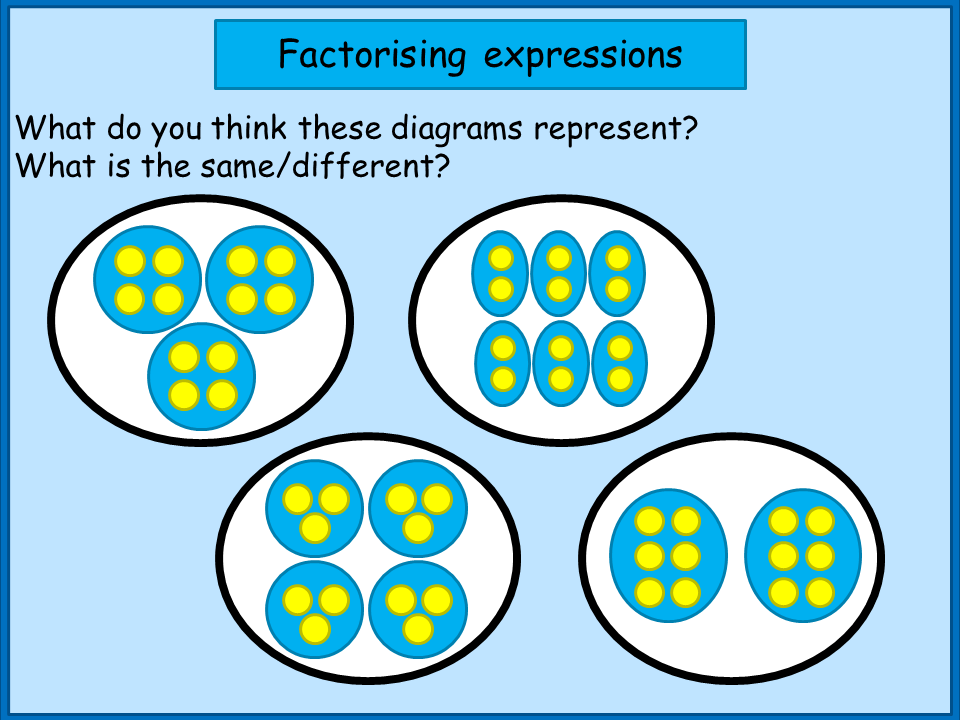
I usually start work on factorising algebraic expressions with a critical look at what factorising actually is and a few reminders of prior learning about factors. I pop up this diagram when pupils enter the classroom, and get them to think about what it is showing. We then have a discussion and collect ideas. The slide represents …

Factorising linear expressions using algebra tiles Read More »